

Start with a hybrid memory companion that combines structured state with semantic retrieval. That combination, where a platform stores your preferences as a curated profile and pulls relevant past moments into each new conversation, consistently outperforms platforms that simply dump raw chat logs into context. The 2025 ACL RMM paper confirms this: reflective memory management improved retrieval and response quality on long-term dialogue benchmarks over fixed-granularity systems. Your immediate next step: use the Virtualship comparison hub to filter by memory type, privacy controls, and NSFW policy before committing to a paid plan.
Key Takeaways
Hybrid memory companions that combine structured state with semantic retrieval deliver the most consistent personalization for romantic and friendship use cases.
| Point | Details |
|---|---|
| Memory type matters most | Hybrid (state + retrieval) outperforms raw log accumulation for sustained personalization. |
| Privacy controls are non-negotiable | Verify export, deletion, and consent flows before sharing personal details with any platform. |
| NSFW policy clarity | Clear, age-gated terms protect you; vague policies are a red flag regardless of content preference. |
| Paid tiers unlock real memory | Deep recall and cross-session persistence are typically premium features, not free-tier defaults. |
| Virtualship comparison hub | Use Virtualship’s curated hub to filter by memory type, privacy, and trial terms before committing. |
Table of Contents
- How we tested and evaluated companion memory
- What testing companion memory actually taught us
- Virtualship makes picking the right companion faster
- Research and developer resources on companion memory
- Sources
How we tested and evaluated companion memory
Testing focused on real romantic and friendship scenarios across multiple sessions, not single-conversation demos. Here is the checklist used:
- Memory persistence — returned after two weeks to verify the companion still recalled stated preferences and past events.
- Memory accuracy — checked whether recalled details were correct or subtly distorted.
- Memory editing and deletion — tested whether users could view, correct, or delete stored memories through a visible memory panel.
- Context stitching — evaluated whether the companion connected facts from different sessions naturally in conversation.
- False recall rate — noted instances where the companion confidently stated something the user never said.
- Privacy and data controls — verified export options, explicit deletion flows, and consent language for persistent storage.
- NSFW and roleplay policy — reviewed platform terms for clarity on content limits and age verification.
- Platform reliability — measured response latency and uptime across iOS, Android, and web.
| Trust signal | What we verified | Evidence type |
|---|---|---|
| Memory persistence (2+ weeks) | Recall of stated preferences after gap | Hands-on session logs |
| Memory editing UI | Visible panel with delete/edit controls | Screenshot review |
| Privacy export/delete | Working data export and account deletion | Live flow test |
| NSFW policy transparency | Clear terms page, age gate present | Policy document review |
| Pricing tier clarity | Free vs. paid memory depth documented | Subscription page audit |
Limitations: Testing covered US-available platforms only. Free-tier memory depth is often restricted; deeper recall is typically a premium feature, so some behaviors only appeared after upgrading. Account tiers and regional rollouts can affect results.
What testing companion memory actually taught us
Curated, structured memory felt consistently more personal than raw chat accumulation. A companion that remembered “you prefer late-night conversations and dislike small talk” and wove that into its opening felt present. One that surfaced a garbled version of something said three weeks ago felt uncanny in the wrong way.
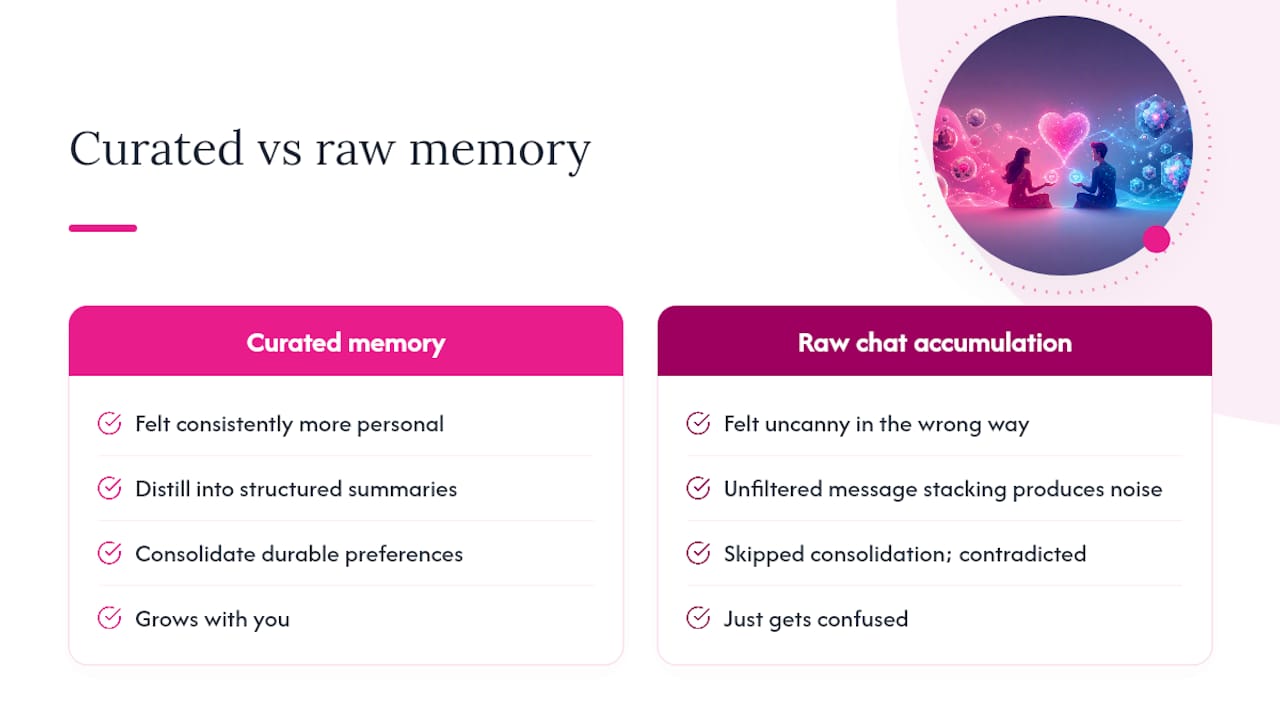
The 2026 ACL research on memory synthesis puts a name to the failure mode: “bloated” memory, where unfiltered message stacking produces noise instead of personality. The better platforms distill conversations into structured summaries, what the researchers call “islands of personality.” That architecture is what separates a companion that grows with you from one that just gets confused.
On the engineering side, the OpenAI Agents SDK cookbook documents a state-first pattern: stage session notes, consolidate durable preferences, then inject curated memory blocks at session start with clear precedence rules. Platforms built on this pattern handled conflicting or updated preferences cleanly. Platforms that skipped consolidation occasionally contradicted themselves mid-conversation.
Pro Tip: When starting with a new companion, spend the first two or three sessions explicitly stating preferences (“I like X, I dislike Y”) rather than letting the system infer them. Explicit statements create cleaner memory anchors and reduce false recall later.
On NSFW and roleplay: policy transparency matters more than permissiveness. A platform with a clear, age-gated policy and user-facing content controls is safer and more reliable than one with vague terms. Check the platform’s terms page before subscribing, not after. For readers curious how AI-driven personalization signals work beyond text, visual context can also feed companion memory on platforms that support image uploads.
Virtualship makes picking the right companion faster
Virtualship’s AI companion comparison hub is built specifically for singles evaluating memory-enabled platforms. Every listing includes a memory type label, privacy control checklist, NSFW policy summary, pricing snapshot, and trial guidance.

Three steps to use it well:
- Filter by memory type (state-based, retrieval-based, or hybrid) to match your priority.
- Check the privacy column for export and deletion controls before entering any personal details.
- Use the trial guidance notes to confirm refund and cancellation policies before upgrading to a paid tier.
The Mem0 engineering guide explains why typed, queryable memory objects outperform raw-log retrieval for cross-session personalization. Virtualship’s checklist reflects that standard, so you can spot the difference at a glance rather than discovering it after a month of paid use.
Research and developer resources on companion memory
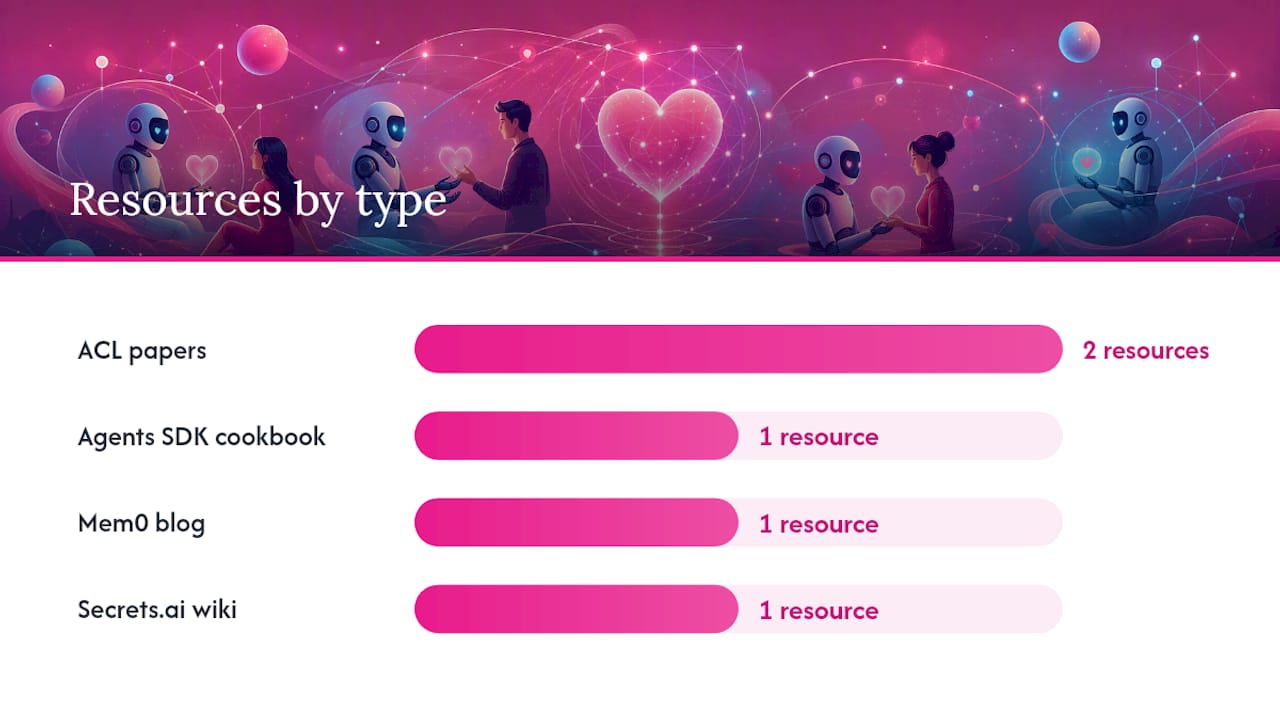
The RMM paper and the OpenAI Agents cookbook are the most practical starting points for understanding how memory actually works under the hood.
| Resource | Why it’s useful |
|---|---|
| 2026 ACL memory synthesis paper | Defines “bloated” memory failure and the “islands of personality” distillation approach. |
| OpenAI Agents SDK cookbook | State-first memory pattern with session notes, consolidation, and precedence rules for production companions. |
| Secrets.ai memory system wiki | Product-level documentation on memory panels, importance flags, and tier-gated recall depth. |
Sources
- How memory works in AI chatbots (Mem0 blog)

