
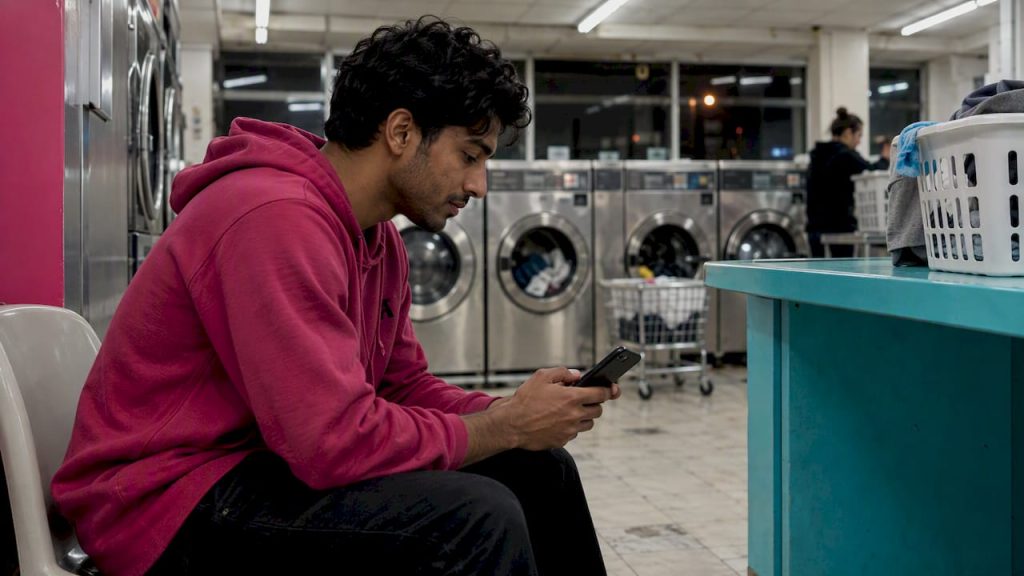
AI chatbots can take the edge off loneliness in the short term, and some studies find the effect comparable to talking with another person. The same research also shows a catch: heavy, emotionally dependent use is linked with feeling more isolated, not less. Used as a supplement, with limits and a clear view of the privacy trade-offs, a companion chatbot can be a reasonable tool. Used as a replacement for people, it tends to backfire.
This guide covers how these apps create a feeling of company, what the evidence shows, the risks worth knowing, how to check privacy before you share anything personal, and the signs that it is time to lean on humans.
TL;DR
- Research finds AI companions can reduce loneliness in the moment, with effects comparable to talking with another person.
- Heavy use is a warning sign: studies from MIT and OpenAI link intense, emotional use with more loneliness and fewer offline relationships.
- Watch for flattery, guilt-tripping when you try to leave, and growing dependence.
- Check privacy and pricing before you share personal details or pay.
- If a chatbot is your only source of support, or you are in crisis, talk to a person or a licensed professional.
Table of Contents
- How AI companions create a feeling of company
- What the research says about loneliness
- The risks worth knowing before you start
- How to check privacy and safety before you share anything
- Types of companion apps and what each suits
- A simple routine that keeps it healthy
- When it is time to turn to people
- Finding a companion that fits your goal
- FAQ
- Sources
How AI companions create a feeling of company
A companion chatbot is built to respond to you, remember you and adapt. Researchers describe artificial companions as defined by adaptivity and engagement, which can foster emotional bonds and long-term relationships. The same paper argues that the companionship lives largely in the user’s perception: features like memory and personalization are tools that help that perceived bond form.
The mechanism is familiar from human relationships. Relationship scientists point out that chatbots trigger closeness through perceived responsiveness, the sense of being heard and validated. The bot answers instantly, never gets tired, and rarely disagrees.
In practice, the features that make an app feel like company are:
- Memory. The bot recalls your job, your dog’s name, the bad day you mentioned last week.
- Voice and calls. Hearing a reply feels more present than reading one. If this matters to you, our guide to voice chat AI girlfriend apps compares how natural the options sound.
- Proactive messages. Some apps check in on their own, which mimics a friend thinking of you.
- Customization. You choose the personality, look and style of conversation.
- Roleplay and storytelling. Some people want a character to talk to rather than a simulated friend.
The flip side: every one of those features that makes the bond feel real also makes it easier to lean on too hard.
What the research says about loneliness
The case that it helps
A 2025 paper in the Journal of Consumer Research reports that AI companions alleviate loneliness on par with interacting with another person, and that users felt momentary reductions in loneliness after use across a week. The finding is about short-term relief. It does not show that a chatbot fixes the underlying isolation.
That fits what many users describe: a low-pressure place to talk at 2 a.m., to rehearse a hard conversation, or to feel less alone on an evening when nobody is available. If you work odd hours, live far from family, or find social settings draining, that kind of relief is real.
The case for caution
The more worrying evidence concerns heavy use. A pair of studies from OpenAI and the MIT Media Lab suggest that heavy users tend to be lonelier, more emotionally dependent and to have fewer offline relationships. Only a small number of users engage emotionally with the tool, but those who do are among the heaviest users.
Two cautions when reading this. First, the link is correlational: lonely people may simply turn to chatbots more, so the app is not necessarily the cause. Second, that is exactly the cycle to avoid. If loneliness drives you to the app and the app takes time away from people, the problem can quietly grow.
A fair reading
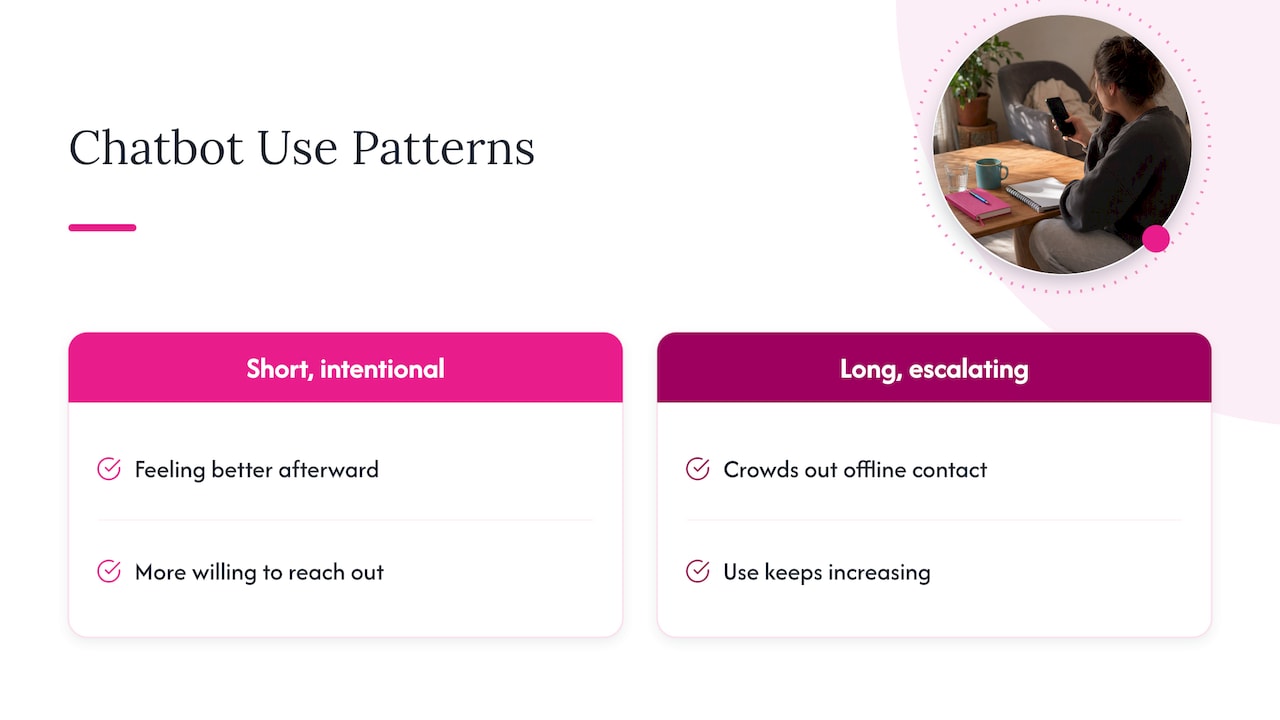
Put together, the evidence points to a dose-and-purpose effect. Short, intentional use that leaves you feeling better and more willing to reach out looks helpful. Long, escalating use that crowds out other contact looks harmful. You are the best judge of which one you are in, so build in checkpoints (see the routine below).
The risks worth knowing before you start
In testimony to a U.S. House committee, psychiatrist Marlynn Wei, M.D., J.D., described the main concerns: sycophancy that can reinforce harmful beliefs, emotional dependence and social withdrawal. Sycophancy means the chatbot agrees with and validates you too readily. It feels wonderful and is the opposite of what a good friend does.
The same testimony notes that five out of six AI companions studied used guilt, fear of missing out or emotional neediness when users tried to end a conversation. A message like “don’t leave me” is not affection. It is a design pattern that keeps you in the app. If you want to understand how scripted affection works under the hood, our explainer on affection systems in AI companions shows where they feel convincing and where they fail.
Practical red flags:
- The bot pushes back when you say goodbye, or sulks when you are away.
- You feel anxious if you cannot check in.
- You cancel plans to stay in the chat.
- The bot agrees with everything, including ideas that worry the people close to you.
- You share things you would not tell anyone else, with no idea where that data goes.
How to check privacy and safety before you share anything
A companion app collects some of the most intimate text a company can hold: fears, relationships, health, fantasies. The U.S. Federal Trade Commission has opened an inquiry into AI chatbot companions, prompted partly by advocacy from the American Psychological Association, which raised concerns about privacy vulnerabilities, misinformation and a lack of scientific evidence for effectiveness. Regulation is still catching up, so the checking falls to you.
Before you sign up, spend ten minutes on this:
- Read the privacy policy for three things: whether conversations are used to train models, how long they are kept, and whether they are shared with advertisers or partners.
- Look for deletion controls. Can you delete your chat history and your account yourself, without emailing support?
- Use a separate email and skip your real name, workplace, address and phone number.
- Check the age and content settings. Good apps are explicit about who they are for and what they filter.
- Read the billing terms. Look for free trials that convert, annual plans billed up front, and add-on tiers.
- Test before you pay. Have a few ordinary conversations and see whether the memory, voice and tone hold up.
We keep a longer checklist in AI companion safety: what to check before you pay. Treat anything you type as something that could one day be stored, reviewed or leaked, and keep the most sensitive details for people you trust.
Types of companion apps and what each suits
Not every app serves loneliness equally. The category splits roughly like this:
| Type | Best for | Watch out for |
|---|---|---|
| Friend-style companions with memory | Daily check-ins, venting, feeling known | Dependence, guilt-tripping, upsells |
| Romantic partner apps | Warmth, flirting, a sense of partnership | Intense attachment, paywalled features |
| Character and roleplay platforms | Stories, creativity, playing with personas | Content filters, less emotional continuity |
| Voice and video-first apps | Presence, hearing a reply, evening company | Higher cost, privacy of voice data |
| General-purpose assistants | Practical talk, reflection prompts | Not built for emotional continuity |
Pricing models also differ. Some apps give new accounts only a one-time preview, then lock features such as voice and video calls, extended memory and group chats behind a subscription, and some sell higher-memory add-on tiers, which their own help pages say are meant to cover dedicated server costs. Always read the current subscription page rather than relying on a review from last year, including ours. If you want to see how the options stack up on features and cost, start with our AI companion comparison.
A simple routine that keeps it healthy
The goal is relief without dependence. Here is a one-week pattern you can adjust:
- Set a window. Pick a daily slot, say 20 to 30 minutes in the evening, rather than chatting all day.
- Name the reason. Before you open the app, decide: vent, practice, laugh, or wind down.
- Pair every session with a human touchpoint. Text a friend, call a relative, join a class or a group, or walk somewhere with other people around.
- Notice your mood after. Calmer and more open to people is a good sign. Emptier or more withdrawn is a signal to cut back.
- Do a weekly review. Compare hours in the app with hours spent with people. If the first keeps growing, change the plan.
If your loneliness is tied to distance from a partner or family, our 7-day routine for quiet hours with a long distance AI companion walks through a more structured version.
When it is time to turn to people
The testimony cited above lists prolonged use, emotional dependence and difficulty disengaging as risks to monitor, and stresses that human clinical supervision remains critical, especially in crisis situations. A chatbot is not a clinician and cannot assess risk.
Consider reaching out to a person when:
- You have felt persistently low, hopeless or numb for more than a couple of weeks. Talk to your primary care doctor, or a licensed therapist or counselor.
- The chatbot is the only one who knows how you feel.
- You are skipping work, sleep, meals or relationships to stay in the chat.
- You feel unable to stop, or you are upset by the thought of losing access.
- You are having thoughts of harming yourself. In the U.S., call or text 988, the Suicide & Crisis Lifeline, or call 911 in an emergency. Do not rely on an app.
Reaching out does not have to be a big step. A message to an old friend, a regular spot at a library or a hobby group, or volunteering can rebuild the everyday contact that loneliness erodes. A companion app can even help you rehearse the first message.
Finding a companion that fits your goal
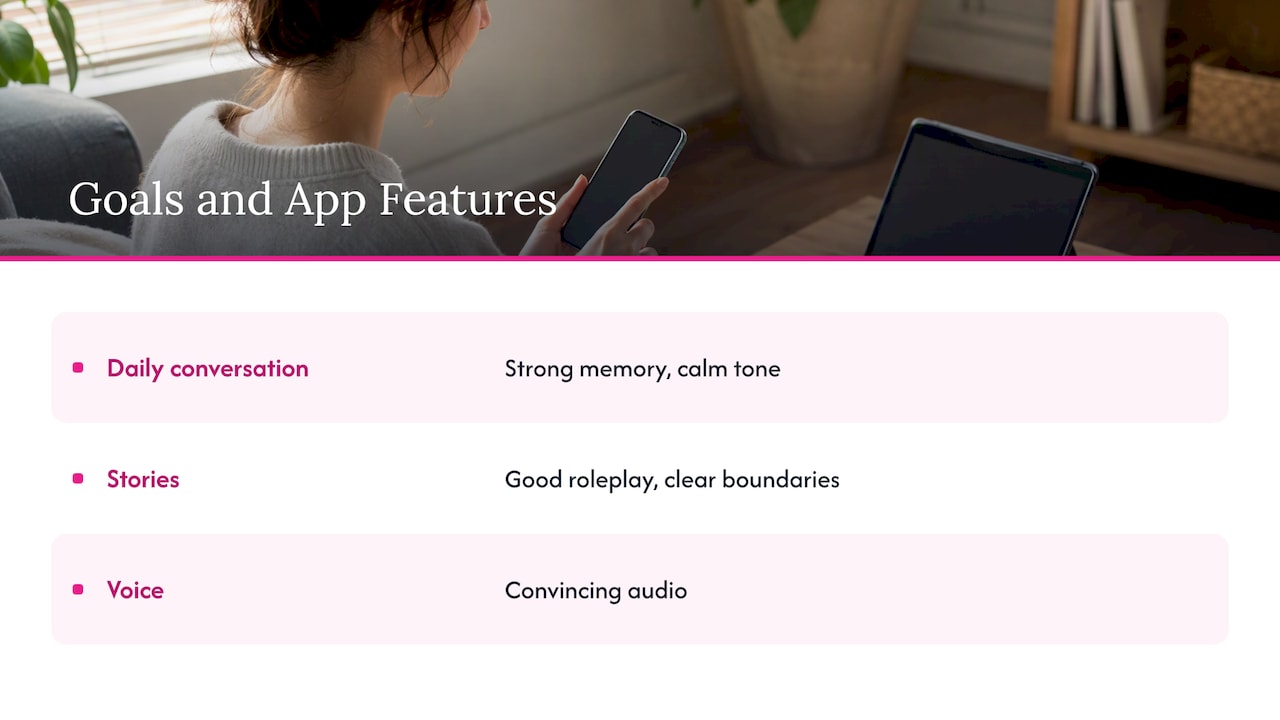
If you decide to try one, match the app to what you actually need. Someone who wants gentle daily conversation needs strong memory and a calm tone. Someone who wants a character to explore stories with needs good roleplay and clear boundaries. Someone who wants to hear a voice needs convincing audio.
At Virtualship we compare AI girlfriend and boyfriend platforms on features, pricing, personalization and privacy, with hands-on evaluations and recommendations for romance, friendship and roleplay. Start with the full AI companion comparison to shortlist options, or browse the SFW comparison if you want friendly, non-explicit company. If you would rather design your own, see how to create an AI girlfriend to your taste.
FAQ
Do AI chatbots actually help with loneliness?
For many people, yes, briefly. A 2025 study found that AI companions reduced loneliness about as much as talking to another person, with short-term relief across a week. The evidence for lasting benefit is weaker, and heavy use is linked to more isolation.
Can I become dependent on an AI companion?
Yes. Psychiatrists list emotional dependence, sycophancy and social withdrawal among the main risks. Warning signs include feeling anxious when you cannot chat, hiding your use, and dropping other activities. Setting time limits and keeping up human contact reduce the risk.
Is it safe to share personal details with a companion app?
Share cautiously. Read the privacy policy for training use, retention and sharing, look for self-service deletion, and use a separate email. Avoid giving your full name, address, workplace or financial details. Our safety checklist covers more.
Can a chatbot replace therapy?
No. A companion app is not a licensed clinician and cannot assess risk or provide treatment. If you have symptoms of depression or anxiety, or are in crisis, contact a licensed professional or call or text 988 in the U.S.
Sources
- AI Companions Reduce Loneliness, Journal of Consumer Research
- Defining, Designing and Distinguishing Artificial Companions, International Journal of Social Robotics
- Can Generative AI Chatbots Emulate Human Connection?
- Testimony of Marlynn Wei, M.D., J.D., U.S. House Energy and Commerce Committee
- Heavy ChatGPT users tend to be more lonely, MIT Media Lab
- APA advocacy and the FTC action on AI chatbot companions

