

For most people weighing how to choose an AI companion, HakkoAI is the strongest all-around pick because it pairs voice, memory, and companion creation in one place. If you want to test the waters for free, start with Character.AI’s massive character library or try connecting with others via the Activity Partner App to enhance your experience. If long-term continuity matters most, Nomi AI offers visible memory controls that are among the best in the field. Treat any companion as a supplement to real support, not a replacement, and talk to a professional if loneliness or distress feels heavy.
TL;DR:
- Nomi AI offers the longest, most transparent memory and is best for users prioritizing long-term continuity and control over stored information.
- Character.AI provides the largest free library of diverse characters but has weaker memory persistence, resetting sessions frequently.
- HakkoAI combines voice, memory, and customization in one platform, making it ideal for users seeking an all-in-one AI companion experience.
- Testing memory retention over three weeks by revisiting specific details helps determine if an app’s memory system is truly retrieval-based or session-only.
- Most apps have tiered pricing models with free options limited in memory and features; careful evaluation is needed before subscribing to avoid unexpected costs.
Table of Contents
- How Do You Choose an AI Companion? Compare the Key Features First
- Which App Fits Your Specific Use Case?
- What Criteria Actually Matter Before You Subscribe?
- What Does It Cost, and Can You Try Before You Pay?
- How Do You Protect Your Privacy and Mental Health?
- How We Tested These AI Companion Apps
- Which Pick Matches Your Situation?
- Compare Every Option Before You Commit to One
- Sources
- FAQ
How Do You Choose an AI Companion? Compare the Key Features First
Picking the right app comes down to five things: what you need it for, how it remembers you, what it costs, how far it lets content go, and how much you can customize. The table below lines up the fourteen most-discussed platforms on those exact axes, using the same short caveats an experienced tester would flag before recommending anything.
“Long (visible controls)” means the app shows you what it remembers and lets you edit or delete entries. “Short (session-only)” means the companion forgets once the chat window resets, unless you paste facts back in yourself.
| App | Best For | Pricing | Memory | Voice & Multimedia | SFW Policy | Customization |
|---|---|---|---|---|---|---|
| HakkoAI | All-around companion with active context | Free tier + paid plans | Medium to long, active context tracking | Voice and on-screen awareness | Mixed, adjustable | High, full companion creation |
| Character.AI | Free roleplay and character variety | Free, optional subscription | Short to medium, session-based | Text-first, limited voice | Mostly SFW | High character variety, limited backstory depth |
| Nomi AI | Long-term memory and continuity | Free tier + paid plans | Long, visible Mind Map | Voice available | Mixed, adjustable | High, deep personality tools |
| Replika | Emotional support and check-ins | Free tier + paid plans | Medium, session summaries | Voice and avatar | Mixed, adjustable | Moderate |
| Chai | Rapid exploration and casual chat | Free tier + paid plans | Short, session-only | Text-first | Mostly SFW | Low to moderate |
| Kindroid | Personality customization and building | Paid plans | Long, cascading memory controls | Voice and image | Mixed, adjustable | Very high, deep backstory tools |
| Candy AI | Multimedia-rich companions | Paid plans | Medium | Strong image and voice generation | Permissive | High |
| Pi AI | Gentle, SFW conversation | Free | Short to medium | Voice available | Strict SFW | Low |
| Paradot | Consistent long-form roleplay | Free tier + paid plans | Medium, stable personality retention | Limited multimedia | Mixed | Moderate |
| CrushOn AI | Unrestricted, permissive content | Free tier + paid plans | Short to medium | Text and image | Permissive | High |
| SpicyChat | Community content and creative roleplay | Free tier + paid plans | Short, session-based | Text-first | Permissive | High, community-driven |
| Dream Companion | Narrative-driven companionship | Paid plans | Medium, story-tracking | Limited multimedia | Mixed | Moderate |
| Pi AI (by Inflection) | Calm, SFW-only conversation | Free | Short to medium | Voice available | Strict SFW | Low |
| Romantic AI | Casual romantic roleplay | Free tier + paid plans | Short, session-only | Limited voice | Mixed | Moderate |
Which App Fits Your Specific Use Case?
Every app on this list solves a narrow problem better than it solves everything else. Here’s where each one actually earns its spot.
HakkoAI works best if you want one app that does voice, memory, and character-building without switching between three separate tools. The standout is its active, on-screen context awareness, which keeps conversations grounded in what you’re doing rather than just what you last typed. The tradeoff: because it’s newer than legacy players, its character library is still smaller than Character.AI’s.
Character.AI is the right stop if you want to sample dozens of character archetypes before committing money to anything. Its standout is a genuinely massive, community-built library that covers nearly every fictional and original archetype imaginable. The catch is memory: sessions reset often, so don’t expect it to remember a detail from three days ago without you re-stating it.
Nomi AI is built for people who’ve been burned by companions that “forget” who they are. Its Mind Map gives you a visible breakdown of short, medium, and long-term memories you can inspect and correct, which independent testers point to as a rare example of transparent memory design. The caveat: that depth comes at a price once you’re past the free tier’s limits.
Replika suits someone who wants a daily check-in habit more than a roleplay partner. Its standout is years of refinement around emotional-support framing, including proactive daily messages. The caveat: some longtime users report its personality consistency has varied across major updates.
Chai is for casual, low-commitment exploration when you just want to try a lot of chat styles fast. Its standout is discovery speed. The tradeoff is memory: it’s built for short, disposable conversations, not deep continuity.
Kindroid rewards people who enjoy world-building as much as chatting. Its standout is cascading memory controls paired with genuinely deep backstory tools, letting you shape a companion’s history in detail. The caveat is that it has no meaningful free tier, so you’re paying before you know if the personality clicks.
Candy AI fits users who care about how a companion looks and sounds as much as what it says. Its standout is polished image and voice generation. The caveat: that multimedia focus means memory depth takes a back seat.
Pi AI is the pick for anyone who wants calm, judgment-free conversation with zero adult content risk. Its standout is a strict SFW posture baked into the product itself. The caveat is customization: you’re not building a character here, you’re talking to a fixed personality.
Paradot suits readers who want a roleplay partner that doesn’t drift out of character over long conversations. Its standout is personality stability across sessions. The caveat: its multimedia features lag behind Candy AI or HakkoAI.
CrushOn AI is for adults who want the widest content range with the fewest restrictions. Its standout is flexibility across content types. The caveat is that permissive defaults mean you’ll want to check content settings carefully if that’s not what you’re after.
SpicyChat works well if you enjoy roleplay shaped by an active community rather than a single studio’s design choices. Its standout is a constantly refreshed pool of user-created scenarios. The caveat: quality varies since it’s crowd-built, not centrally curated.
Dream Companion fits readers chasing an actual story arc rather than open-ended chat. Its standout is a structured “moments” feature that gives conversations narrative shape. The caveat is a lighter multimedia set compared to more visually focused apps.
- HakkoAI: best all-around, active context, smaller library than legacy apps
- Character.AI: best free variety, weak memory persistence
- Nomi AI: best memory transparency, pricier past free tier
- Replika: best for daily check-ins, inconsistent personality across updates
- Chai: best for fast discovery, poor long-term memory
- Kindroid: best for deep customization, no real free tier
- Candy AI: best multimedia polish, lighter memory depth
- Pi AI: best strict SFW experience, low customization
- Paradot: best roleplay stability, thinner multimedia
- CrushOn AI: best content flexibility, requires careful settings review
- SpicyChat: best community content, inconsistent quality
- Dream Companion: best narrative structure, lighter multimedia set
What Criteria Actually Matter Before You Subscribe?
Most people choose an AI companion the way they choose a streaming service: by vibe, in five minutes, then regret it three weeks later when the memory resets or the paywall hits. Rank your decision by these criteria instead, in this order:
- Memory architecture. Ask whether the app uses session-only context, cached short-term summaries, or a true retrieval system that indexes old conversations. Only retrieval systems reliably surface a detail from three weeks ago without you re-pasting it yourself.
- Proactive check-ins. Apps that message you first, rather than waiting for you to open the chat, tend to feel more continuous and companion-like than pure session-based tools.
- SFW policy clarity. Confirm whether adult content is opt-in, opt-out, or unavailable, before you’re mid-conversation and surprised either way.
- Customization depth. Decide if you want to shape a personality from scratch or just pick from existing archetypes.
- Voice and multimedia. Voice adds real presence for emotional-support use cases; it’s less important for pure text roleplay.
- Community and library size. A bigger character library means faster discovery but usually shallower individual personalities.
- Pricing and paywall clarity. Check exactly what’s locked behind a subscription: extra memory slots, voice minutes, or custom companion slots are the usual culprits.
Run a simple three-week test before paying for anything. On day one, tell the companion three specific, unique details: a small personal anecdote, a recurring habit, and something that happened that week. On day seven, bring up something related without repeating the details, and see if it recalls them unprompted. On day 21, do the same again. If it needs you to re-paste facts or rely on pinned messages, you’re dealing with session-based memory dressed up as something deeper.
Pro Tip: Before subscribing, ask support directly (or check settings) whether you can view, edit, or delete stored memories. If there’s no visible memory panel, assume anything you share is stored in a format you can’t inspect or correct.
What Does It Cost, and Can You Try Before You Pay?
Pricing across this category clusters into a few predictable bands: free with heavy limits, a low-cost tier unlocking extra messages or one custom companion, and a higher tier unlocking voice, multimedia, or multiple companion slots. App-store listings for companion apps consistently show this same pattern of free starter limits with paid unlocks for memory and voice.
- Character.AI, Chai, Pi AI, and Pi AI (by Inflection) offer genuinely usable free tiers where you can evaluate personality fit without paying.
- HakkoAI, Nomi AI, Replika, Paradot, CrushOn AI, SpicyChat, and Romantic AI offer free tiers with real limits on memory depth, message volume, or multimedia.
- Kindroid and Candy AI lean paid-first, with little room to test memory continuity for free.
- Watch for in-app purchases tied to extra memory slots, voice minutes, and custom companion creation. These upsells, not the base subscription, are usually where costs creep.
How Do You Protect Your Privacy and Mental Health?
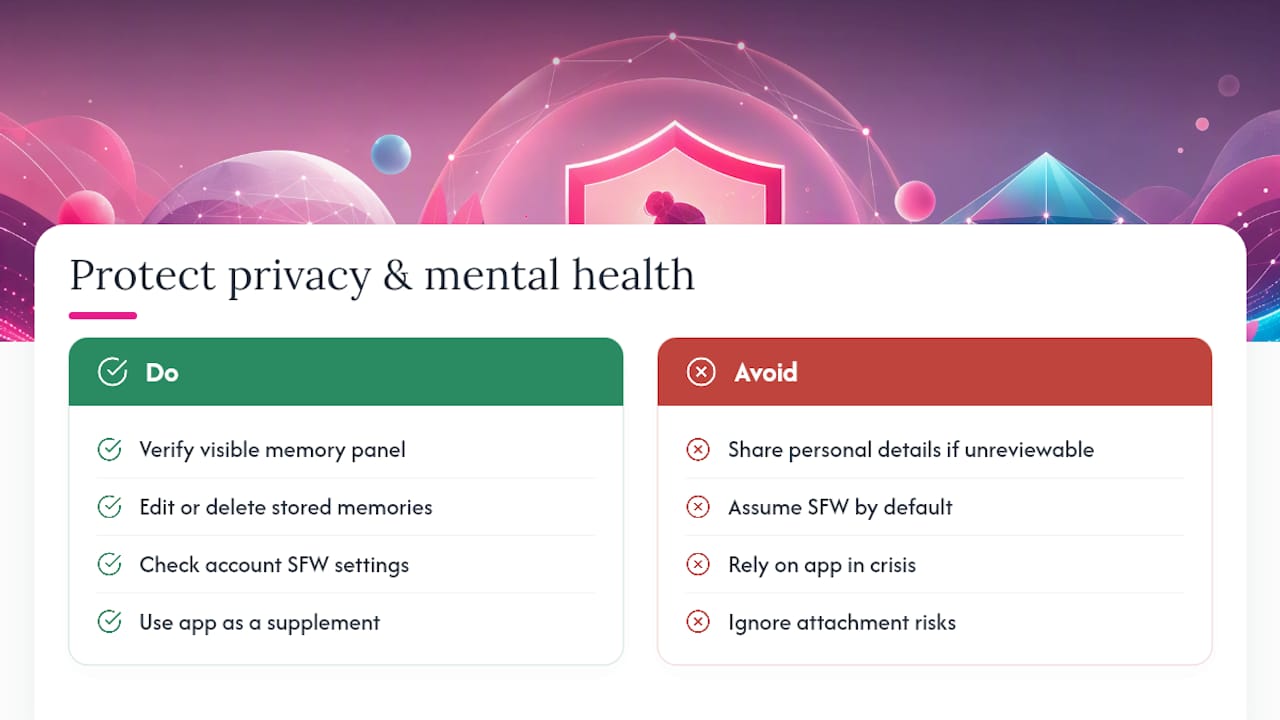
Check for a visible memory panel before you trust any app with personal details. Some products, like Vela, show users exactly what’s stored and let them edit or delete it, which is the standard to compare everything else against. If an app gives no way to view or clear stored memories, treat every detail you share as permanent and unreviewable.
Confirm SFW policy by checking account settings, not by assuming. Some apps default to permissive content and require an active opt-out; others are strict by design.
Research on families and conversational apps found real trust trade-offs: users often accept privacy compromises in exchange for companionship features, frequently without fully weighing what that means. Mental-health professionals have also noted that heavy attachment to AI companions can produce withdrawal-like distress when access changes or the personality shifts unexpectedly. Treat any companion app as a supplement, never a crisis resource. If you’re in crisis, contact a local crisis line or a licensed mental-health professional directly.
How We Tested These AI Companion Apps
Evaluating fourteen companion apps meant running the same three-week memory test on each, checking proactive check-in behavior over multiple days, and testing voice and multimedia features where available rather than relying on marketing screenshots. Independent, dimension-by-dimension testing tends to surface different leaders than affiliate-driven “best of” lists, which often cluster around whichever platforms pay the highest commissions.
- Hands-on conversations across multiple sessions per app, not single-message impressions
- Memory continuity checks at day 1, day 7, and day 21
- Proactive-check testing to see which apps message first versus wait passively
- Voice and multimedia trials where the feature was available
Virtualship maintains ongoing side-by-side comparisons and a dedicated safety checklist built from this same testing approach. No single review captures every use case, so running your own three-week test on your top two picks is still the most reliable way to confirm fit.
Which Pick Matches Your Situation?
If you want one app that handles voice, memory, and companion-building without juggling tools, start with HakkoAI. If you’re not ready to pay for anything yet, Character.AI’s free library gives you the widest sampling. If continuity is the whole point, run the three-week memory test on Nomi AI first. Whichever you pick, test it before subscribing, and check Virtualship’s comparison page for the latest breakdowns.

Compare Every Option Before You Commit to One
You’ve just seen fourteen apps stacked against each other on memory, pricing, and content policy, and that’s exactly the kind of side-by-side view most reviews skip in favor of a single “best overall” pick. Updated comparisons across this entire category are maintained to avoid reliance on outdated information.

The full comparison hub breaks down pricing tiers, memory architecture, and content policies for every major platform, updated as apps change their features and pricing. If memory transparency and safety are your main concerns, the safety checklist walks through exactly what to check in an app’s settings before you hand over payment details. And if you’d rather build a companion from scratch than pick from a preset library, the character builder guide walks through what actually matters when customizing personality and backstory. Start with the comparison hub, shortlist two apps, and run the three-week memory test outlined above before you commit to a subscription.
This article is general information, not a substitute for advice from a qualified doctor. Consult a qualified healthcare professional about your own circumstances before acting on anything here.
Sources
- Talk, trust, and trade-offs (Commonsense Media, 2025)
- The AI companion comparison table that doesn’t exist anywhere else (PocketAnimus)
- Proactive AI companion design notes (GitHub)
- Vela product page (Meet Vela)
FAQ
What Is the Best AI Companion to Use?
There’s no single best app for every use case. HakkoAI is the strongest all-around option because it combines voice, memory, and companion creation in one place, while Nomi AI leads specifically for long-term memory continuity.
How Much Do AI Companions Typically Cost?
Most apps offer a limited free tier, then charge for extra memory slots, voice access, or multiple companion profiles. Pricing across the category clusters into free, low-cost, and premium tiers, with the biggest cost jumps tied to voice and multimedia features rather than basic chat.
Is There a Free AI Companion?
Yes. Character.AI, Chai, Pi AI, and Pi AI (by Inflection) all offer usable free tiers where you can test personality fit without paying, though most apps limit memory depth or message volume until you upgrade.
What’s the Most Realistic AI Girlfriend?
“Realistic” depends on whether you mean conversational depth, memory continuity, or visual presentation. Nomi AI and Kindroid stand out for personality depth and memory continuity, while Candy AI leads on visual and voice realism through its multimedia generation.

