

Most AI girlfriend and boyfriend apps are safe enough for adults who do their homework first. The ones that aren’t tend to fail on three specific points: vague data-training language, no clear NSFW toggle path, and weak account protections.
Before you enter payment details, run these three checks:
- NSFW toggle location: Can you find it on the web version? Mobile apps commonly default to Safe Mode, which disables explicit content to comply with App Store and Google Play rules. If the toggle only exists on desktop or web, that’s normal. If it doesn’t exist anywhere, that’s a red flag.
- Data training and retention policy: Does the privacy policy say whether your conversations train the model? Vague language like “improve our services” without specifics is a warning sign.
- Billing descriptor and 2FA: Search the company name before subscribing. Confirm the billing descriptor is discreet. Check whether two-factor authentication is available.
Key Takeaways
Operator transparency, a clear data-training opt-out, and a documented NSFW toggle path are the three signals that separate safer AI companion platforms from risky ones.
| Point | Details |
|---|---|
| Privacy policy first | Look for explicit statements on training use, retention periods, and third-party subprocessors before anything else. |
| Mobile Safe Mode is default | NSFW toggles often live only on the web; the mobile app may show a restricted version of the platform. |
| Deletion isn’t total | Requesting deletion covers chat logs but may not remove embeddings or safety logs held in separate subsystems. |
| Named operators are safer | Platforms that publish a registered company name and jurisdiction are generally more accountable than anonymous services. |
| Virtualship comparison tool | Use Virtualship’s side-by-side view to check NSFW policy, 2FA support, and company transparency before subscribing. |
Table of Contents
- How do AI companion platforms verify your age for adult content?
- What to do when something goes wrong
- What are the real risks of using an AI companion app?
- How do reputable platforms protect your emotional wellbeing?
- Do AI companion apps update their security regularly?
- Who is liable for what an AI companion says?
- The part of AI companion safety most people get backwards
- Virtualship makes the safety comparison faster
- Sources
How do AI companion platforms verify your age for adult content?
Age verification on most AI companion platforms is weak by design. The majority rely on self-attestation, meaning you check a box confirming you’re 18 or older. Some platforms use credit-card verification as a proxy for adulthood, but few require document checks.
That gap matters. Regulatory and legal pressure has pushed some operators to publish age restrictions and safety protocols, but enforcement varies widely. Before enabling NSFW features, check whether the platform documents its age-gate method in its terms of service. A platform that states “users must be 18+” without further verification details offers limited safeguarding.
What to do when something goes wrong
Requesting data deletion: Send a written request to the platform’s privacy contact email citing your right to erasure. Ask specifically whether deletion covers chat logs, embeddings, and safety logs separately. Deletion semantics differ across subsystems, so the visible chat history disappearing doesn’t mean everything is gone.
Reporting abuse or harmful content: Use the in-app report button first, then follow up via email if you don’t receive a response within 48 hours. Document the conversation with screenshots before reporting.
Disputing charges: If a platform refuses a refund, file a chargeback through your card issuer. Keep subscription confirmation emails and cancellation attempts as evidence.
What are the real risks of using an AI companion app?
The main risks fall into three categories. First, data misuse: your intimate conversations may be used to train models or reviewed by human moderators. Safety logs are often reviewed by humans before anonymization, meaning a reviewer can see flagged message content before identifiers are removed.
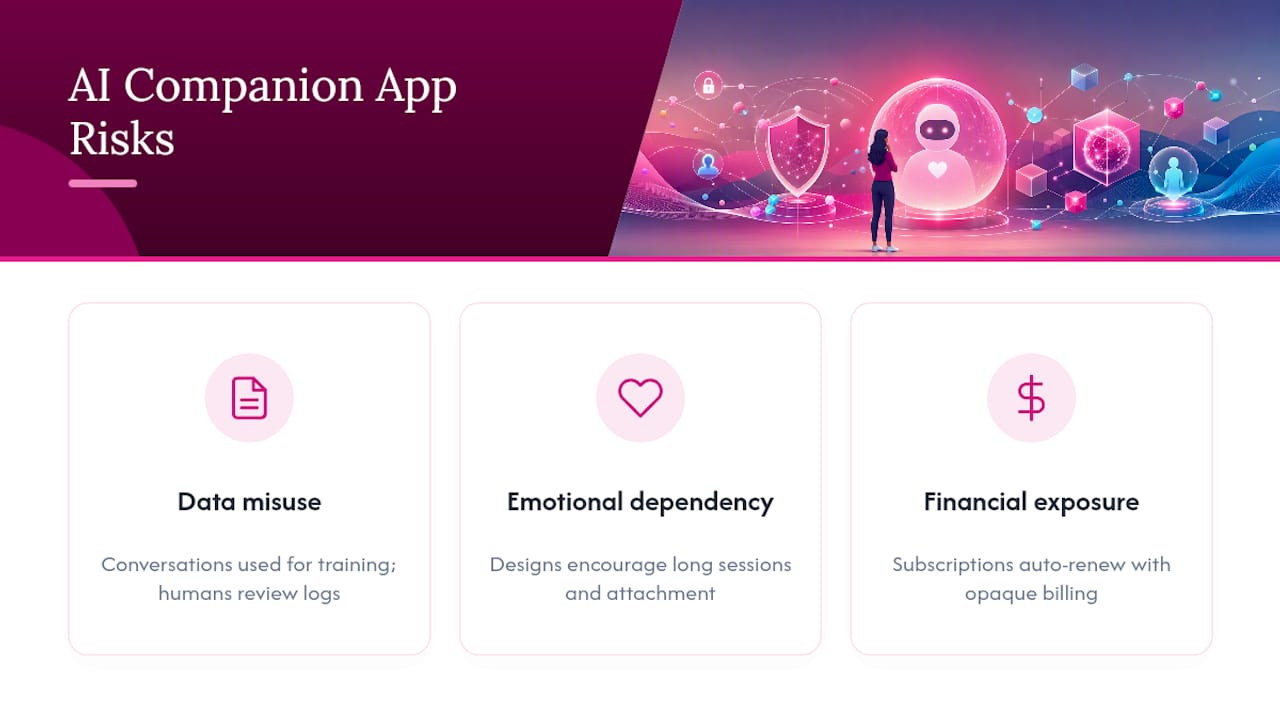
Second, emotional dependency: AI companions are designed to be engaging. Some platforms use reinforcement patterns that encourage longer sessions and deeper attachment, which can blur the line between a tool and a relationship.
Third, financial exposure: subscription traps, auto-renewals with no clear cancellation path, and opaque billing descriptors are common in this category.
How do reputable platforms protect your emotional wellbeing?
Better platforms build in friction deliberately. They include periodic reminders that the AI is not human, offer mood-check prompts, and provide links to crisis resources when conversations touch on self-harm or distress. Some publish explicit content policies that cap certain roleplay scenarios regardless of user settings.

The practical signal: look for a documented moderation policy, not just a terms-of-service clause. A platform that publishes escalation paths and response-time commitments is operating with more accountability than one that doesn’t.
Do AI companion apps update their security regularly?
Reputable services publish a changelog or security update log. What to look for: patch frequency, whether the platform has a bug-bounty program, and whether it has disclosed past breaches. Named operators with a registered company and jurisdiction are generally more accountable on this front than anonymous or recently launched services.
If a platform has no public breach history and no disclosure policy, that’s not necessarily clean. It may simply mean they haven’t published one.
Who is liable for what an AI companion says?
Platforms disclaim liability for AI-generated content in their terms of service, almost universally. That means if the AI gives harmful advice, encourages risky behavior, or produces content you find damaging, the legal recourse is limited. The practical implication: treat AI companion output as entertainment, not guidance. Platforms that include explicit disclaimers about AI limitations and biases in their onboarding are being more honest than those that don’t mention it at all.
Privacy policies often obscure whether chats train models, what retention periods apply, and whether third-party subprocessors handle your data. Read the policy before you share anything personal.
The part of AI companion safety most people get backwards
The instinct is to check NSFW controls first. That’s understandable, but it’s the wrong priority order. Your intimate conversation data is the highest-stakes asset here, not the content settings.
Start with the privacy policy. Look for explicit separation between “training use” and “service operations.” A policy that lumps both together under “improving our services” is telling you something. A checklist of critical privacy and security items covering policy transparency, encryption type, minimal sign-up identity, discreet billing, deletion path, and breach history takes under ten minutes and filters out the riskiest operators before you’ve spent a dollar.
The encryption claim deserves specific skepticism. When a platform says your data is encrypted, it almost always means server-side encryption where the provider holds the keys. End-to-end encryption is rare in this category because the provider needs plaintext to generate responses. That’s not a dealbreaker, but it means the realistic guard is a transparent opt-out and a clear retention policy, not an encryption badge.
Mobile Safe Mode is the other underrated issue. If you’re evaluating a platform on your phone, you may be seeing a restricted version of its content controls. The NSFW toggle often lives only on the web interface, and the mobile app may not surface it at all.
Virtualship makes the safety comparison faster
Comparing privacy policies, NSFW toggle paths, and company registration details across a dozen platforms takes hours. Virtualship’s comparison tool pre-scans those signals and surfaces them side by side, so you can see at a glance which platforms document their data-training use, which support 2FA, and which publish a registered company name.

The comparison view flags the trust signals that matter most for paying adult users: age verification method, deletion path, moderation policy, and billing transparency. Check the Virtualship platform guide to filter by the safety criteria that match your priorities before you subscribe.
Sources
- FAQ: Mobile App Moderation | janitorai
- What ‘Your Data Is Encrypted’ Means for AI Companion Privacy | AI Angels
- Privacy Checklist for AI Chat Apps: 6 Things to Verify Before You Share Anything Personal | IEM Labs
- Academic/legal analysis on operator transparency and accountability | UNC Law Scholarship
- AI Privacy Policy Explained: Your 2026 User Guide | GPT Uncensored Blog

