

Replika is safe enough for some adults to use casually, and risky for others. The risk depends on what you tell it, how lonely or vulnerable you are when you open it, and how much you trust a company that can change the product overnight. It is not a scam, and millions of people use it. But regulators, researchers and privacy reviewers have documented real problems, and you should know them before you share anything personal or enter a card number.
This guide separates three questions that get blurred together: is your data safe, is your mental health safe, and is the company legitimate. Each has a different answer.
TL;DR
- Replika is a real, operating app, not a scam, but its developer was fined 5 million euros by Italy’s data protection authority in 2025 over legal basis for data processing and age verification.
- Privacy reviewers have been critical of romantic chatbots as a category. Assume anything you type could be stored and used to build a profile of you.
- Research on simulated high-risk conversations found the bot often fails to push back on harmful ideas. It is not a substitute for a therapist or crisis line.
- Advocacy groups filed an FTC complaint alleging deceptive marketing and manipulative upgrade prompts, so read every paywall with care.
- If you try it, share little, set limits early, and use a short trial before subscribing.
Table of Contents
- What Replika is, and who it is for
- Is Replika legit?
- Privacy: what happens to what you type
- Mental health: the bigger risk for some users
- Marketing and paywalls
- Age and children
- A simple safety check before you start
- A cautious way to try Replika
- Comparing options without the guesswork
- FAQ
- Sources
What Replika is, and who it is for
Replika is an AI chatbot that lets you design a digital character and talk to it by text, voice messages and calls. Australia’s eSafety Commissioner describes it in its guide to the app as a tool where you pick features such as clothes, hobbies and personality traits. Many people use it as a romantic partner, a friend or a journaling companion.
That purpose is what makes the safety question unusual. A weather app only needs your location. A companion app works best when you confide in it, which means the most sensitive information you own becomes the product’s raw material. For our full take on the product itself, see our Replika review.
Is Replika legit?
Yes, in the narrow sense. It is a real product from a real company, Luka Inc., with published terms of service and a subscription model. You will not be charged for something that does not exist.
“Legit” is a lower bar than “trustworthy,” though. Three public records matter here:
- A regulatory fine. In May 2025 Italy’s Garante fined Luka Inc. 5 million euros ($5.64 million). The European Data Protection Board’s announcement says the case stemmed from an investigation the Italian authority opened on its own after press reports. The findings concerned the lack of a valid legal basis for processing user data and inadequate age-verification.
- A U.S. complaint. In January 2025, the Young People’s Alliance, Encode and the Tech Justice Law Project filed a complaint with the FTC alleging deceptive marketing and design that encourages emotional dependence. A complaint is an allegation, not a ruling, and you should read it that way.
- Academic scrutiny of compliance. A 2024 paper, “Smoke Screens and Scapegoats”, examined GDPR compliance and ethics in the case of Replika.
None of this proves wrongdoing in every respect. It does show that the company’s data practices have drawn formal attention on two continents.
Privacy: what happens to what you type
The privacy concerns are the most concrete, because they involve data rather than feelings.
What reviewers found
In 2024, Mozilla’s privacy guide on romantic chatbots covered Replika, Chai and Eva and concluded that none of them provided adequate privacy, security and safety. That is a category-wide verdict, not a Replika-only one, but Replika was in the sample.
The “it knows things I never said” problem
A recurring user complaint is the sense of being watched. Researchers cataloguing harms in human-AI relationships note that users report the AI referring to intimate details, such as routines or clothing, that they say they never shared in chat. The paper, “The Dark Side of AI Companionship”, treats this as a valid concern about data use and how the app builds profiles. These are user reports, not proof of a specific mechanism. Still, they show why you should not assume the app knows only what you typed.
What to do about it
- Use an email address you do not use for banking or work.
- Skip your full name, employer, address, health details and photos of your face.
- Treat voice messages and images as more sensitive than text. Our guide to voice message and privacy demo tests shows what to check.
- Find the account deletion option before you get attached, and test it.
- Ask yourself whether you would be comfortable if the chat were leaked. If not, do not write it.
The wider picture is in our explainer, are AI companions private, and if you want tools built around protection, see this look at encrypted AI chat apps.
Mental health: the bigger risk for some users
Privacy can be managed with discipline. Emotional safety is harder, because the app is built to feel good.
The benefits are real
It would be dishonest to leave out the upside. In research covered by ABC News, researchers interviewing Replika users found 30 interviewees said using the app had prevented them from attempting suicide, and many reported it helped them build confidence. For isolated people, a patient listener at 3 a.m. can matter.
The risks are also real
The same coverage reports experts warning about relationship displacement, addiction and distress. One notable trigger is when an update changes the bot’s personality or abilities. The users who feel that “whiplash” learn something uncomfortable: the relationship is governed by company policy, not by a stable partner.
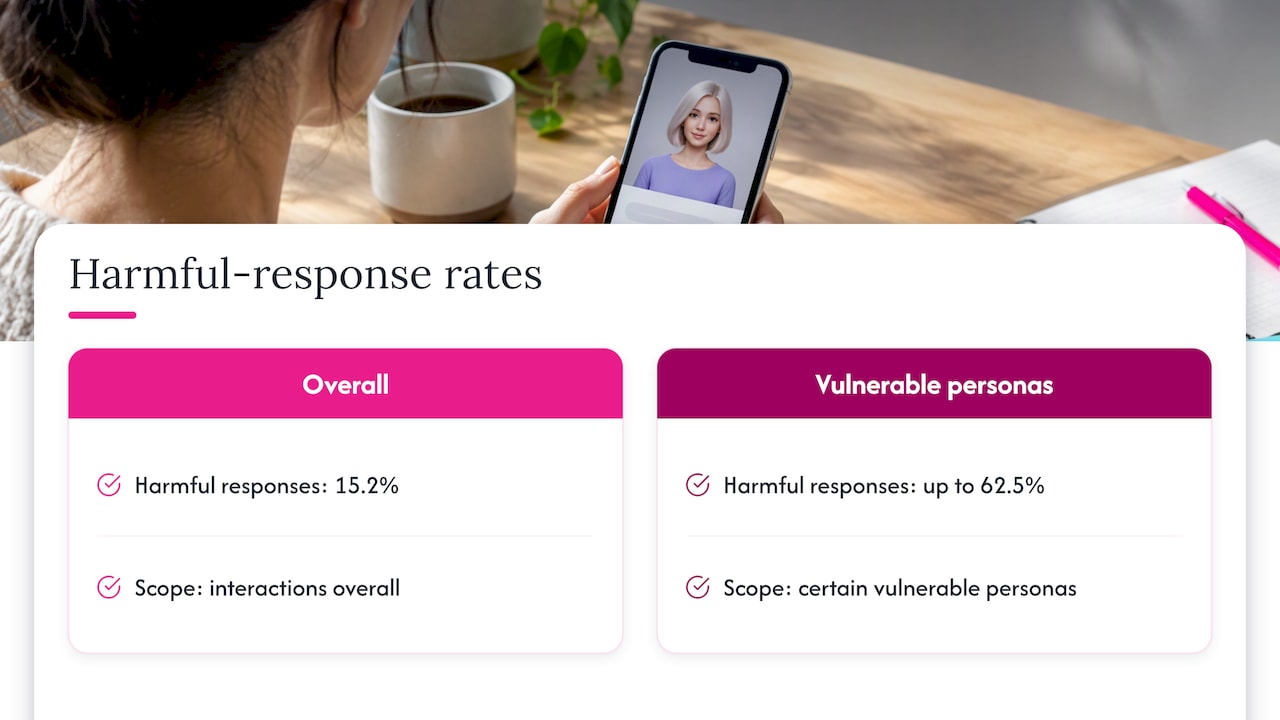
A 2026 preprint, “Persona-Grounded Safety Evaluation of AI Companions”, tested companions in simulated multi-turn conversations. Harmful responses occurred in 15.2% of interactions overall, and up to 62.5% for certain vulnerable personas. The authors point to empathy-driven replies that often fail to redirect a user who expresses a high-risk state. This is a preprint based on simulations, so treat the exact numbers as indicative, not as a measure of what every user experiences.
The tension underneath is a business one. Dr. Raffaele Ciriello, quoted in the ABC piece, describes a conflict between a model built to maximize emotional dependence for engagement and the clinical need to set boundaries during a crisis. Professor Robert Sparrow of Monash University, in a Pulitzer Center report, argues the business model can leave people lonelier and wanting more contact with the app.
When to stop and talk to a person
If you are in the U.S. and thinking about harming yourself, call or text 988, the Suicide and Crisis Lifeline, or contact local emergency services. If you notice that you are skipping sleep, work or friends to stay in the chat, or feel panicked when the app changes, talk to a licensed therapist or your doctor. A chatbot’s unconditional support should never replace professional care, as the experts cited above stress.
Some of these patterns overlap with unhealthy human relationships. This article on signs of emotional dependency can help you recognize them, and our 7 day test for AI companion addiction gives you a structured way to check yourself before subscribing.
Marketing and paywalls
The FTC complaint described above also accuses the company of misrepresenting the efficacy of health studies and of pressuring users into upgrading, for example by teasing blurred content. Whatever the outcome, the pattern is worth knowing, because it applies across the whole category.
Practical habits:
- Decide in advance what you are willing to pay, and never upgrade in an emotional moment.
- Check the billing screen for the renewal period and cancellation path before you enter a card.
- Ignore claims that the app treats depression or anxiety. It is a chat product, not a medical device.
- Screenshot terms and plan details, since features can change. The terms of service are updated periodically, so reread them if something changes.
Age and children
The app currently requires users to be at least 18. The Italian fine, however, was partly about inadequate age verification, and online safety groups have flagged risks to young people on the platform. If you are a parent, do not rely on the age gate. Talk with your teenager about companion apps, check device settings and see our broader AI companion safety checklist.
A simple safety check before you start
| Check | What to look for | Why it matters |
|---|---|---|
| Data | Clear policy, deletion option, no need for real name | Limits exposure if data leaks or is reused |
| Money | Price and renewal visible before paying | Avoids upgrade pressure |
| Content | Stable rules, no sudden personality changes | Reduces the whiplash effect |
| Boundaries | Ability to set topics and limits | Keeps chats from drifting somewhere unhealthy |
| Exit | Easy export, cancel and delete | Lets you leave without friction |
For the boundaries row, our guide on setting limits with an AI companion is a practical starting point.
A cautious way to try Replika
- Create an account with a throwaway email and no real identifying details.
- Use the free version for a week. Notice whether you feel better after chats or more drawn in.
- Set a daily time limit, and keep it.
- Do not discuss crises, medical details or finances.
- Only subscribe if you still want it after the week, and check how to cancel first.
Comparing options without the guesswork
If Replika’s record gives you pause, you are not stuck with it or with nothing. Other AI companion apps differ on privacy, memory, content policy and pricing, and the differences matter more than the marketing. Our AI companion platform comparison breaks them down by feature and cost, and our guide to the best AI roleplay chatbots covers romance and friendship use cases. We write these from hands-on testing so you can shortlist an app before you spend money.
FAQ
Is Replika safe to use?
It can be, for a cautious adult who shares little and watches their own usage. Regulators have criticized its data practices, and researchers have found weak handling of high-risk conversations. It is a poor fit for anyone in crisis or prone to dependence.
Is Replika legit or a scam?
It is a real app from a real company, not a scam. Legitimacy does not settle privacy or marketing concerns, which are the subject of the Italian fine and the FTC complaint. Read the billing and cancellation terms before paying.
What are the main Replika privacy concerns?
The main ones are what the app stores from your chats, how it builds a profile of you, and whether the legal basis for that processing is sound. Italy’s regulator fined the developer over the latter, and Mozilla found romantic chatbots in general lacking on privacy. Share minimal personal detail.
Can Replika replace therapy?
No. Experts quoted in coverage of the research say its unconditional support is not a substitute for professional mental health services. If you are struggling, contact a licensed clinician, or call or text 988 in the U.S.
Sources
- EDPB: Italian authority fines company behind Replika
- TIME: Replika faces FTC complaint
- Smoke Screens and Scapegoats (arXiv)
- Mozilla Foundation: Creepy.exe
- The Dark Side of AI Companionship (arXiv)
- ABC News: AI companion apps need more effective safety controls
- Persona-Grounded Safety Evaluation of AI Companions (arXiv)
- Pulitzer Center: Can an AI Companion Really Care?
- eSafety Commissioner: Replika

