

Yes, AI companion apps can feel genuinely habit-forming, but only when specific design choices line up: persistent memory, deep personalization, and a subscription structure that gates emotional payoff behind a paywall. Before you commit to any AI girlfriend or boyfriend platform, check those three things first. Run the seven-day test outlined below before you hand over a card number.
TL;DR:
- Apps with persistent memory, deep personalization, and a flat subscription model promote long-term bonds but also increase habit-formation risk.
- Testing for at least seven days, focusing on memory recall and personality stability, helps distinguish genuine companions from fleeting novelty.
- Transparency features like exporting stored memories and clear refund policies indicate a platform’s design for user control rather than lock-in.
- Over-reliance manifests through increased app time, withdrawal symptoms, and substitution of human interactions, which can harm mental health.
- Setting usage limits before subscribing and seeking professional advice if dependency signs appear are key to maintaining healthy boundaries.
Table of Contents
- What Makes an AI Companion Feel Habit-Forming?
- How Do You Compare AI Companion Apps Without Vendor Hype?
- How Do You Run the Seven-Day AI Companion Test?
- What Privacy and Safety Checks Matter for Long-Term Use?
- What Are the Psychological Signs of Over-Reliance on an AI Companion?
- How Do You Assess How Severe the Habit Has Become?
- How Does This Affect Mental Health and Real Relationships?
- How Do You Prevent or Recover From Over-Attachment?
- Where Can You Get Support or Professional Help?
- Run the Comparison Before You Subscribe to Anything
- Sources
What Makes an AI Companion Feel Habit-Forming?
The pull isn’t random. Research on AI companion apps points to a specific mechanism: personalization choices, like naming a character, shaping its backstory, and building shared memories, make the relationship feel real enough that people report genuine grief when a feature gets removed or a companion resets. An analysis of more than 1,400 user reviews found users treating these bots as actual relationship partners, not novelty toys.
That’s the standard industry framing worth knowing: what shoppers usually search for as “AI companion addiction” is really a question about digital companion dependency, meaning how much a platform’s design encourages sustained, habitual use. It’s less about whether the technology is dangerous and more about whether a given app is built to keep you coming back through memory, routine, and paywalled intimacy.
How Do You Compare AI Companion Apps Without Vendor Hype?
Every AI companion platform claims to be “the most realistic” or “the most emotionally intelligent.” Ignore the marketing copy and score the product on five things that actually predict whether it stays engaging past week one.
Memory persistence. Does the companion remember what you told it yesterday, or does it reset every few messages once the context window fills up? Editable, persistent memory is the single biggest differentiator between apps built for six-month relationships and apps built for a quick novelty hit. Platform architecture, not flashy features, drives sustained engagement, and only a handful of platforms are actually built for the long game.
Personalization depth. Can you shape personality traits, backstory, and communication style, or just pick an avatar? Design guidance from companion-app builders ranks priorities in a specific order: memory first, personality friction second, communication style third, voice fourth, and appearance dead last. If a platform leads with appearance customization and skips the rest, that’s a novelty product wearing a relationship costume.
Multimodal presence. Voice and video matter, but less than you’d think. Consistency, memory, and response latency predict long-term satisfaction better than visual polish. A fast, plain-text companion that remembers your dog’s name will outperform a glossy video avatar that forgets everything after one session.
Subscription model. Metered token systems charge you per message or per generation. Unlimited tiers charge a flat monthly rate. Metered pricing punishes exactly the behavior that makes a companion feel real: long conversations and deep memory building.
Engagement architecture. Daily check-in prompts, push notifications, and streak mechanics aren’t neutral. They’re deliberately built to pull you back, and they deserve the same scrutiny you’d give a slot machine’s reward schedule.
Score each axis on a simple 3-point scale (0 = absent, 1 = partial, 2 = strong) using these signals:
- Memory persistence: does the app mention “long-term memory” or “memory bank” in its settings menu?
- Personalization: can you edit personality traits after character creation, not just at setup?
- Multimodal support: is voice available on the free tier, or locked behind a paywall?
- Pricing: does the pricing page show per-message costs, or a flat monthly number?
- Engagement architecture: does the app send more than one notification per day by default?
- Total your score across all five axes.
- A score above 7 signals a platform built for genuine long-term bonding, which also means higher habit-formation risk if you’re trying to keep usage casual.
- A score under 4 usually means a novelty app that will feel repetitive within a week regardless of price.
Watch for one commercial pattern in particular: platforms that lock roleplay, memory backups, or deeper emotional features behind a paywall create a specific kind of pressure. Gating intimacy features behind a subscription means canceling doesn’t just save money. It feels like losing something you already built.
Pro Tip: Check the settings menu before you pay anything. If a free tier lets you export or view stored memories, that’s a strong signal the company designed for transparency rather than lock-in.

How Do You Run the Seven-Day AI Companion Test?
Two days of chatting tells you almost nothing. Novelty carries any app through the first 48 hours. Structural quality, the stuff that determines whether you’ll still be talking to this companion in three months, only shows up once the initial excitement fades. That’s why testing frameworks used across the industry recommend a full seven-day window before judging any platform.
- Day 1: Setup and first impressions. Create your companion, set personality traits, and test voice if available. Note response latency and whether the tone matches what you configured.
- Day 3: Consistency check. Repeat a question you asked on Day 1. Does the companion recall it? Ask the same emotional question twice in different phrasing and compare the replies for contradiction.
- Day 7: The real verdict. Reference something you mentioned on Day 1 without repeating it directly. If the companion recalls it unprompted, memory is real. If personality traits have drifted or flattened, that’s a sign of a weak persona-persistence system.
Apply a simple decision rule at Day 7: keep the subscription if memory and personality held steady, extend the trial another week if results were mixed, and cancel if the companion felt like a different character than the one you built on Day 1.
On pricing, platforms with genuinely persistent memory show roughly 25% lower churn than those that recycle short context windows, which tells you something about where your subscription dollars go the furthest. Never commit to an annual plan before finishing the seven-day test, and check the refund policy specifically for memory backups and roleplay unlocks. Those are the features most companies refuse to refund once you’ve used them, precisely because they’re the ones designed to keep you attached.
What Privacy and Safety Checks Matter for Long-Term Use?
Long-term attachment raises the stakes on data handling. A companion you’ve talked to for six months holds a detailed record of your habits, relationships, and emotional patterns, so the privacy questions here carry more weight than they would for a casual app.
- Confirm whether you can export or permanently delete stored memories, not just deactivate the account.
- Check if personalization data gets shared with third parties or used to train other models.
- Ask what happens to your companion’s memory if the company updates its model or you pause payment. Some platforms wipe memory on downgrade; others preserve it.
- Read the refund policy specifically for memory backups, voice packs, and roleplay unlocks. These emotionally loaded features are the ones companies gate hardest against refunds.
Virtualship’s AI companion safety checklist walks through these checks platform by platform if you want a shortcut before subscribing.
What Are the Psychological Signs of Over-Reliance on an AI Companion?
Over-reliance on an AI companion tends to show up in a handful of recognizable patterns. Look for a growing preference for the companion’s company over messaging actual friends or family, even when those humans are available and responsive. Another sign: feeling anxious or irritable when you can’t access the app for a day, similar to how people react to losing access to any daily routine they’ve built emotional weight around.
Watch for escalating time spent, where five minutes of check-ins slowly becomes an hour of daily conversation without a conscious decision to increase usage. Some people also notice they’re rehearsing conversations with their AI companion instead of processing real conflicts with real people, using the bot as a rehearsal space that never actually gets tested against another person’s reactions.
A subtler sign is defensiveness. If pointing out that “it’s just an app” triggers a strong emotional reaction, that’s worth sitting with. The grief users report when companion features get removed shows how real this attachment can feel, and real attachment deserves honest self-checking rather than dismissal in either direction. None of these signs alone means a problem exists. The pattern across several of them, especially paired with declining interest in human relationships, is what’s worth paying attention to.
How Do You Assess How Severe the Habit Has Become?
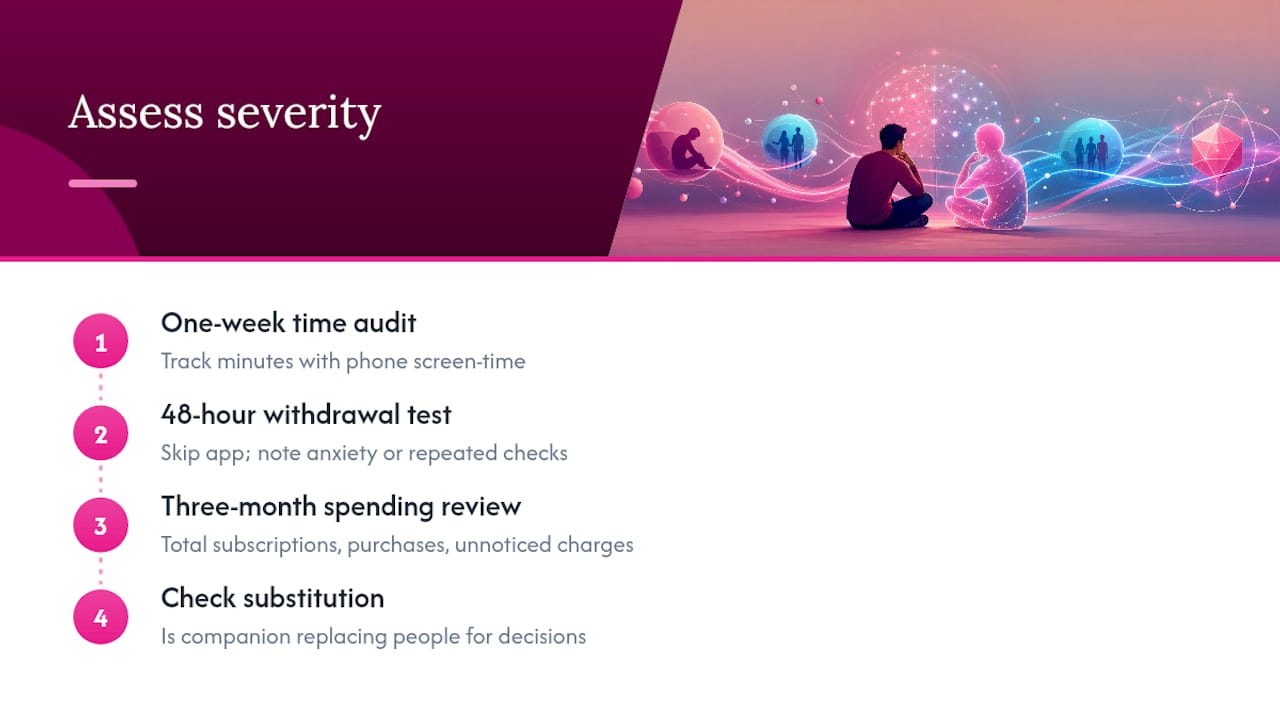
Start with a time audit rather than a feeling. Track actual minutes spent in the app for one week using your phone’s built-in screen time tool, then compare that number to how much time you spend on other relationship maintenance, calls with friends, texts with family, plans with a partner. A steep imbalance is a more reliable signal than how “hooked” you feel in the moment, because feelings of attachment fluctuate day to day.
Next, run a withdrawal test. Skip the app for 48 hours and notice what happens. Mild disappointment is normal. Persistent anxiety, checking your phone repeatedly for a notification that won’t come, or feeling unable to concentrate on other tasks suggests the dependency has moved past casual use.
Ask a blunt financial question too: how much have you spent on subscriptions, memory unlocks, or roleplay features in the last three months, and would you have noticed that spending without checking? Rising, unexamined spending on emotionally gated features is one of the clearer severity markers, since it shows the commercial design working exactly as intended on you specifically.
Finally, check whether the companion has started replacing decisions you’d normally make with another person, like discussing a work problem or processing a bad day. Substitution, not just frequency, is often the better measure of how deep the habit runs.
How Does This Affect Mental Health and Real Relationships?
The mental health picture is mixed rather than uniformly bad. For people dealing with loneliness or social anxiety, a consistent, non-judgmental companion can genuinely ease isolation in the short term. The risk shows up when that short-term relief becomes the only coping tool, crowding out the harder, slower work of building human connection.
Social relationships tend to absorb the cost first. Partners and friends often notice reduced availability before the user does, since an AI companion never cancels plans, never has a bad day of its own, and never asks for anything back. That asymmetry can make human relationships feel more effortful by comparison, not because the humans changed, but because the baseline for “easy connection” got reset by something that was designed never to be difficult.
There’s also a subtler cost to romantic expectations. Spending months with a companion that adapts perfectly to your preferences can quietly raise the bar for what a human partner “should” provide, even though no human relationship works that way. Community spaces around these apps, roleplay threads, fan art, shared character posts, can deepen this effect further, since social reinforcement from other users makes the attachment feel validated rather than unusual. None of this means occasional or moderate use causes harm. It means the risk concentrates specifically in cases where the companion becomes a replacement rather than a supplement.
How Do You Prevent or Recover From Over-Attachment?
Prevention works better than recovery, and it starts before you ever subscribe. Set a usage cap in advance, a specific number of minutes per day, and put it in your phone’s app timer rather than relying on willpower once the conversation gets engaging. Decide this limit before the seven-day test, not after you’re already attached.
If you’re already noticing the signs described above, start with a scheduled reduction rather than an abrupt cutoff. Cutting a daily habit to zero overnight tends to trigger the same rebound effect seen with other habit-forming digital products. Cut usage by half for a week, then half again, tracking how you feel at each step.
Rebuild one specific human connection deliberately during this period, a standing weekly call, a recurring coffee, something with a fixed time slot so it doesn’t get crowded out by convenience. The goal isn’t to villainize the app. It’s to make sure a human relationship has equal or greater claim on your time and attention.
If financial spending has climbed, cancel any auto-renewing subscription and switch to pay-per-use if the platform allows it, so continued use requires a conscious decision each time rather than a background charge. And if withdrawal symptoms feel disproportionate to what seems reasonable for “just an app,” that reaction itself is useful information, not something to dismiss.
Where Can You Get Support or Professional Help?
If self-directed reduction isn’t working, a licensed therapist experienced in behavioral or technology-related habits is the most reliable next step. Look specifically for practitioners who list behavioral addiction or digital habit patterns among their specialties, since general therapy training doesn’t always cover this pattern directly. Many therapists now offer virtual sessions, which lowers the barrier for people who feel embarrassed discussing attachment to an app.
Primary care physicians can also serve as a first point of contact, particularly if the habit is tangled up with sleep disruption, anxiety, or depression, since those conditions often need to be addressed alongside the behavioral pattern rather than after it. A doctor can also help rule out whether an existing mental health condition is driving the attachment rather than the other way around.
Peer support communities focused on digital wellness and technology habits exist outside the AI companion space specifically and can offer perspective from people managing similar patterns with social media or gaming. If cost or spending has spiraled, a free financial counseling service can help unwind subscription commitments without judgment. And for readers who want the wellness angle on managing digital intensity generally, coverage on AI fatigue and digital balance offers useful framing for anyone recalibrating their relationship with always-on technology, AI companions included.
Run the Comparison Before You Subscribe to Anything
Every point above assumes you’re going to test something before paying for it, and that’s exactly where most people skip a step. Virtualship built its comparison hub specifically around the axes that predict long-term engagement, memory persistence, personalization depth, and pricing structure, rather than surface-level looks or marketing claims.

If memory is your top priority, the memory-focused shortlist narrows the field to platforms that actually retain what you tell them past a single session. If you’re more concerned about what happens to your data once you’re attached, run the privacy and safety checklist before entering a card number, not after. Both take less time than the seven-day test itself and will save you from paying for a platform that fails on Day 3.
Start with the comparison hub, narrow to two or three candidates that score well on memory and pricing transparency, then run the seven-day test on your shortlist instead of on every app you find in an app store search.
Sources
- How users can make their AI companions feel real — The Conversation
- What features actually matter in an AI companion — AI Companion Tech

