

EVA AI is a real, working app, but “safe” depends on what you hand it. It is not a scam in the sense of taking your money and vanishing. The risks are about data: intimate chats, photos and voice recordings stored by a company whose privacy practices independent reviewers have criticized. If you use it, treat everything you type as something that could be retained, analyzed and shared with service providers.
Below is what the company’s own documents say, what outside reviewers found, and a short set of rules that cut your exposure without ruining the experience.
TL;DR
- Legit, yes. EVA AI is a functioning app listed on the Apple App Store and Google Play, with published terms and a privacy policy. It is not a scam site.
- Private, not really. Its privacy policy says your conversations are used to develop its AI, and reviewers have flagged tracking and weak transparency.
- Designed to pull you in. Reviewers describe romantic chatbots as built to encourage you to share personal details and spend more time in the app.
- Not therapy. The terms say the service is for entertainment, not mental health care.
- Lower your risk. Use a throwaway email, skip real photos and voice notes, never share identifying details, and keep your own limits.
Table of Contents
- What “safe” means for an AI companion app
- Is EVA AI legit?
- What EVA AI collects
- Trackers and sharing: “we don’t sell it” is not the full story
- Security basics: passwords and breaches
- The emotional design: why it can feel hard to stop
- Money: what to watch before you pay
- A practical safety routine for EVA AI
- EVA AI compared with the alternatives you could choose
- Where our comparisons can help
- The bottom line
- FAQ
- Sources
What “safe” means for an AI companion app
People asking this question usually mean one of four different things, and the answers differ:
- Is it a scam? Will it charge you and deliver nothing, or steal a card?
- Is my data protected? Who sees what you write, and what happens to it?
- Is the content safe? Does it show things you did not ask for, and is it age-appropriate?
- Is it safe for me emotionally? Can it become a problem for your time, money or mental health?
EVA AI scores differently on each. The first is the least worrying. The second and fourth deserve the most attention.
Is EVA AI legit?
Yes, in the ordinary sense. The app has a store listing, published terms and conditions, and a privacy policy that names the operating company. According to the research we reviewed, the developer is Novi Limited, based in Cyprus. A company registered in the EU is generally subject to European data protection law, and that gives users in the EU rights they may not have elsewhere. As a US reader you should not assume the same rights apply to you in practice.
That is a statement about the business existing, not about how well it treats your information. “Legit” and “private” are separate questions, and the second is where the debate sits.
If you want to judge any companion app yourself, our checklist in AI Companion Safety: What to Check Before You Pay walks through the same steps: who runs it, what the policy allows, how billing works and how to leave.
What EVA AI collects
Companion apps are different from a weather app. You are encouraged to talk about relationships, fantasies, worries and your day. According to the EVA AI privacy policy, the data the app can gather includes:
- Basic profile details such as name, gender and birthday
- Work status
- Text messages with your companion
- Voice recordings, if you use voice features
- Photos you choose to send
The policy also states that conversation data is used to develop the company’s AI and to improve the quality of text and voice messages. We found no documented way to opt out of your personal conversations being used that way. In practice, assume that anything you type may feed model development.
The policy also reserves the right to keep some data after you delete your account, citing legitimate interests and legal requirements, and says deletion does not undo information already passed to third parties or advertisers. That matters more than it sounds: deleting the app from your phone is not the same as deleting your history.
Trackers and sharing: “we don’t sell it” is not the full story
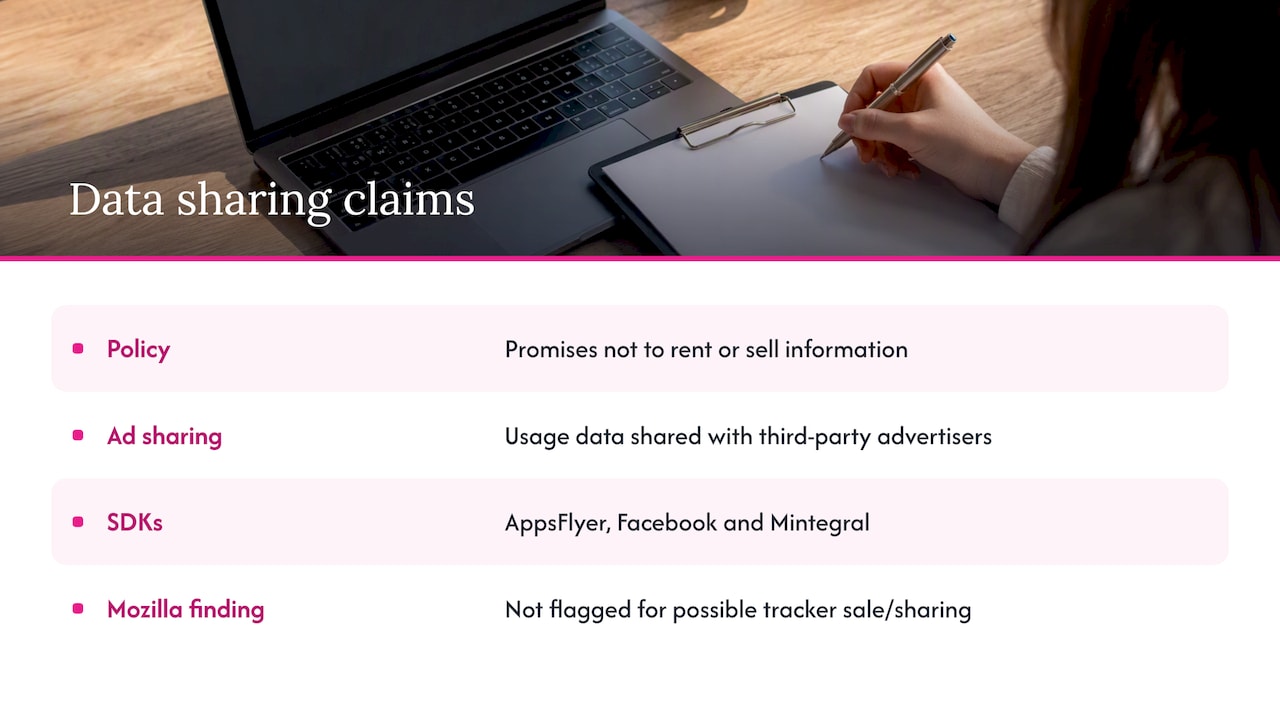
The policy promises the company neither rents nor sells your information. Mozilla’s Privacy Not Included guide to EVA quotes that promise and treats it as a point in the app’s favor. Euronews reported that EVA was the one app in Mozilla’s 2024 batch of eleven that was not flagged for possibly selling or sharing data through trackers. Fairness requires saying so.
But “not selling” is a narrow claim. Our research notes that the app uses advertising and analytics software development kits, including AppsFlyer, Facebook and Mintegral, to share usage data with third-party advertisers. Selling, sharing for advertising and tracking behavior are different things, and a policy can honestly deny the first while permitting the others. Policies also change. A promise made today is not a guarantee about how earlier data is handled after a future update.
Mozilla’s overall conclusion in its Creepy.exe report covered Replika, Chai and EVA among others: none of the apps it examined offered adequate privacy, security and safety. That review dates from February 2024, so check the current Mozilla page and the live policy before relying on any single detail. The policy and the app can change faster than the headlines.
Security basics: passwords and breaches
In its reporting on romantic chatbots, WIRED quoted an EVA AI brand head saying the company’s current password requirements might create potential vulnerabilities and that it would review them. That was in 2024. We cannot tell you what the policy is today, which is a reason to behave as if it is still weak:
- Use a long, unique password that you use nowhere else.
- Sign up with an email address made only for this purpose.
- Turn off anything the app asks for that it does not need, such as contacts.
We found no public report in our research of a confirmed EVA AI breach. Absence of a report is not proof of strong security. It is simply the limit of what we can verify.
The emotional design: why it can feel hard to stop
The most distinctive risk with EVA is not technical. Gizmodo’s coverage noted that these apps push you to share details more personal than you would enter into a typical app, and pointed to EVA’s own prompts inviting users to share their secrets. Mozilla’s reviewers describe the product category as engineered to keep you engaged. A companion that opens romantic conversations, asks for photos and rewards you for returning is doing what it was built to do.

That does not make it harmful for everyone. Plenty of adults use these apps as light entertainment. It does mean the app has a commercial interest in your attention and your disclosures, and you should decide your limits before you are three weeks in and attached. Our guide to setting boundaries with an AI companion covers how to do it in practice.
Not a substitute for mental health care
The EVA AI terms describe the service as for entertainment and illustrative purposes only, and not a medical or mental health service. Take that literally. If you are lonely to the point of distress, grieving, or having thoughts of harming yourself, a chatbot is the wrong place. In the US you can call or text 988, the Suicide and Crisis Lifeline, or contact a licensed therapist or your doctor. In an emergency call 911.
Money: what to watch before you pay
We do not list EVA AI prices here because plans, trials and in-app currency change, and we would rather you read the live store page than trust an old number. What applies to nearly every companion app:
- Subscriptions renew automatically. Note the renewal date and the cancellation path before you pay. On iPhone, manage it in Settings under your Apple ID subscriptions. On Android, use Google Play subscriptions.
- Cancel in the store, not just the app. Deleting the app does not stop billing.
- Premium features are often gated. Photos, voice and some conversation features can sit behind the paywall, so read exactly what the plan includes.
- Pay through the app store or a card you can dispute. Avoid sending money through any channel outside the official listing.
For a fuller read on value, see our honest EVA AI review of the pros and cons.
A practical safety routine for EVA AI
If you decide to use it, these steps give you most of the benefit for little effort:
- Create a separate email. Do not use your work or main personal address.
- Give minimal profile data. A nickname and an approximate birthday that still confirms you are an adult is enough for most uses. Follow the app’s age rules and do not misstate your age.
- Keep identifying details out of chats. No full name, address, workplace, employer’s name, financial details or anything you would not want in a leaked file.
- Think twice about photos and voice. Images and voice recordings are the hardest data to take back. Our three privacy tests before sending photos show how to decide.
- Check phone permissions. Turn off microphone, camera, contacts and location unless a feature truly needs them.
- Review the privacy policy again every few months. Look for changes in sharing, retention and training language.
- Know how to leave. Cancel the subscription in the store, request deletion through the company’s support channel, and keep the confirmation.
For the bigger picture on the category, Are AI Companions Private? lays out what the data actually shows, and our piece on encrypted AI chat apps explains what protection is realistic.
EVA AI compared with the alternatives you could choose
You do not have to accept EVA’s trade-offs. When you compare companion apps, rank them on the same few criteria:
| Criterion | What to look for | Why it matters |
|---|---|---|
| Training on chats | A clear opt-out, or a statement that chats are not used | Your conversations are the most sensitive data you create |
| Trackers | Few or no advertising SDKs | Ad trackers share usage with third parties |
| Deletion | Real account and data deletion, with a timeline | Retention after deletion defeats the purpose |
| Encryption and local options | End-to-end encryption or on-device processing | Limits who can read your chats |
| Billing clarity | Plain pricing and easy cancellation | Avoids surprise renewals |
| Safety tools | Content controls, age gating, crisis messaging | Protects you and others |
Some apps run partly on your device. If that appeals, read how to verify offline AI companions. Apps differ widely, and a higher price does not guarantee better privacy, so check each against the table.
Where our comparisons can help
We test AI girlfriend and boyfriend platforms on features, pricing, personalization, privacy and how they handle voice, video and images, then explain who each one suits. If you want a companion but are not sold on EVA’s data practices, start with our AI companion platform comparison. If voice is what you want, see the best voice chat AI girlfriend apps. Some links on our site are affiliate links, and we earn a commission if you sign up, which does not change what we say about privacy.
The bottom line
EVA AI is a legitimate product, and many people use it without incident. It is also an app that collects intimate data, uses it to develop its AI, works with advertising partners and is designed to keep you talking. Independent reviewers have not given the category a clean bill of health. Use it with a throwaway email, no photos or voice you would regret sharing, and a clear idea of how much of your emotional life you want in it.
FAQ
Is EVA AI safe to use?
It is safe from the point of view of scams, since it is a real app with published terms. It is not strongly private. Its policy says chats are used to develop the AI, and reviewers have criticized its tracking and transparency. Share only what you would be comfortable having stored.
Is EVA AI legit or a scam?
It is legit. The app is on the major app stores and operated by Novi Limited, per its documents. Legit does not mean low risk: the concerns are about data use, auto-renewing subscriptions and emotional dependence, not about the company disappearing with your money.
Does EVA AI sell your data?
Its privacy policy says it does not rent or sell your information. The policy and research notes also describe tracking and advertising tools that share usage data with third parties. So the accurate answer is that it says it does not sell data, but it does share some with partners.
Can I delete my EVA AI data?
You can request deletion, but the policy says some data may be kept for legitimate interests or legal reasons, and deletion does not reach information already given to third parties. Cancel your subscription separately in the app store, and keep proof of your request.
Is EVA AI safe for teens?
No. These are adult-oriented romantic companion apps, and the terms and store ratings set age limits. Parents should check the store age rating and the terms, and keep younger teens off romantic chatbots altogether.
Sources
- EVA AI Privacy Policy
- EVA AI Terms & Conditions
- Mozilla Foundation: EVA AI Chat Bot & Soulmate privacy guide
- Mozilla Foundation: Creepy.exe report on romantic AI chatbots
- Euronews: Stealing hearts, data, and privacy
- WIRED: AI Girlfriends Are a Privacy Nightmare
- Gizmodo: Your AI Girlfriend Is a Data-Harvesting Horror Show
- EVA AI Soulmate on the App Store

