

No, not by default. Most AI companion apps collect far more than the conversation itself, and several of the biggest names in the category have already been fined, investigated, or flagged by regulators for how they handle that data. Italy’s data protection authority hit Luka Inc., the company behind Replika, with a €5 million fine in April 2025 for GDPR violations tied to how the app handled user data and age verification. Around the same time, the FTC opened a formal inquiry into seven companion chatbot providers, asking pointed questions about monetization, safety testing, and how these companies treat data from minors.
That doesn’t mean every app is a privacy disaster, or that you should delete your account and swear off the category. It means privacy here depends entirely on which app you pick, what settings you touch, and how much you assume rather than verify. Do these three things before your next session:
- Stop typing anything you wouldn’t want screenshotted: full name, address, workplace, financial details, health conditions.
- Open your settings and look for a model-training opt-out and a memory/data deletion control.
- Turn on two-factor authentication if the app offers it, since account takeover is often the easiest way your private chats end up somewhere else.
Key Takeaways
Privacy for AI companions depends on specific, checkable factors: training opt-outs, encryption at rest, retention windows, and how the company responds when you actually test its deletion process.
| Point | Details |
|---|---|
| No universal answer | Privacy varies by app; assume nothing until you check the actual policy and settings. |
| Enforcement is already happening | Italy fined Luka Inc. €5 million and the FTC is investigating seven companion providers over data practices. |
| Training use is the hidden risk | Look specifically for a model-training opt-out; de-identification language often isn’t enough on its own. |
| Retention windows vary wildly | Policies range from 28 days to 5 years for the same categories of chat data. |
| Compare before you commit | Virtualship’s comparison page tracks privacy scores alongside features across major AI companion apps. |
Table of Contents
- Privacy for AI Companions: The Real Baseline
- What Counts as an AI Companion, and Why That Changes the Privacy Math
- How Companion Apps Collect, Store, and Use Your Data
- Primary Privacy Risks From AI Companions, Ranked
- Where the Law Stands on AI Companion Privacy
- Technical Safeguards That Actually Reduce Your Exposure
- How to Protect Your Privacy When Using an AI Companion
- Questions to Ask Before You Sign Up or Pay
- How to Fully Exit a Companion App and Limit What’s Left Behind
- How Virtualship Evaluates Privacy in AI Companion Reviews
- What to Watch Next in AI Companion Privacy
- Where Virtualship Fits Into Your Privacy Decision
- Frequently Asked Questions
- Sources
Privacy for AI Companions: The Real Baseline
“Privacy for AI companions” isn’t a single setting you can toggle on. It’s a combination of what the app collects, how long it keeps it, whether your words train the underlying model, and how well the company secures all of it. Get any one of those wrong and the rest doesn’t matter much.
What Counts as an AI Companion, and Why That Changes the Privacy Math
An AI companion is a conversational agent designed around a persistent persona, ongoing memory, and personalization that deepens the longer you talk to it. That’s the core distinction from a general chatbot: you’re not asking it one-off questions, you’re building a relationship with it, and it’s building a profile of you in return.
A workable definition includes a few consistent features:
- Persistent identity: the companion remembers previous conversations, not just the current session.
- Emotional or romantic framing: many apps, including Replika and Character.AI, are explicitly designed to simulate intimacy, friendship, or romance.
- Personalization loops: the app adjusts tone, topics, and responses based on what you’ve revealed about your preferences and history.
Modalities vary widely. Some apps are text-only. Others add voice synthesis, generated avatars or images, and a few now bundle in agent-like features that connect to payment methods or third-party services. Each added modality is another data type that needs protecting: a voice sample carries biometric information a typed sentence never could.
Intimacy is what makes the privacy calculus different from, say, a productivity chatbot. When you tell a companion about a breakup, a health scare, or a family conflict, you’re generating exactly the kind of sensitive personal data that most privacy law treats with extra caution. An arXiv interview study of 17 users in romantic AI relationships found that memory features make personal boundaries more porous over time. People forget what they’ve already disclosed, and the app never does. Some interview subjects had started using pseudonyms or separate accounts specifically to manage that risk, which tells you something about how aware heavy users already are that the default setup isn’t private enough.
How Companion Apps Collect, Store, and Use Your Data
Every message you send generates more than the text on your screen. Understanding the full data flow is the first step toward knowing what you’re actually exposing.
The inputs are the obvious part: text messages, voice recordings if the app supports voice, and photos or images if you upload them. From there, the app typically derives secondary data you never directly provided.
- Derived profiles: sentiment analysis, inferred personality traits, relationship status, interests, and emotional patterns built from your messages over time.
- Metadata: timestamps, session length, device type, IP address, and location signals that can narrow down who and where you are even without a name attached.
- Payment data: billing information tied to subscription tiers, which creates a direct link between your identity and your chat history through the payment processor.
- Third-party linkages: analytics SDKs, ad networks, and crash-reporting tools that many apps embed by default, often sharing behavioral data outside the core product.
An independent audit of app-store privacy labels found wide variance across the category: some companion apps collect only basic identifiers, while others pull in photos, audio, precise location, and extensive analytics. That range matters because it means you genuinely cannot assume one app behaves like another just because they’re in the same category.
| Data type | Common use | Retention pattern |
|---|---|---|
| Chat text | Response generation, sometimes model training | 28 days to 5 years depending on the app |
| Voice recordings | Speech synthesis, voice matching | Often retained longer than text logs |
| Photos/images | Avatar generation, personalization | Varies widely, rarely disclosed clearly |
| Metadata (IP, device) | Fraud prevention, analytics | Frequently indefinite |
A comparative review of 27 companion app privacy policies found retention windows ranging from 28 days to five years, with most apps scoring poorly on consistency between what they say and what they actually appear to do. That gap between stated policy and observable practice is exactly why reading the privacy policy alone isn’t enough.
The line between “used to generate this response” and “used to train the next model version” is the one most users miss. Some companies process your message, generate a reply, and discard the raw input shortly after. Others retain conversations specifically to fine-tune future model versions, meaning something you said in March could shape how the model responds to a different user in October. OpenAI’s privacy policy is a useful example of how this language typically works: even where a company describes de-identification, that language often comes bundled with a broad license to use content for training unless you find and activate a specific opt-out.
Picture the chain of custody on a single voice clip: you record a message, it’s transcribed and stored, the audio itself is retained for “quality improvement,” it gets flagged for a training dataset six months later, and a server misconfiguration exposes that dataset to the open internet. Every link in that chain is a normal, common practice on its own. Stacked together, they explain how private conversations end up in places nobody intended.
Primary Privacy Risks From AI Companions, Ranked
Not all privacy risks carry equal weight. Here’s how they stack up from most to least damaging, based on both real incidents and how regulators and researchers are prioritizing their scrutiny.
- Data leaks and exposed archives. Misconfigured servers have exposed millions of intimate conversations, according to reporting on romantic AI chatbot breaches. An exposed chat archive containing confessions, health details, or relationship struggles is the single most damaging failure mode because it’s often permanent and searchable once it’s out.
- Inference and re-identification. Even “anonymized” data can be pieced back together. Location metadata plus writing style plus a mentioned workplace can re-identify someone who never gave their name.
- Model regurgitation of private content. If your specific phrasing or personal details were used in training, there’s a nonzero chance a future user’s conversation surfaces fragments of it, especially with smaller or less-filtered models.
- Voice and face cloning. A voice sample given to an app for a more natural-sounding companion can, in the wrong hands, be repurposed to bypass voice-based bank authentication or impersonate you in a scam call.
- Manipulative design and emotional dependence. Regulators are increasingly asking whether human-like design choices are built to maximize disclosure and engagement rather than serve the user, a concern central to the FTC’s current inquiry.
- Risks to children and vulnerable users. Weak age verification means minors routinely access apps built for adult intimacy, often without any parental awareness.
- Indefinite retention feeding future training pipelines. Canada’s privacy regulator found that earlier large-model training pipelines collected overly broad personal information, raising real questions about whether users ever gave meaningful consent for that specific use.
These risks rarely show up alone. A weak authentication system plus indefinite retention plus a training pipeline that doesn’t strip identifying details is how a single leaked password turns into years of intimate conversation history landing in the wrong hands.
Where the Law Stands on AI Companion Privacy
Regulation here is playing catch-up, but enforcement has already started, and it’s worth knowing what’s actually happened rather than what’s theoretically possible.
- April 2025: Italy’s data protection authority fined Luka Inc. €5 million over Replika’s handling of user data, citing inadequate age verification and unclear legal basis for processing emotionally sensitive information.
- September 2025: The FTC’s inquiry into seven chatbot companion providers asked for detailed information on child safety measures, data collection, and monetization strategies.
- 2026: A European Parliamentary Research Service briefing concluded there’s no AI-companion-specific law in the EU yet, but existing frameworks including GDPR, the AI Act, and the Digital Services Act likely apply, with lawmakers actively discussing additional child-safety and consumer safeguards.
Under GDPR and similarly structured regimes, you typically have the right to request a copy of your data, ask for correction, and demand deletion. In practice, that means you can email a company’s privacy contact and request an export or erasure of your chat history, and the company generally has a legal deadline to respond. Whether they respond fully, or whether “deletion” actually removes your data from a training dataset already baked into a model, is a separate and much murkier question.
The gap between the right on paper and the outcome in practice is real. Enforcement is difficult across borders when a company is headquartered in one country, hosts data in another, and serves users worldwide. Private one-on-one conversations are also, by nature, hard for regulators to audit without a specific complaint or breach triggering an investigation. A systematic review of AI privacy research makes the same point from the technical side: the tools to protect privacy exist, but adoption is inconsistent, and regulation alone doesn’t force a company to use them.
Technical Safeguards That Actually Reduce Your Exposure
Some engineering choices meaningfully lower privacy risk, and knowing what to look for helps you separate marketing language from a real design commitment.
- Encryption at rest and in transit protects your data from being readable if a server is breached, though it does nothing to stop the company itself from using your data internally.
- On-device processing keeps some data (like voice-to-text conversion) on your phone instead of a remote server, reducing what ever leaves your device.
- Federated learning lets a model improve from aggregated patterns across many users without centralizing raw conversations in one place.
- Differential privacy adds statistical noise to datasets so individual users can’t be picked out of aggregate training data.
- Selective memory controls let you delete specific facts the companion has stored about you without wiping the whole relationship history.
- Documented training opt-outs and audit logging give you a way to verify, rather than just trust, that your data isn’t feeding a model you never agreed to train.
The systematic review from PMC documents all of these as viable, currently used techniques, not theoretical ideas. The trade-off is real, though: an app relying heavily on on-device processing and differential privacy will sometimes feel slightly less personalized or slower to adapt to you, because it has deliberately less centralized information to work with.
Pro Tip: If an app forces you to choose between privacy and personalization, prioritize a documented training opt-out and encryption at rest over deeper memory features. You can always add personalization later; you can’t easily undo data that already trained a model.
How to Protect Your Privacy When Using an AI Companion
Here’s a sequence you can actually follow, not just a list of vague good intentions.
- Use a unique password and enable two-factor authentication. Account takeover is one of the simplest ways private chats end up exposed.
- Review app permissions before granting them. Does the companion actually need microphone or camera access for the features you use, or is it requesting more than the experience requires?
- Find the memory and training settings. Look specifically for a toggle that lets you opt out of having your conversations used for model training.
- Treat payment data as part of your privacy footprint. Subscribing with a credit card links your billing identity to your chat history through the payment processor, something a GDPR enforcement analysis flags as an underappreciated exposure point, even on paid tiers.
- Keep sensitive facts out of the conversation entirely. Full names, addresses, financial details, and health information don’t need to be typed into a companion app to have a meaningful conversation with it.
Parents and caregivers should treat these apps the way they’d treat any social platform: check the app’s stated minimum age, review conversation logs periodically if the household device allows it, and have a direct conversation about what the AI companion is (a product designed to maximize engagement) rather than what it might seem like to a young user.
Pro Tip: A privacy policy heavy on vague phrases like “we may share data with partners” and light on specific retention windows or opt-out mechanisms is a red flag. Contact support directly and ask for a specific answer; a company confident in its practices will give you one.
Questions to Ask Before You Sign Up or Pay
Before creating an account, especially before upgrading to a paid tier, get direct answers to a short list of questions:
- Is my conversation data used to train future models, and is there a specific opt-out?
- What’s the exact retention window for chat text, voice recordings, and images?
- Is data encrypted at rest, not just in transit?
- Do humans review conversations, and under what circumstances?
- Is any data shared with third parties, including analytics or ad partners?
- What’s the deletion process, and does it apply to data already used in training?
- Is access to my data logged and auditable internally?
Scan the terms of service for phrases like “perpetual, irrevocable license” to your content, broad “de-identification” clauses that don’t specify a method, or acquisition clauses that let a buyer inherit your data if the company is sold. If support gives you a vague or scripted answer to any of these, that’s information too. Escalate to a written request through the company’s designated privacy contact, and if that goes unanswered, you generally have the option to file a complaint with your national data protection authority.
How to Fully Exit a Companion App and Limit What’s Left Behind
If you’re done with an app, a clean exit takes more than just deleting it from your phone.
- Export your data first, if the option exists, so you have a record of what the company held.
- Revoke any connected integrations, including linked payment methods and third-party logins.
- Delete the account through the app’s official settings, not just uninstalling it.
- Submit a written erasure request to the company’s privacy contact, referencing GDPR or your applicable regional law if relevant.
- Follow up to confirm deletion, and escalate to a data protection officer or your national regulator if you get no response within the legal timeframe.
One honest caveat: “de-identified” data used in a past training run may legally remain in a model’s weights even after your account is deleted, since the specific conversation, once anonymized and absorbed into training, often can’t be surgically removed. Account deletion stops future collection. It doesn’t always undo the past.
How Virtualship Evaluates Privacy in AI Companion Reviews
Virtualship’s review process treats privacy as a factual question, not a marketing claim to take at face value. That means checking specific, verifiable things rather than repeating what an app’s landing page says about itself.
- Policy review: reading the actual privacy policy and terms of service, not the marketing summary of them.
- Encryption verification: looking for documented at-rest and in-transit encryption, not just a generic “we take security seriously” statement.
- Retention checks: comparing stated retention windows against what the app’s own settings and support responses confirm.
- Opt-out testing: attempting to locate and activate a training opt-out to see if it actually exists and functions.
- Deletion flow documentation: tracking whether an account deletion request is honored within a reasonable, stated timeframe.
A credible proof point is a documented policy paired with observable behavior, ideally both. A marketing claim is a promise with no corresponding setting, log, or written policy backing it up. That distinction shapes every privacy assessment in Virtualship’s comparison work.
What to Watch Next in AI Companion Privacy
The near-term picture looks like a slow tightening rather than a sudden fix. Age verification is likely to get stricter across major markets as regulators keep pressing on child safety, and I expect more companies to start publishing specific training opt-out mechanisms simply because the FTC and EU scrutiny make silence look worse than disclosure. The apps that survive this wave of enforcement well will probably be the ones that started documenting their data practices before they were forced to.
None of that means you should wait around for the law to catch up before protecting yourself. Read the privacy policy for retention windows and training language, not just the marketing copy. Look at responsible AI transparency practices as a model for what a company being upfront about data handling actually looks like, and treat any app that can’t answer basic questions about deletion or opt-outs with real skepticism, regardless of how good the conversation feels.
Where Virtualship Fits Into Your Privacy Decision
Picking a companion app by app-store screenshots and glowing reviews means you’re gambling on privacy practices you haven’t actually checked. Virtualship’s comparison work exists specifically to close that gap: reading the policy, testing the opt-out, and checking whether deletion requests actually go through before we tell you an app handles your data responsibly.

That means you don’t have to cross-reference five different privacy policies yourself before choosing where to spend your evenings, or your subscription dollars. Our comparison page lays out privacy scores alongside the personalization, roleplay, and pricing details that actually matter for the experience, so you’re weighing the full picture instead of guessing. If you’re deciding between apps right now, start there and see which ones actually document a training opt-out and a real deletion process before you hand over a card number.
Frequently Asked Questions
Is it safe to tell an AI companion personal secrets?
Treat it the way you’d treat a public forum post rather than a locked diary. Even with encryption, your words may be retained, reviewed, or used in training depending on the app’s policy, so avoid sharing anything you’d be uncomfortable seeing exposed.
Do AI companion apps sell my data to third parties?
Some do, often through analytics or advertising SDKs disclosed deep in the privacy policy rather than sold outright to data brokers. Check the specific third-party sharing clause rather than assuming a “we don’t sell your data” headline covers every kind of sharing.
Can I get my data deleted from an AI companion app?
Usually yes, under GDPR-style rights, but there’s a real gap between deleting your account and removing data that already fed a training run. Submit a written erasure request and escalate to a regulator if the company doesn’t confirm deletion within its stated timeframe.
Are AI companion apps safe for teenagers?
Most weren’t designed with teens in mind, and age verification across the category remains weak, which is a core focus of the current FTC inquiry. Parents should treat these apps as adult-oriented products and set clear boundaries rather than assuming built-in safeguards exist.
What’s the single biggest privacy mistake users make with AI companions?
Assuming a paid subscription automatically means better privacy protection. Billing data creates its own exposure point, and price tier has little correlation with how well a company handles retention, training use, or deletion requests.
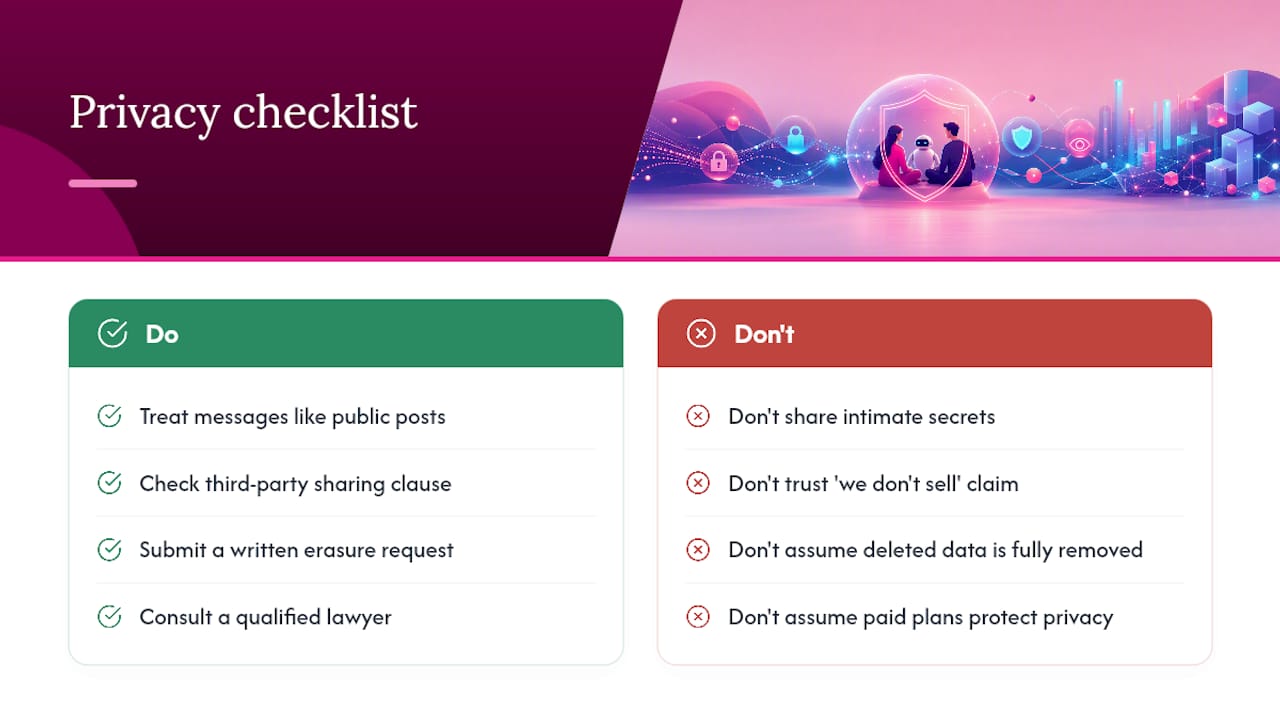
This article is general information, not a substitute for advice from a qualified lawyer. Consult a qualified legal professional about your own circumstances before acting on anything here.
Sources
- FTC launches inquiry into AI chatbots acting as companions
- The spread of AI companions and the challenges they generate — European Parliamentary Research Service (EPRS) briefing
- Privacy and AI: a systematic review (PMC)
- Investigations into businesses — Office of the Privacy Commissioner of Canada (OPC)

