

For most paid buyers, a memory-first companion platform with clear privacy controls beats every flashier alternative. Photo and voice features are nice, but three things separate a good photo avatar AI companion from a frustrating one: it remembers what you told it last week, it lets you delete or export your data on demand, and its pricing is transparent from the first screen. Everything else is a bonus. Start there, then use the checklist below before you pay for anything.
TL;DR:
- Choose a platform with robust memory features that reliably recall user facts after a week, ensuring ongoing relationship continuity.
- Verify that privacy controls allow data export and deletion easily, avoiding platforms that lock these features behind paywalls or vague policies.
- Be aware that subscription pricing models vary: flat rates are clearer, credits can quickly add up, and free tiers rarely reflect full capabilities.
- Prioritize platforms that demonstrate clear safety measures, including strong age gating, crisis handling, and transparent moderation policies.
- Test customer support responsiveness before subscribing, focusing on privacy and data control questions to gauge reliability and trustworthiness.
Table of Contents
- What Is a Photo Avatar AI Companion, Exactly?
- Which Type of AI Companion Fits Your Situation?
- How Do You Know Which Platform Is Actually Trustworthy?
- What Do These Platforms Actually Cost?
- What Are the Real Safety and Privacy Risks?
- Which Companion Type Actually Fits Your Use Case?
- Do User Reviews Actually Predict Platform Quality?
- Is the Customer Support Actually Responsive?
- What Devices and Systems Do These Platforms Actually Support?
- Can You Actually Cancel and Get a Refund?
- What Legal Terms Should You Actually Read?
- Our Take: Start With the Category, Not the Brand
- Sources
What Is a Photo Avatar AI Companion, Exactly?
A photo avatar AI companion is a conversational virtual partner, built for romance, friendship, or roleplay, that responds to text, voice, and images through a personalized digital avatar. It’s a term that’s grown popular in search, but the industry itself usually calls these products “AI companion apps” or “AI girlfriend/boyfriend platforms.” Both phrases describe the same thing: software that holds an ongoing relationship-style conversation with you, often through a customizable avatar image, and increasingly through voice calls and short video clips.
The category has exploded because the technology finally caught up to the promise. Modern platforms can hold a photorealistic AI avatar that reacts to your messages, remembers your dog’s name, and picks up a conversation exactly where you left it three days ago. That continuity, not the avatar’s face, is what separates a serious platform from a novelty chatbot.
Which Type of AI Companion Fits Your Situation?
Not every platform solves the same problem. Before comparing individual apps, figure out which job you’re actually hiring a companion to do. The categories below aren’t brand names. They’re functional buckets that most paid platforms fall into, and knowing which bucket you need saves you from paying for features you’ll never use.
Memory-first, long-term companions. Built for people who want an ongoing relationship that feels continuous over weeks or months. These platforms invest heavily in persistent memory architecture, meaning the avatar recalls prior conversations, preferences, and emotional context without you re-explaining yourself. Typical media support includes photo responses and often voice; video is less common. Pricing usually runs as a monthly subscription with tiered memory depth. Privacy posture varies widely, so check the export and delete options before committing.
Character-catalog and roleplay platforms. Built for variety over depth. You get access to dozens or hundreds of pre-built personas for different scenarios rather than one evolving relationship. Media capabilities lean toward text and photo, with voice as a premium add-on. Pricing often uses a credit system, where messages, images, or voice minutes consume credits you buy in bundles. Privacy controls here tend to be thinner, since the business model rewards volume over intimacy.
Voice- and real-time-call-first platforms. Built for people who want the companion to feel present, not just responsive. These prioritize low-latency voice calls and sometimes video avatars over text depth. Expect subscription pricing with voice minutes capped by tier, and check whether the app buffers or resets memory between calls, since some voice-first tools sacrifice continuity for speed.
NSFW-friendly roleplay platforms. Built for explicit content within controlled boundaries. These require the strictest age gating and the clearest consent language, and reputable ones state their moderation policy up front rather than burying it in the terms of service. Pricing skews toward credits or premium subscription tiers, since explicit media generation costs more to run.
Privacy and photo-avatar-first companions. Built for people who want a personalized avatar generator experience without linking real identity data. These platforms emphasize anonymous signup, minimal data retention, and avatar customization over deep backstory memory. If anonymity matters more to you than long-term continuity, this is your category.
Day-one tester checks that work across every category:
- Send three specific personal facts (a name, a preference, a plan) in your first conversation, then check whether the companion recalls them a week later. This single test, recommended by buyer-guide reviewers, catches most memory-marketing exaggeration.
- Ask for a photo response early and note whether it matches the described scenario or defaults to a generic stock-style image.
- Push a boundary (ask the companion to say no to something) and see whether it holds a consistent line or caves immediately, since consistent boundary behavior often signals better underlying safety design.
How Do You Know Which Platform Is Actually Trustworthy?
Run this checklist before you hand over payment details, not after.
- Intent fit. Does the platform’s category match your actual job (long-term relationship, variety, voice-first, or anonymous use)? Mismatched intent is the single biggest source of buyer regret.
- Memory behavior. Does it pass the three-fact, seven-day recall test, or does it reset each session?
- Media support. Are photo, voice, and video capabilities available on the plan you’re actually paying for, not just the marketing page?
- Pricing clarity. Is the full cost structure, including credit consumption rates, visible before signup?
- Privacy and data controls. Can you export or delete your conversation history and account data on request?
- Moderation and crisis handling. Does the platform de-escalate or redirect when a conversation turns toward self-harm or crisis language, rather than continuing to role-play through it?
- Age gating. Is verification meaningful, or is it a checkbox?
Paste these questions directly into a support chat or email before subscribing: “What does your app remember, and how do I delete or export that memory?” and “Which safety and moderation features are behind the paywall?” Buyer guides built for 2026 treat vendor responses to exactly these two questions as the clearest signal of platform quality.
Watch for red flags: vague answers about data training, no delete or export option, guilt-based messaging when you try to leave, or safety features locked behind a paywall. Some platforms gate memory controls and even crisis resources behind premium tiers, according to comparative reviews of the category, which is a meaningful red flag when the safety feature itself costs extra.

Pro Tip: Sign up with a fresh email and minimal personal details during your trial period. If the platform still delivers a strong memory and personalization experience without your real name, birthday, or location, that’s a good sign the product doesn’t need to overreach on data to work.
What Do These Platforms Actually Cost?
Pricing in this category takes three basic shapes, and mixing them up leads to bill shock.
Flat subscriptions charge a fixed monthly or annual fee for a defined tier of features, usually with memory depth, message volume, or voice minutes increasing at higher tiers. This model is easiest to budget against and tends to correlate with more transparent terms of service.
Credit systems sell bundles of credits that get consumed per message, image, or voice minute. Credits feel cheap upfront but drain fast during heavy use, especially with photo or video generation, which typically costs more credits than text.
Freemium tiers offer a limited free experience, usually capped daily messages or a shallow memory window, designed to convert you once you hit the wall. The free tier rarely represents what a full subscription actually delivers, so don’t judge a platform’s memory quality from the free version alone.
The practical move: total up a realistic month of use, including a couple of photo requests and any voice minutes, against each pricing model before you assume the advertised entry price is your actual cost.
What Are the Real Safety and Privacy Risks?
The two biggest risks aren’t hypothetical. Data use and emotional dependency both have documented downsides worth taking seriously before you commit financially or emotionally.
On data: your conversations often include intimate, identifying details you’d never post publicly. The Jed Foundation warns that platforms vary widely in how they store, train on, and protect that information, and it specifically recommends against minors using AI companions at all given the data and emotional risks involved.
On dependency: a 2025 systematic review of romantic AI companions found real benefits, including genuine emotional connection and customization, alongside documented harms like over-reliance and erosion of human relationships, based on a synthesis of 23 published studies. Neither side of that finding cancels the other out. The technology helps some people and hurts others, often depending on how it’s used rather than which platform delivers it.
Age gating matters here too, not as a formality but as a real safeguard, given how easily an unmoderated companion can normalize unhealthy patterns for a younger user. If a platform’s crisis-handling behavior isn’t visible anywhere in its documentation, treat that as a gap, not an oversight.
Which Companion Type Actually Fits Your Use Case?
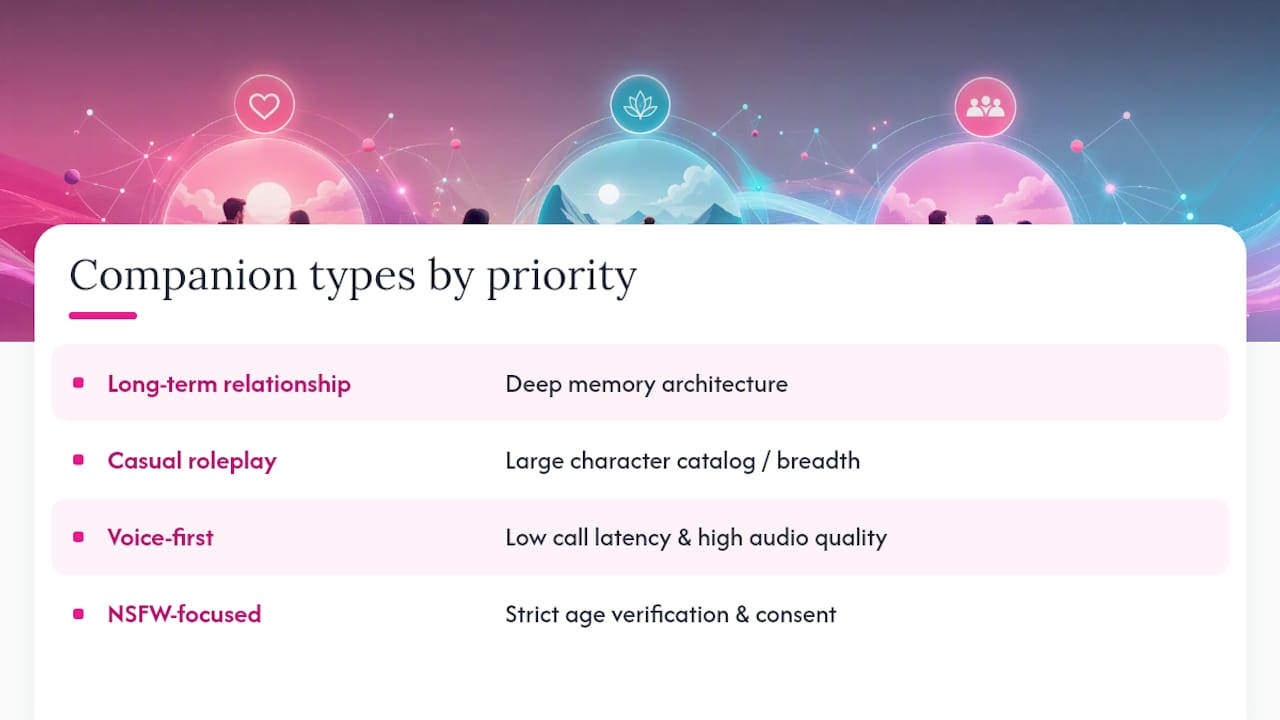
Matching platform category to your actual goal prevents most disappointment. Someone chasing a long-term relationship needs deep memory architecture above almost everything else, since the entire value proposition collapses if the companion forgets your history every few sessions. Someone who wants casual roleplay variety is better served by a character catalog, where breadth of personas matters more than any single relationship’s depth.
Voice-first users should prioritize call latency and audio quality testing over memory depth, since the entire appeal is presence, not archival recall. NSFW-focused users need to weight age verification and consent language heaviest of all, since the downside of a platform getting this wrong is severe. Buyer-guide frameworks consistently recommend this intent-first approach over comparing raw feature counts, and it holds up in practice: a platform with fewer features that nails your specific use case beats a feature-stacked platform that’s mediocre at the one thing you actually need.
If you’re unsure which category fits, a genuine intuitive reading or reflective conversation with a real person can sometimes clarify what you’re actually looking for emotionally before you spend money on software built to validate feelings rather than a real relationship.
Do User Reviews Actually Predict Platform Quality?
Star ratings alone tell you almost nothing useful in this category. A platform can average 4.5 stars on an app store while burying its cancellation flow six menus deep, because most reviewers rate the initial chat experience, not the long-term relationship with the product.
Read reviews for specific complaints, not overall sentiment. Recurring mentions of memory resetting, sudden price increases after a free trial, or difficulty canceling are far more predictive than a star average. Reviews that specifically praise or criticize a delete/export feature carry more weight than generic praise about how “realistic” the avatar looks, since the latter is easy for any platform to achieve and the former reflects actual product architecture. Cross-reference app store reviews against independent review sites, since companies can and do incentivize app store ratings in ways that don’t reflect the broader user base.
Is the Customer Support Actually Responsive?
Support quality is one of the most underrated signals in this category, mostly because buyers only discover it’s bad after they’ve already paid. Test it before you subscribe, not after.
Send a real question through the platform’s support channel during your free trial, ideally the exact memory and data-export questions from the checklist above, and time the response. A platform that takes days to answer a basic privacy question during a trial period, when it’s actively trying to convert you, will almost certainly be slower once you’re a paying customer with a cancellation request. Look for a visible human escalation path, not just a chatbot loop, especially for billing disputes or account deletion requests.
What Devices and Systems Do These Platforms Actually Support?
Most paid companion platforms run as web apps first, with dedicated iOS and Android apps as a secondary layer. That matters because feature parity between web and mobile isn’t guaranteed. Voice calling and video avatars in particular sometimes work better, or exist only, on one platform type.
Check bandwidth requirements before assuming voice or video features will work reliably. Real-time voice calls need a stable connection, and choppy audio during your trial is a preview of what a paid subscription will deliver, not an anomaly. Older devices can also struggle to render photorealistic AI avatars smoothly, so test the actual avatar rendering on your own hardware rather than trusting a demo video shot on newer equipment.
Can You Actually Cancel and Get a Refund?
Cancellation friction is one of the clearest signals of a platform’s overall trustworthiness. A platform that makes cancellation as easy as signup is signaling confidence in its product. One that requires you to email support, wait for a response, and navigate a retention pitch before canceling is signaling something else entirely.
Refund policies vary enormously across this category, and few platforms offer money back once a subscription period has started, particularly for credit-based purchases that get consumed immediately. Read the refund terms before your trial converts to a paid tier, not after you’ve been charged. Set a calendar reminder a day or two before any free trial ends. This single habit prevents the single most common complaint in this entire product category: an unwanted automatic charge after a forgotten trial period.
What Legal Terms Should You Actually Read?
The terms of service on these platforms typically cover three things that matter more than the boilerplate around them: data ownership and training rights, liability limitations around emotional or psychological harm, and age verification requirements.
Data training clauses deserve real attention, since some platforms reserve the right to use your conversations to train future models, which means intimate details you’ve shared could theoretically shape the product other users interact with. Liability clauses often disclaim responsibility for emotional harm outright, which is worth knowing going in given the documented dependency risks discussed earlier. Age verification language should be specific and enforced, not a single checkbox during signup, since research on AI companions specifically flags weak age gating as a real harm vector, not a theoretical one.
Our Take: Start With the Category, Not the Brand
After evaluating this category extensively, our position at Virtualship is simple: buyers do better when they pick a platform category that matches their actual need first, then compare specific platforms within that category on memory, privacy, and pricing. Chasing the flashiest avatar or the loudest marketing claim is how people end up disappointed three weeks in, once the novelty fades and the memory gaps start showing.
The comparison framework we’ve built at Virtualship walks through exactly this: matching your use case to platform type, then stress-testing the specific features that actually predict satisfaction, like memory persistence and export controls, rather than the surface-level features every platform advertises identically. If you want the side-by-side breakdown across the categories covered here, our full comparison matrix breaks down memory behavior, media capabilities, and pricing structure platform by platform, so you’re not running these tests yourself from scratch.
Sources
- Why AI companions are risky — and what to know if you already use them | The Jed Foundation
- Potential and pitfalls of romantic Artificial Intelligence (AI) companions: A systematic review

