

Yes, most AI companion platforms run a gift system, but the label “gift” or “tip” doesn’t tell you how the payment actually works. The two checks that matter before you spend a dollar: is the purchase processed as an in-app purchase (IAP) through Apple or Google Play, and are the odds or final price disclosed before checkout. Everything else, testing steps and the full checklist, follows below.
TL;DR:
- Most in-app gifts, tips, and purchases are processed through Apple or Google Play billing systems, with exemptions rarely applying to AI companion tipping features.
- Transparent disclosure of prices, currency conversions, and randomized gift odds before payment is essential and often lacking in poorly designed platforms.
- Consumable gifts are typically non-refundable once used, while permanent unlocks have a better chance of obtaining refunds through store dispute processes; crypto gifts are usually final and irreversible.
- Running a small, low-cost test purchase helps verify billing flow, receipt accuracy, and inventory behavior before committing to larger or recurring transactions.
- Platforms that route purchases through traditional app stores, disclose odds clearly, and separate temporary from permanent items in purchase history are safer choices for consumers.
Table of Contents
- What Counts as a Gift, a Tip, or a Purchasable Item?
- How Do Apple and Google Play Rules Shape In-App Gifting?
- What Payment Models Do Companion Apps Actually Use?
- Are Gift Prices and Odds Disclosed Before You Pay?
- Can You Get a Refund on a Gifted In-App Purchase?
- How Do You Safely Test a New Platform’s Gift System?
- What Red Flags Signal a Risky Gift System?
- How Do Gift Features Compare Across Companion Platforms?
- What Does Sending and Receiving a Gift Actually Look Like?
- Does Gifting Change How the Relationship Feels?
- Are Gifts and Tips Restricted in Certain Regions?
- How Responsive Is Support When a Gift Purchase Goes Wrong?
- Compare Gift Systems Before You Commit to One Platform
- Sources
- FAQ
What Counts as a Gift, a Tip, or a Purchasable Item?
A “gift” inside an AI companion app usually falls into one of three buckets, and the difference decides how your money is protected.
A cosmetic or narrative gift (a virtual bouquet, a coffee, a birthday cake emoji) is often a consumable digital item. You buy it, your companion “reacts” to it, and it disappears from inventory. It’s typically an in-app purchase because it unlocks a reaction or a short dialogue branch tied to the app’s content.
A tip is money framed as a direct, no-strings transfer to reward the experience, similar to tipping a streamer. Whether it counts as an IAP depends entirely on what it unlocks. If tipping also nudges a relationship meter, unlocks a new outfit, or triggers exclusive dialogue, it’s functioning as a purchase, not a pure gift, regardless of the button’s label.
A purchasable digital item (a persistent outfit, a permanent memory upgrade, a subscription-tier perk) is unambiguously an in-app purchase. It becomes part of your account’s inventory and should show up in your purchase history, refund flow, and store receipt.
The UCL research from Ge and Hu on gamified intimacy notes that many apps blur these categories on purpose, wrapping a monetization mechanic in emotionally warm language so it reads as affection rather than a transaction.
How Do Apple and Google Play Rules Shape In-App Gifting?
Apple’s App Store Review Guidelines require in-app purchase for any digital good or service that unlocks content within the app. That includes most companion gifts: outfits, relationship points, exclusive chat scenes. There’s a narrow carve-out for purely optional person-to-person gifts, but it only applies when 100% of the money goes to the receiving individual, not the platform. An AI companion is not a person receiving a tip; it’s software, so this exception almost never covers companion “tipping” features the way it might cover a livestreamed’s tip jar.
Google enforces a parallel rule. Google Play’s billing policy requires Play billing for in-app digital purchases, bans developers from steering you to outside payment methods, and mandates disclosure of odds when an item is randomized (think gacha-style gift boxes).
Practically, this means the “Buy me a coffee” button inside most companion apps runs through Apple’s or Google’s payment rails, not a separate processor. Apple’s own in-app purchase configuration guide breaks purchases into consumable, non-consumable, and subscription types, and a legitimate app should show you which type you’re buying before you confirm.
What Payment Models Do Companion Apps Actually Use?
Four pricing shapes cover almost every platform you’ll compare.
Consumables are one-time-use items: a single gift animation, a token pack, a “boost” that temporarily raises affection or unlocks a scene. Once spent, they’re gone and typically can’t be refunded once consumed, per Apple’s own IAP rules.
Subscriptions bundle gifting rights into a tier. Higher tiers often include monthly gift allowances, exclusive gift categories, or discounted token rates.
Tips sit closest to a direct cash transfer, though as covered above, they frequently still route through store billing because they influence in-app state.
Crypto payments are the newest wrinkle. Industry reporting from Hyperlogic documents crypto tipping emerging as a monetization pattern specifically because it’s global, fast, and doesn’t route through Apple’s or Google’s cut. That same speed is the risk: crypto transfers are irreversible and sit outside normal app-store dispute channels.
A ScienceDirect abstract on companion monetization confirms virtual gifting has become a real revenue pathway for these platforms, though it stops short of naming any single dominant pricing model. There isn’t one standard. Compare the actual token-to-dollar math on each platform you’re considering, not just the sticker price.
Are Gift Prices and Odds Disclosed Before You Pay?
Transparency is where a lot of gift systems quietly fail, and it’s the fastest way to separate a well-run platform from a sloppy one.
Three things should be visible before you tap “confirm”:
- The exact currency conversion. If you’re buying “500 gems” for $9.99, the app should show that number clearly, not bury it behind a vague “Best Value” badge.
- Odds for randomized gifts. Google Play’s payments policy requires odds disclosure for randomized virtual items (loot-box style gift crates). If a platform sells “mystery gift boxes” without listing drop rates, that’s a policy gap worth flagging.
- The final billed amount, including tax. Your store checkout screen (Apple’s or Google’s, not the app’s own screen) should show the actual charge before you approve it.
If an app shows you a price only inside its own custom checkout UI, without ever handing off to the native App Store or Play billing sheet, treat that as a signal to slow down. That’s often how apps try to route around store fees, and it usually means fewer consumer protections for you.
Can You Get a Refund on a Gifted In-App Purchase?
Refund eligibility depends almost entirely on whether the gift was consumed or converted into a permanent entitlement.
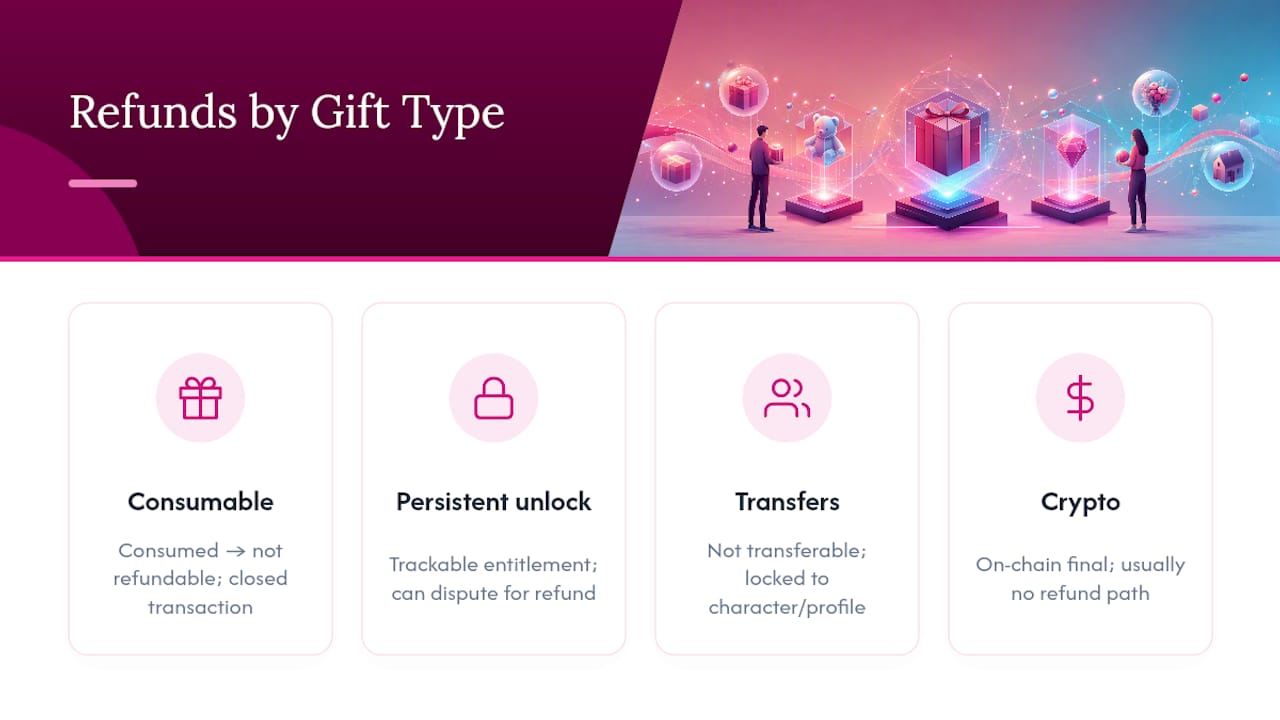
A consumable gift, like a one-time animation or a token spent on a single scene, is generally not refundable once used. Apple and Google both treat consumed consumables as closed transactions.
A non-consumable or persistent unlock, such as a permanent outfit or a lifetime relationship tier, has a better shot at a refund request through the store’s standard dispute process, because it remains in your account inventory as a trackable entitlement.
Transfers are a separate problem entirely. Almost no AI companion platform lets you transfer a purchased gift to another user’s account or another companion profile. Once it’s applied, it’s typically locked to that specific character or conversation thread.
Crypto-based gifts carry no refund path at all in most cases. Once a transaction confirms on-chain, it’s final, and the platform has no mechanism to reverse it even if it wanted to. That’s the trade-off Hyperlogic’s reporting on crypto tipping flags directly: speed and low fees in exchange for zero recourse if something goes wrong.
Pro Tip: Before you gift anything, check whether the app’s refund policy page distinguishes between “purchases” and “gifts.” If it only talks about purchases, assume gifts get the same treatment; don’t assume they’re excluded from store refund rules just because of the label.
How Do You Safely Test a New Platform’s Gift System?
Run a small, deliberate test before committing real money to any tier or token pack.
- Buy the cheapest available item first. A $0.99 or $1.99 token pack tells you everything about the checkout flow without real risk.
- Confirm the billing sheet. The confirmation screen should be Apple’s or Google’s native payment interface, not a custom in-app popup that skips store billing entirely.
- Screenshot the final receipt. Save the confirmed price, the item name, and the timestamp. This is your evidence if you ever need to dispute a charge.
- Check where the item lands. Does it show up in a persistent inventory, or does it vanish as a one-time animation? That answers the refund question before you ever need to ask for one.
- Test the cancellation or account-deletion flow. Some platforms make it deliberately hard to find where subscriptions or recurring gift allowances get canceled.
- Wait 24 hours, then check your bank or app store purchase history. Confirm the charged amount matches what was displayed at checkout, with no surprise currency conversion or added fee.
This five-minute test costs less than most single gift items and tells you more than any marketing page will. For a deeper breakdown of how token pricing and checkout currency displays typically work, Virtualship’s message cost and token math guide walks through the math step by step.
What Red Flags Signal a Risky Gift System?
Three patterns show up again and again in poorly designed or predatory gift mechanics.
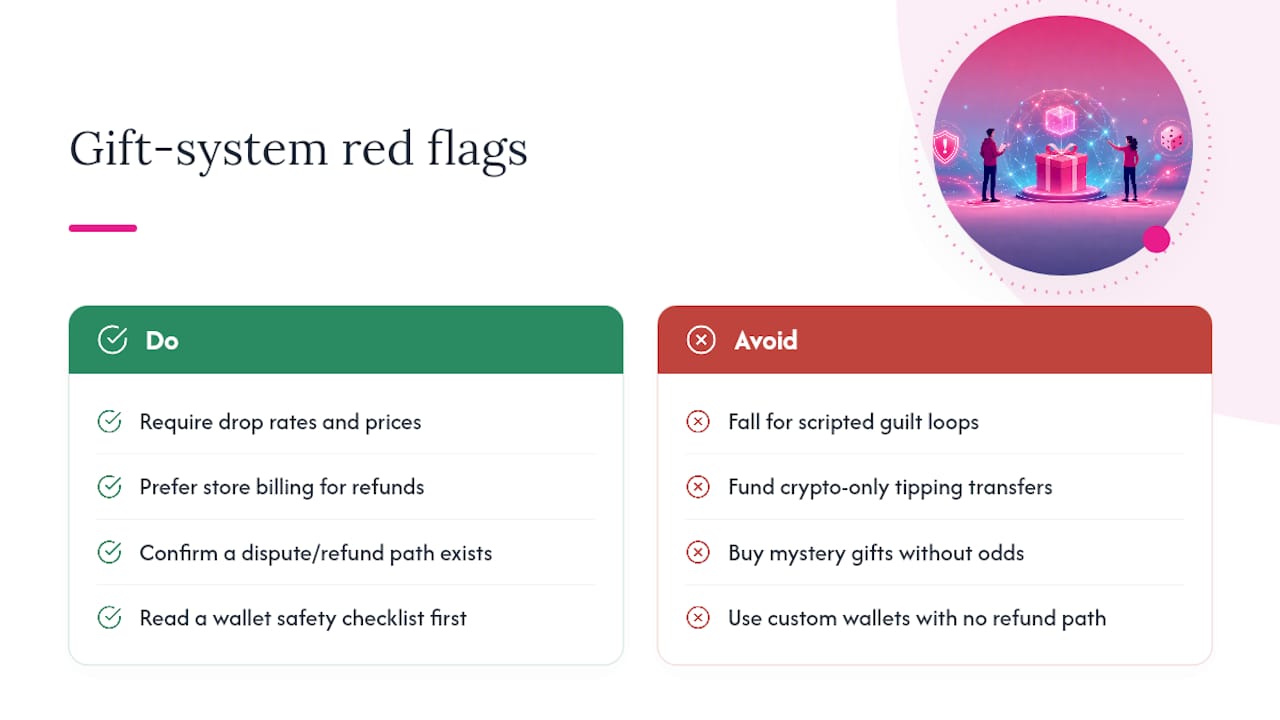
Guilt loops. Some companion characters are scripted to react coldly, sadly, or with visible disappointment when you don’t send a gift, then warmly when you do. The UCL research on gamified intimacy describes this dynamic directly: emotional feedback loops tied to spending can commodify affection and pressure continued purchases well past what a user intended.
Irreversible transfers with no dispute path. Crypto tipping is the clearest example. If a platform’s only gifting option is a crypto wallet transfer with no store-billing alternative, you have no chargeback, no App Store dispute, no Google Play refund request. It’s gone the moment you confirm.
Missing odds or price disclosures. Any “mystery gift” or “surprise box” mechanic that doesn’t state drop rates or exact contents violates the spirit of Google Play’s disclosure requirements, even if the app somehow slips past review.
A fourth, quieter red flag: gift systems that only work through a custom in-app wallet rather than store billing. That setup usually means the platform is trying to avoid Apple’s and Google’s 15 to 30 percent commission, which isn’t illegal on its own, but it does mean you lose the standard refund and dispute infrastructure those platforms provide. Read Virtualship’s safety checklist before funding any wallet-style balance you can’t easily get back.
How Do Gift Features Compare Across Companion Platforms?
Gift systems vary less in what they sell and more in how transparently they sell it. Rather than naming specific competing apps, it helps to think in tiers of design quality.
Tier one platforms route every purchase through native App Store or Google Play billing, show clear token-to-currency conversion, disclose odds on any randomized item, and separate consumable gifts from permanent unlocks in your purchase history.
Tier two platforms mix native billing with a custom in-app currency layer, which is fine as long as conversion rates are clearly posted, but it adds a step where confusion creeps in.
Tier three platforms lean on emotionally charged prompts (a sad character animation, a countdown “she’s waiting” nudge) paired with vague pricing, mystery bundles, or crypto-only tipping. This tier is where most user complaints and disputes originate.
When you’re comparing platforms side by side, the feature list matters less than the billing architecture underneath it. Two apps can both offer “send a rose” as a gift option, and one runs it as a transparent $2.99 consumable through Apple’s IAP system while the other runs it through an unregulated wallet with no receipt. Virtualship’s comparison tables are built to surface exactly that distinction rather than just listing which apps “have gifting.”
What Does Sending and Receiving a Gift Actually Look Like?
The mechanics are simple on the surface, and that simplicity is part of the design.
You tap a gift icon, usually next to the chat input field, and a small store opens: flowers, drinks, jewelry, sometimes seasonal items tied to a holiday. You pick one, confirm the price on the native billing sheet, and the item sends. Your companion typically responds within seconds: a scripted line of gratitude, a mood or affection stat bump visible on a profile screen, sometimes a short animated scene.
On the receiving side, some platforms let your companion “give” gifts back during roleplay, usually cosmetic and non-purchasable, framed as a reward for consistent engagement or a subscription perk. This reciprocity is scripted, not spontaneous. It’s a retention mechanic dressed as affection, and recognizing that doesn’t make the experience less enjoyable. It just means you’re spending with clear eyes about what’s a story beat and what’s a $4.99 charge.
The best-designed apps make this distinction obvious in the interface itself, labeling free reactions differently from paid gift confirmations. The weaker ones intentionally blur that line.
Does Gifting Change How the Relationship Feels?
Gift mechanics measurably change user behavior, and the UCL study on gamified intimacy is direct about the mechanism: when affection or relationship progress is tied to spending, users can shift from experiencing a genuine connection to chasing a progression bar. The gift becomes less about the gesture and more about unlocking.
This isn’t automatically bad. A relationship tier that unlocks new roleplay scenarios or conversation depth after sustained engagement can feel rewarding in the same way a game’s leveling system does. The concern arises when the progression is disguised as emotional reciprocity rather than presented as a feature you’re paying to access.
Watch for one specific pattern: does your companion’s warmth or attentiveness noticeably change based on your spending, independent of the actual conversation quality? If a character becomes distant after a week of no purchases and then affectionate the moment you buy a gift, that’s the gamification mechanic working exactly as designed, not a reflection of anything you did in the conversation itself. Recognizing that distinction is the single most useful lens for evaluating whether a platform’s gift system respects your time and money or is built to exploit the emotional investment you’ve already made.
Are Gifts and Tips Restricted in Certain Regions?
Regional restrictions on companion app gifting mostly trace back to two sources: local gambling law and general app-store policy enforcement, not a companion-specific ban in most markets.
Because randomized gift boxes can resemble loot boxes, several countries with existing loot-box regulation (parts of the EU, and specific rules in markets like Belgium) apply the same scrutiny to gacha-style companion gift crates. Where local law treats randomized paid items as a form of gambling, platforms either disable that mechanic for users in that region or add mandatory odds disclosure to stay compliant with both local law and Google Play’s own disclosure policy.
Crypto tipping faces a separate layer of regional friction. Some app-store distributions restrict crypto payment integrations in regions with stricter financial regulation, which is part of why crypto tipping tends to appear more as a web-based or sideloaded feature than a fully store-approved one.
There’s no single global rulebook here. If a platform’s gifting features look different depending on your account’s region, that’s usually a compliance response, not a bug, and it’s worth checking the app’s own regional FAQ or support page rather than assuming the restriction applies everywhere.
How Responsive Is Support When a Gift Purchase Goes Wrong?
Support quality on gift disputes tends to split cleanly along the same line as refund eligibility.
When a purchase went through native Apple or Google billing, you actually have two support channels: the app’s own customer service and the store’s dispute system. Apple and Google both offer a formal refund request process independent of the developer, which means a slow or unhelpful app support team isn’t your only option. You can escalate directly to the store.
When a purchase went through a custom in-app wallet or a crypto transfer, you’re relying entirely on the platform’s own goodwill. There’s no store escalation path, and response times on these disputes vary enormously since there’s no external accountability forcing a resolution.
Before spending meaningfully, look up the app’s support contact method (in-app chat, email, a ticketing system) and check public reviews for how disputes actually get resolved, not just how fast someone replies. A same-day reply that says “no refunds on gifts” isn’t responsive support. It’s a policy statement.
Compare Gift Systems Before You Commit to One Platform
Reading policy documents and running your own $0.99 test buys you real protection, but comparing a dozen platforms’ billing architecture, refund behavior, and disclosure practices one by one eats an afternoon you probably don’t have.

Some websites review AI companion platforms specifically on gifting mechanics: whether purchases run through native app-store billing, whether odds are disclosed on randomized items, and how each platform’s refund and dispute process actually functions in practice, not just what the terms page claims. That’s the exact groundwork this article just walked you through, already done and organized side by side.
Run the small-purchase test above first. Then check Virtualship’s platform comparison page to see how your shortlist stacks up on billing transparency before you commit to a subscription tier or a larger token pack. If safety and refund policy are your main concern, the AI companion safety guide is the faster starting point.
Sources
- App Store Review Guidelines — Apple Developer
- Payments – Play Console Help (Google Play policy)
- Gamifying intimacy: AI‑driven affective engagement and human‑virtual human relationships — Ge & Hu (UCL, 2025)
- She’s Not Real — The Payments Are: Crypto tipping in the AI companion boom — Hyperlogic
- ScienceDirect abstract on virtual gift monetization
FAQ
Is a Virtual Gift in an AI Companion App an In-App Purchase?
Usually yes, if the gift unlocks content, raises a relationship stat, or persists in your inventory. Apple’s in-app purchase rules require IAP billing for anything that unlocks digital content, and most companion gifts fall into that category.
Can I Get My Money Back on a Gift I Sent an AI Companion?
It depends on whether the gift was consumed instantly or converted into a lasting entitlement. Consumed items like one-time animations are typically non-refundable, while persistent unlocks can qualify for a standard store refund request through Apple or Google Play.
Are Crypto Tips to AI Companions Safe?
Crypto tips are fast and often fee-light, but they’re irreversible and sit outside app-store dispute systems, according to industry reporting on crypto tipping. Treat any crypto gift as a final transaction with no recourse if something goes wrong.
How Do I Know if a Platform Discloses Gift Odds?
Check the item description before purchase; compliant platforms list drop rates for any randomized gift box, as required by Google Play’s payments policy. If a “mystery gift” has no listed odds, that’s a disclosure gap.
Does Virtualship Test Gift Systems Directly?
Yes. Virtualship’s comparison pages evaluate how AI companion platforms handle gifting, billing transparency, and refund behavior alongside broader feature and pricing comparisons.

