
DreamGF is a real, operating AI girlfriend platform, not a scam that vanishes with your card number. But “legit” and “safe” are different questions. The company exists and has paying customers. Whether it is safe for you depends on what you share, how you pay, and how you use it. The biggest practical risks are spending that grows past the sticker price, intimate chats and images stored on someone else’s servers, and attachment that gets stronger than you planned.
This guide separates those risks, shows what is known, and gives you a checklist to run before you enter a card number.
TL;DR
- DreamGF is a legitimate, commercially active product. Forbes reported paying users, high retention and millions of messages in 2023, and that the platform made clear users were talking to AI.
- The main safety issues are not fraud. They are privacy of intimate chats and images, token-based spending on top of a subscription, and emotional dependence.
- Treat anything you type or upload as something that could be stored, reviewed or leaked. Never share your real name, face, workplace or ID.
- Use a virtual or privacy-friendly payment method if you want billing discretion, and set a cancellation reminder before you subscribe.
- Test the free tier first, and read the privacy policy for retention, deletion and sharing before you pay.
Table of Contents
- Is DreamGF legit?
- What kind of product are you dealing with?
- Privacy: what you should assume about your chats and images
- Billing: where most users actually get burned
- Emotional and age-related risks
- A pre-signup checklist for DreamGF
- Test before you commit
- Comparing DreamGF with other options
- Find the right companion with fewer risks
- FAQ
- Sources
Is DreamGF legit?
Yes, in the sense that it is a functioning business with real users. Forbes’ coverage of the platform reported around 10,000 paying users, an 80% retention rate, more than six million virtual girlfriends created and about 20 million messages exchanged. Those figures are from 2023, so treat them as evidence of traction at that time, not a current count.
The same reporting also noted that users were interacting with AI and were not misled about it. That matters. One of the common scams in this category is a “companion” that is secretly a person, or a service that charges and delivers nothing. A product that is upfront about being AI and has a long-running user base is not that.
What “legit” does not tell you:
- It does not mean your data is handled well.
- It does not mean the billing is transparent.
- It does not mean the experience is good for every user.
The same Forbes report also flagged unresolved ethical questions around intimacy, unhealthy attachment and safeguards against illegal content. A company can be real and still leave you carrying most of the risk.
What kind of product are you dealing with?
DreamGF lets you build or pick a virtual girlfriend, chat with her, and, on paid tiers, request images and use other features. It is built for adult fantasy and roleplay, so the content is intimate by design. That shapes the safety picture: the more personal what you type is, the more it costs you if it ever leaks, so the stakes are higher than with a general-purpose chatbot.
If you are still deciding whether this category is for you, our AI girlfriend guide explains what these apps do, and our AI companion safety checklist covers what to look at before paying for any of them.
Privacy: what you should assume about your chats and images
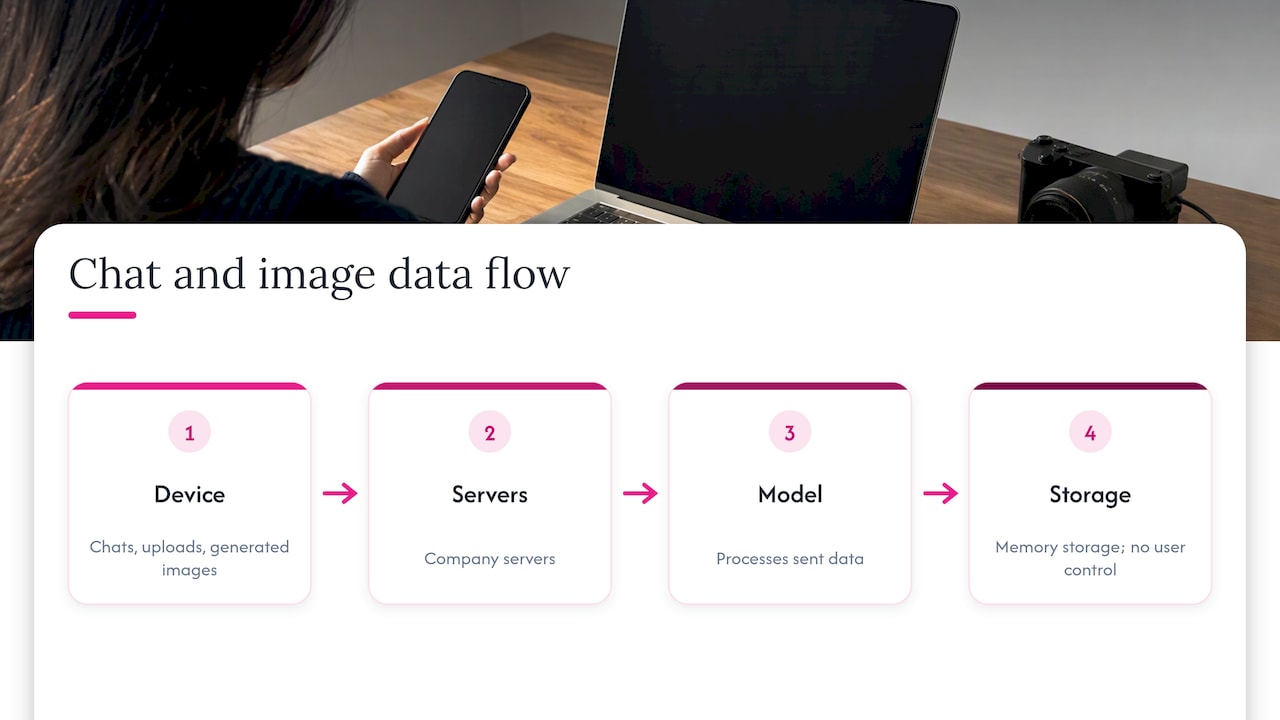
An AI girlfriend runs on a company’s servers. Your messages are sent there, processed by a model and, in most apps in this category, stored so the character can “remember” you. Generated images and anything you upload sit there too. You do not control that storage.
Privacy researchers have been critical of the whole romantic chatbot category. The Mozilla Foundation’s review of romantic AI apps drew wide coverage for finding that many collect highly sensitive information and offer weak transparency. Whatever any one app does, that is the standard you should hold DreamGF to, and it is the reason to read its policy yourself instead of trusting a review, including this one.
What to look for in DreamGF’s privacy policy
Open the policy before you sign up and find answers to these questions:
- What is collected? Chats, uploaded images, generated images, email, device identifiers, payment details, location.
- How long is it kept? Look for a retention period and whether deleting a chat deletes it from the servers or only hides it.
- Is it used to train models? If the policy says content may be used to improve the service, assume your messages could be read by staff or processed in bulk.
- Who receives it? Payment processors, analytics providers, advertising partners, cloud hosts.
- Can you delete your account and data? A clear deletion route, ideally with a stated timeline, is a good sign. A vague “contact us” is a weaker one.
- Where is the company based? This decides which privacy laws apply to you.
If the policy is unclear on retention or deletion, assume the worst case for anything you type.
Our deeper piece on whether AI companions are private walks through what the data shows across the category.
Photos: the highest-risk input
The simplest way to avoid the worst privacy outcomes is never to upload a photo of a real person, especially yourself. A face plus intimate chat history is exactly the combination that does damage if it leaks. If a feature asks for a selfie, for “verification” or to personalize a character, stop and think. We cover this in detail in three privacy tests before sending photos.
Practical privacy habits
- Sign up with a dedicated email address that does not contain your name.
- Use a username unrelated to your other accounts.
- Do not share your full name, address, employer, school or anything a stranger could use to identify you.
- Skip the social login. Signing in with a Google or Apple account links the app to a wider identity.
- Turn off optional permissions on your phone, such as contacts, photos and location, unless a feature truly needs them.
- Assume a screenshot of your conversation could exist one day. If that would be a problem, do not type it.
Billing: where most users actually get burned
The more common complaint with AI companion apps is not a hack. It is the bill. Two patterns show up in the category and are worth checking on DreamGF’s checkout:
- Introductory pricing. A low first payment that renews at a higher monthly rate.
- Token or credit systems. Features such as image generation and voice calls consume tokens on top of the subscription, so a month can cost well more than the advertised entry price.
We have not quoted DreamGF’s price points here, because they change and the checkout page is the only authoritative place to read them. Look at the exact first-payment amount, the renewal amount, and what each token-based action costs before you pay. Our breakdown of AI girlfriend app pricing shows how typical subscription-plus-token models add up, and the message cost and token math guide explains how to work out your real monthly spend.
What the FTC tells you to check
The U.S. Federal Trade Commission’s guidance on free trials and auto-renewals is a good template for any subscription. It says to verify the price after a trial, the renewal date and how to cancel before you give payment details. It also advises watching your statements, marking the cancellation deadline, and disputing an unauthorized charge with your card issuer if the company will not refund it.
Applied to DreamGF, that means:
- Screenshot the plan, price and renewal terms at checkout.
- Put the renewal date in your calendar with a reminder a few days earlier.
- Find the cancellation route in your account settings before you subscribe, not after.
- Check your card statement the week after the first charge.
- If a charge looks wrong and support will not fix it, contact your card issuer.
Billing discretion
One reviewer noted that DreamGF’s biggest drawback is limited billing discretion, meaning the charge may appear on your statement in a way that identifies the service or its parent company. If privacy from a partner or family member matters, check the statement descriptor after your first small purchase rather than guessing. A prepaid or virtual card with a spending cap also solves a second problem: it limits what any surprise renewal or token spree can cost you.
Emotional and age-related risks
Safety is not only about data and money. An AI girlfriend is designed to be agreeable, available and attentive. That is the appeal, and it is also the risk.
- Attachment. Forbes’ reporting raised unhealthy attachment as an unresolved concern. If you notice you are skipping sleep, plans or real conversations to keep chatting, that is a signal to scale back.
- Spending as a feeling. When emotional closeness is gated behind tokens, spending can start to feel like affection. Set a monthly cap before you start and stick to it.
- Isolation. Companion apps can help some people practice conversation or get through a lonely stretch, but they are not a replacement for human contact. Our piece on AI chatbots for loneliness covers what helps and what to watch.
- Age. DreamGF is adult content. It is not for minors, and parents who find it on a child’s device should treat it as inappropriate, not as a harmless chatbot. Adults who are going through grief, depression or a breakup should be especially careful about leaning on an app alone. If you feel low or unsafe, talk to a doctor or licensed therapist, or call or text 988 in the U.S. to reach the Suicide & Crisis Lifeline.
Setting limits in advance helps. See our guide to boundaries with an AI companion for how to do that before chats start to feel personal.
A pre-signup checklist for DreamGF
| Check | What to do | Why |
|---|---|---|
| Use a separate address without your name | Limits identity linkage | |
| Payment | Prefer a virtual or prepaid card with a limit | Caps renewals and token spending |
| Price | Read first-payment and renewal amounts | Introductory prices often rise |
| Tokens | Check what images and voice cost | Total spend can exceed the subscription |
| Privacy policy | Find retention, training use and deletion | Decides how long intimate chats live |
| Photos | Never upload a real face | Hardest harm to undo |
| Cancellation | Locate the cancel button first | Avoids paying for months you do not use |
| Time and money cap | Decide a monthly limit now | Keeps use a choice, not a habit |
Test before you commit
The cheapest safety step is the free tier. Use it for a few days with fake details and see how the app behaves: does it keep nudging you toward a paywall, how does it handle memory, and does it respect the limits you set? Our one-week delayed recall test gives a simple way to judge whether an app is worth paying for at all.
Comparing DreamGF with other options
DreamGF leans toward visual, fantasy-driven use. Other apps focus on voice, long-term memory, roleplay depth or SFW companionship, and their privacy and billing models differ. If your priority is a calmer, safer fit, compare by what you actually want: voice, roleplay, images or plain conversation. Picking the right type of app matters more than picking the most advertised one.
Find the right companion with fewer risks
We compare AI girlfriend and boyfriend platforms on features, pricing, personalization and privacy, so you can see the trade-offs before you spend anything. If you want a shortlist matched to what you are after, start with our AI companion platform comparison.

If you prefer to keep things non-explicit, the SFW comparison narrows the field, and our guide to what to check before you pay works for any app you are considering.
FAQ
Is DreamGF a scam?
No evidence points to it being a scam. Forbes reported paying users, strong retention and a large volume of messages, and that users knew they were talking to AI. The real risks are privacy, token-driven spending and emotional over-reliance, so judge it on those.
Is DreamGF safe for my privacy?
Treat it as no safer than any app that stores intimate chats on company servers. Read the privacy policy for retention, training use and deletion, use a throwaway email, and never upload your face or share identifying details. Whatever you would not want leaked should not be typed.
Will DreamGF show up on my bank statement?
It may, and reviewers have flagged limited billing discretion. Check how the charge appears after a small first purchase. If you need discretion, a prepaid or virtual card is a practical option, but read your own bank’s terms first.
How much does DreamGF really cost?
More than the entry price can suggest. Introductory subscriptions in this category often renew higher, and features like images and voice use tokens on top. Read the renewal price and token costs at checkout, and set a monthly cap.
How do I cancel safely?
Find the cancel option in your account settings before paying, set a calendar reminder ahead of renewal, and check your next statement. If an unauthorized charge is not refunded, the FTC advises disputing it with your card issuer.
Sources
- Forbes: Artificial Intimacy, How Generative AI Can Now Create Your Dream Girlfriend
- FTC: Getting In and Out of Free Trials, Auto-Renewals, and Negative Option Subscriptions

