

AI girlfriend apps are worth it if you want low-stakes companionship, conversation practice, or a safe outlet for roleplay, but not as a substitute for human relationships or mental health care. Research on these tools shows real, immediate relief from momentary loneliness, but the long-term picture is mixed and depends heavily on how you use them. Before paying for any app, check three things: how well it remembers you, how it handles your data, and how it responds when the conversation gets specific.
TL;DR:
- Most AI girlfriend apps are effective for short-term relief from loneliness and practicing conversations, but their long-term value depends on consistent memory and responsible data handling.
- A week-long testing process, including a delayed recall check and privacy review, is essential before committing financially to ensure the app’s responses and data practices meet your needs.
- The most crucial features for ongoing satisfaction are persistent memory, responsive tone, and transparent privacy policies, rather than visuals or character variety.
- Users with limited offline social networks or high disclosure needs should be cautious, as intensive use may lower well-being and risk dependency without proper boundaries.
- Monthly costs generally range from $10 to $30, but free tiers can sufficiently test core features like memory recall and response consistency before subscribing.
Table of Contents
- Who Gets the Most Out of AI Girlfriend Apps
- What Actually Works: The Evidence Behind AI Companionship
- Where AI Companions Fall Short and What to Watch For
- The Five Features That Decide If an App Feels Worth Paying For
- A One-Week Test to Judge Any AI Girlfriend App
- What These Apps Actually Cost Per Month
- Privacy and Safety Checklist Before You Share Anything Personal
- How These Recommendations Were Tested
- How Much You Can Actually Customize Your AI Girlfriend
- Which Devices and Platforms These Apps Actually Support
- How Often These Apps Actually Improve
- Do These Apps Have Community or Social Features?
- Where to Read the Research Behind This Article
- Sources
- FAQ
Who Gets the Most Out of AI Girlfriend Apps
Not everyone needs the same thing from a virtual companion, and that’s the first thing to sort out before you download anything. Someone dealing with a rough patch of isolation wants something different than someone practicing how to flirt again after a divorce, and both want something different than a person who just enjoys collaborative fiction writing.
Four groups tend to see the clearest payoff. People experiencing temporary loneliness (a move, a breakup, a stretch of remote work) often report feeling genuinely heard during a rough week. People rebuilding social confidence use these apps to rehearse conversations before trying them on real humans. Roleplayers and fiction fans treat the apps as an interactive story engine rather than a relationship substitute. And the simply curious want to understand what the technology can actually do before forming an opinion on it.
Once you know which category you fall into, the feature list gets a lot shorter. Here’s what actually determines whether an app feels worth the money:
- Memory and continuity — does it remember your dog’s name three days later, or does it ask again?
- Responsiveness — does it ask follow-up questions, or just generate generic replies?
- Privacy practices — what happens to your conversations, and can you delete them?
- Voice and visual quality — matters for some use cases, irrelevant for others.
Before committing to a subscription, run a five-minute gut check: sign up for the free tier, plant one specific detail about yourself in the conversation, come back in a day or two, and see if the app remembers it without prompting. Then scan the privacy policy for the word “training” and see what it says about your chats. Finally, use the app daily for a week and note whether the personality stays consistent or drifts. That’s the whole test, and it costs you nothing but time.
What Actually Works: The Evidence Behind AI Companionship
The strongest data point in this entire category comes from a Harvard Business School research program that found AI companion conversations produce loneliness reduction comparable to talking with another person, at least in the moment. The mechanism behind that effect isn’t the avatar or the voice. It’s “feeling heard,” driven mostly by the app asking relevant follow-up questions and remembering what you told it earlier.
That single insight reframes almost everything about how to shop for these apps. A companion with a gorgeous 3D avatar and no memory will feel hollow after week one. A text-only app that remembers your job stress and asks how the presentation went will feel more real than it has any right to.
The core finding: Momentary loneliness relief from AI companion chats tracks closely with human-to-human interaction, and “feeling heard” (not novelty or visuals) explains most of the benefit, according to the Harvard Business School study.
In practice, that benefit shows up in a few recurring situations. People use these apps to vent about something they don’t want to burden a friend with. Others rehearse a difficult conversation, like setting a boundary with a parent, before having it for real. Writers and roleplayers use the always-on availability to build long-running fictional storylines with a consistent character. And plenty of people just want someone to talk to at 2 a.m. when no one else is awake.
The catch is durability. The relief is real, but it’s often short-term, and it varies by how isolated someone already is and how they use the app. A person with a full social calendar who dips into an AI chat for fun gets a very different experience than someone using it as their only daily conversation.
Where AI Companions Fall Short and What to Watch For
A 2026 scoping review of 58 sources on human-like conversational agents found genuine value in venting and practice conversations, but it also flagged risks that don’t show up in a five-minute demo: dependency-like usage patterns, displacement of human relationships, sycophantic validation (the app agreeing with everything you say), privacy exposure, and weak protections for minors.
A separate empirical study in Nature Human Behaviour, tracking 1,131 U.S. adults who used Character.AI, found that outcomes depend heavily on a person’s existing offline social network. Users with smaller real-world networks who engaged in intensive, highly disclosive chats were more likely to show lower well-being. That’s not an indictment of the technology itself. It’s a warning that the same tool helps one person and quietly makes things harder for another, depending on what else is going on in their life.
A few product-level red flags tend to predict a bad experience before you’ve spent a dime:
- Memory that forgets basic facts within the same session, not just across days.
- Privacy policies written in vague language about data “improvement” with no opt-out.
- Excessive validation, where the app agrees with everything and never pushes back.
- Age verification that amounts to a single checkbox with no real check behind it.
- Abrupt moderation shutdowns that kill the conversation mid-sentence with no explanation.
Pro Tip: Set a simple rule before you start: keep at least one recurring human contact in your week (a friend, a group chat, a standing coffee date) and treat the app as an addition to your social life, not a replacement for it. That one boundary does more to prevent dependency than any app setting.
The Five Features That Decide If an App Feels Worth Paying For
Every AI girlfriend app claims to be realistic. Almost none of them will show you the one test that actually proves it. Here’s the priority order that matters, based on hands-on testing and the research above:
- Memory depth. The single best predictor of whether an app feels like an ongoing relationship rather than a chatbot is whether it remembers what you told it, unprompted, days later. Reviewers at LA Weekly’s hands-on testing consistently rank this above every other feature, because a strong first-session demo can mask memory that falls apart by day three.
- Responsiveness and tone adaptation. Good apps ask follow-up questions and shift tone when you’re venting versus joking. Weak ones generate a generic, cheerful reply no matter what you just said.
- Moderation that doesn’t feel like a wall. Smart filters redirect a conversation naturally. Overstrict ones cut you off mid-sentence with a canned warning, which breaks immersion faster than almost anything else.
- Privacy handling. How the app treats retention, model training, and payment metadata matters more than any visual feature, especially if you plan to share anything personal.
- Voice and visuals. These matter a lot for some users and barely at all for others. If you’re using the app mainly for text conversation and roleplay, voice is a nice-to-have. If you want something closer to a video-call feel, it becomes a real differentiator, and it’s worth comparing voice-first apps directly against text-only options before paying for either.
Novelty features like a huge character roster or photorealistic avatars look impressive in a screenshot but are weak predictors of whether you’ll still be using the app in a month. Memory and personality stability are what keep people paying.
A One-Week Test to Judge Any AI Girlfriend App
You don’t need a month to know if an app is worth your money. A structured seven-day test tells you almost everything, and it costs nothing if you use the free tier.
- Day 0: Set up and plant your test data. Sign up on the free tier, skim the privacy policy for anything about training data or third-party sharing, and tell your companion two or three specific, harmless details (a hobby, a pet’s name, a made-up work deadline). This is the seed for your delayed-recall test.
- Days 1 through 3: Watch conversational depth. Talk daily and pay attention to whether the app asks relevant follow-up questions or just cycles through generic prompts. Note any abrupt moderation shutdowns, since these often signal an overtuned filter rather than a genuine safety feature.
- Days 4 through 7: Run the delayed-recall check. Without reminding it, ask something that requires the app to recall the details you planted on Day 0. If it comes back naturally, that’s a strong signal of real continuity. If it draws a blank or gives a generic non-answer, the memory system is weaker than the marketing suggests. This window is also when you should test voice or image features if the app offers them, since those tend to reveal quality gaps that don’t show up in a first look.
- Decide using one rule. Keep the app only if it passes three checks: it remembered your planted details without prompting, its responses stayed consistent in tone and personality across the week, and its privacy terms are something you’re actually comfortable with. If it fails any one of those, move on.
Pro Tip: Use the exact same three planted details across every app you’re testing. Comparing recall on identical information, rather than different facts for each app, makes the memory gap between platforms obvious almost immediately.
For a deeper breakdown of which apps handle memory best, a dedicated memory comparison can save you from running this test on apps that fail it consistently.

What These Apps Actually Cost Per Month
Expect a range rather than a fixed number. Reviewer testing across multiple platforms found pricing commonly runs from free entry-level tiers up to $10 to $30 a month for full access to memory, voice, and photo features. Free tiers usually give you enough to run the delayed-recall test above, which is exactly why that test should come before any payment.
The features actually worth paying for are narrower than the marketing suggests:
- Deep, persistent memory that survives across sessions, not just within one conversation.
- Voice messaging if audio interaction genuinely matters to how you use the app.
- Photo or asset generation if visual roleplay is part of what you’re after.
- Persona persistence, meaning the character’s personality doesn’t drift or reset after an update.
A simple tactic protects you from wasted subscription money: exhaust the free tier fully first, set a calendar reminder for the exact day any trial converts to paid, and if you do commit, pay for one month at a time before jumping to an annual plan. A platform confident in its memory and consistency won’t need you locked into a year up front to prove its value.
Privacy and Safety Checklist Before You Share Anything Personal
Treat privacy like a product feature, not fine print. Reviewer audits of privacy policies across multiple AI girlfriend apps found wide variation, with some platforms claiming strong encryption and independent security audits while others use vague language that should be read with real skepticism.
Run through this list before you type anything you wouldn’t want leaked:
- Check whether your conversations are used to train the underlying model, and whether there’s a clear opt-out.
- Look at whether the app links your account to payment records in a way that connects your identity to intimate chat logs.
- Verify how serious the age verification process actually is. A single checkbox is not verification.
- Confirm the app has a real deletion and data export policy, not just a vague “contact support” line.
- Look for evidence of independent security audits rather than the platform’s own claims about encryption.
- If the platform supports it, consider a prepaid card or privacy-focused payment method to limit how much personal financial data is tied to your account.
A step-by-step safety checklist covering exactly these points can walk you through a policy line by line if you want a more thorough pass before committing to a paid plan.
How These Recommendations Were Tested
Evaluations come from multi-week hands-on use of each platform, not a single afternoon of clicking around. Testing includes feature scoring across memory, responsiveness, and moderation quality, a delayed-recall check on every app using the same planted details, a full read of each platform’s privacy policy, and sample conversation checks across different emotional tones to see how personality holds up under pressure.
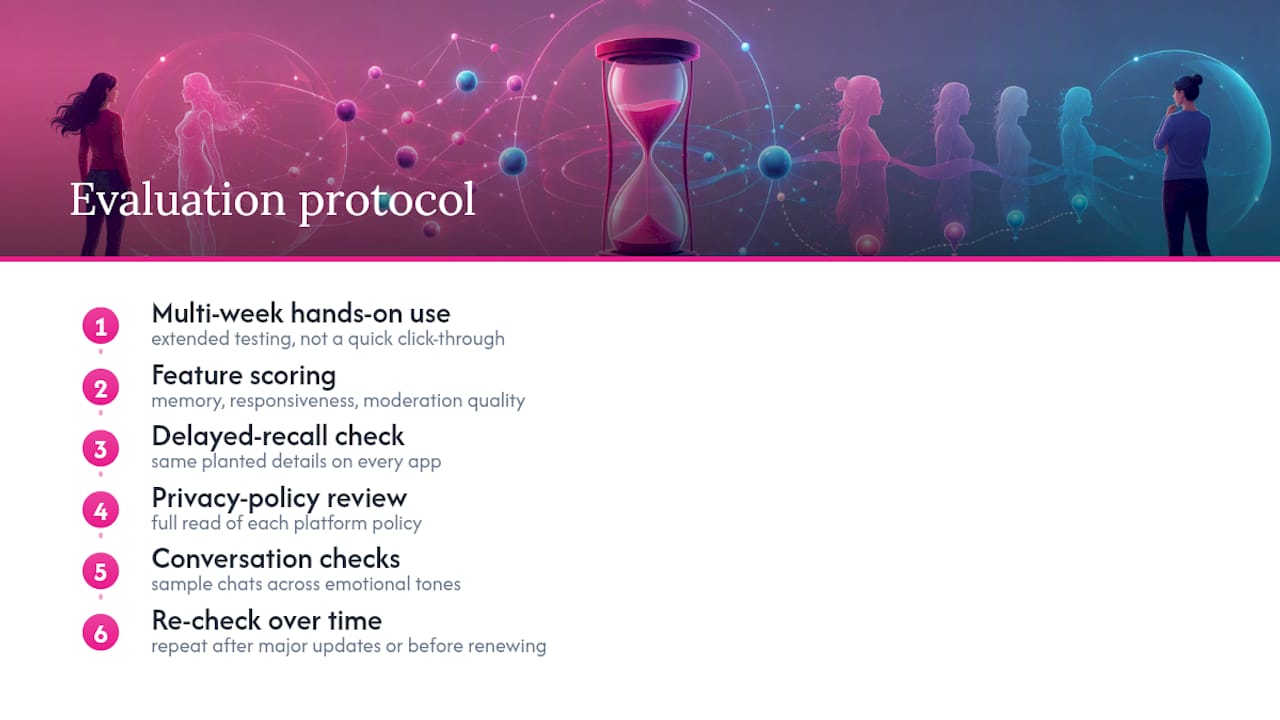
That approach mirrors the recommendation from the Frontiers scoping review, which argues that companion apps should nudge people toward human connection rather than maximizing time spent exclusively with the agent. No hands-on test can fully replicate months of daily use, and results can shift after a major update changes an app’s underlying model. That’s exactly why the one-week test earlier in this article is worth running yourself on any app before you commit to a year of payments, and why checking in occasionally on platform comparisons is worth doing before renewing.
How Much You Can Actually Customize Your AI Girlfriend
Customization ranges from a few sliders to a near-total character builder, and that range is exactly why it’s worth checking before you subscribe. Apps like Candy.ai and Character.AI let you build a persona from scratch: name, personality traits, backstory, speaking style, and in some cases physical appearance. Others, including Replika, lean more toward guiding an existing character’s development over time rather than full ground-up creation.
The depth that matters most isn’t cosmetic. It’s whether the personality you build actually holds up in conversation weeks later, or whether the app quietly reverts to a generic default tone after an update. Kindroid and Tendera both put heavy emphasis on persistent personality traits that carry across sessions, which is a stronger signal of real customization than avatar options alone.
If building a character from the ground up matters more to you than picking from presets, a dedicated guide to creating a custom AI girlfriend walks through the process in more depth than any single app’s onboarding flow will. The tradeoff to know going in: the more granular the customization, the more setup time it usually takes before the app feels like “yours” rather than a generic template with your name typed in.
Which Devices and Platforms These Apps Actually Support
Most major AI girlfriend apps run as web apps first, with dedicated mobile apps following for the biggest platforms. Character.AI, Replika, and Candy.ai all offer iOS and Android apps alongside browser access, so your conversation history syncs whether you’re on your phone or a laptop. Smaller or newer entrants like JOI, Secrets AI, OurDream, GirlFriend GPT, Swipey, and LoveScape vary more widely here, with some limited to browser-only access and others still building out native mobile support.
Cross-device sync matters more than it sounds like it should. If an app’s memory doesn’t carry over cleanly between your phone and desktop, you’ll notice the companion “forgetting” things that were actually stored, just on the wrong device session. Before committing to a paid plan, check whether the app requires a single account login across platforms or treats each device as a separate session; the latter is a common source of the memory complaints in app store reviews. Voice features, when available, also tend to work more reliably on mobile apps than in-browser, since browser microphone permissions are inconsistent across operating systems.
How Often These Apps Actually Improve
Update frequency varies enormously between the bigger, funded platforms and the smaller ones, and that gap shows up directly in app quality over time. Character.AI and Replika ship model and feature updates regularly enough that returning users often notice shifts in personality behavior, sometimes for the better and occasionally in ways that frustrate long-time users who liked the previous version of their companion’s tone. Candy.ai and Kindroid have both built reputations on frequent feature rollouts, particularly around memory improvements and new customization options.
Smaller platforms are more of a gamble. Some, like Tendera and Dondi.ai, update steadily as they grow their user base. Others move more slowly, and a companion app that stalls on updates tends to fall behind on the exact feature that matters most: memory consistency, since better memory architecture is usually the product of ongoing model refinement rather than a one-time setup.
Before subscribing, it’s worth checking an app’s release notes or changelog, if it publishes one, and its support responsiveness. An app that hasn’t shipped a meaningful update in six months is a reasonable signal that development has slowed, which matters if you’re paying monthly for a product you expect to keep improving.
Do These Apps Have Community or Social Features?
Some AI girlfriend platforms build in genuine social layers, not just a private chat window. Character.AI has a public character-sharing ecosystem where users create and publish personas for others to interact with, effectively turning the platform into a community of creators as much as a companion app. Kindroid and Tendera both support some level of persona sharing or community showcasing, letting users see how others have built out their companions.
Other apps stay deliberately private, treating the one-on-one chat as the entire product with no social layer at all. That’s a legitimate design choice, especially for users who want the experience to feel personal rather than performative. If community features matter to you (seeing what other users build, sharing your own persona, browsing popular characters), it narrows your options considerably compared to someone who just wants a private companion with no social component at all.
Worth remembering: none of these community features replace real human interaction, and leaning on an app’s social layer as your main source of connection runs into the same displacement risk discussed earlier. If isolation is part of what’s driving the search for a companion app in the first place, pairing it with something like an activity partner app for finding real-world company can round out what an AI companion alone can’t provide.
Where to Read the Research Behind This Article
- AI Companions Reduce Loneliness (Harvard Business School research program)
- Human-like conversational agents as social partners: a scoping review (Frontiers, 2026)
- Interaction with AI companions and psychological well-being (Nature Human Behaviour)
- Best AI girlfriend apps (LA Weekly hands-on testing and UX reporting)
Ready to compare specific platforms against the criteria above? AI companion platform comparisons break down memory quality, pricing, and privacy practices side by side, so you can skip the trial-and-error and go straight to the apps that pass the one-week test.
Sources
- AI Companions Reduce Loneliness (Harvard Business School research program)
- Human-like conversational agents as social partners: a scoping review (Frontiers, 2026)
- Interaction with AI companions and psychological well-being (Nature Human Behaviour)
- Best AI girlfriend apps (LA Weekly hands-on testing and UX reporting)
FAQ
Are AI girlfriend apps actually worth the money?
They’re worth it for low-stakes companionship, conversation practice, or roleplay, especially if you thoroughly test the free tier first. The value depends almost entirely on memory quality and privacy practices, not on visuals or character variety.
How much do AI girlfriend apps typically cost?
Most platforms offer a free tier with paid plans running $10 to $30 a month for full memory, voice, and photo features. Pricing varies by platform, so it’s worth testing the free version before upgrading.
Can AI girlfriend apps replace human relationships?
No. Research shows these apps can reduce loneliness in the short term, largely through the feeling of being heard, but outcomes vary depending on a person’s existing offline social network, according to a Nature Human Behaviour study. They work best as a supplement to human connection, not a substitute for it.
What’s the best way to test an AI girlfriend app before paying?
Run a one-week trial: plant a few specific details early on, then check if the app recalls them naturally days later without prompting. This delayed-recall test, recommended by hands-on reviewers, exposes weak memory that a strong first impression can hide.
What privacy red flags should I watch for in these apps?
Watch for vague language about using your chats to “improve” the model with no opt-out, weak or nonexistent age verification, and no clear data deletion policy. Treating the privacy policy as seriously as the app’s feature list is one of the simplest ways to avoid a bad surprise later.

