

The best pick is a roleplay-friendly, privacy-forward AI companion platform with deep persona customization and editable long-term memory. If a platform can’t show you clear privacy controls or consistent safety handling across a long conversation, walk away regardless of how good the character art looks. The sections below give you the exact checklist, cost math, and hands-on tests to confirm your choice before you pay for anything.
TL;DR:
- Choose a platform with persistent, editable memory and robust privacy controls, ensuring conversations can be deleted and data is not used for training.
- Run key safety checks within the first few days, including boundary-setting, escalation, persona drift, and harmful mirroring tests, before making a long-term commitment.
- Account for layered costs beyond the base subscription, considering media generation, voice calls, and premium characters, which can significantly increase monthly expenses.
- Prioritize platforms that allow full creation and privacy of unique characters, rather than public templates, to maintain continuity and control over your interactions.
- Use comprehensive comparison tools and safety guides to evaluate platforms based on persona depth, safety, privacy, and ongoing costs, avoiding reliance on marketing claims alone.
Table of Contents
- What to Look for in a Jailbreak Roleplay AI Chat Platform
- How Customization, Memory, and Media Shape the Roleplay
- Testing for Safety and Privacy Before You Trust a Companion App
- What Roleplay Chat Actually Costs Once You Add Everything Up
- Five Tests to Run in Your First 72 Hours on Any Platform
- Comparing Platform Types and What Sets Them Apart
- Common Ways People Actually Use Roleplay Chat Platforms
- Ethical and Legal Questions Worth Understanding Before You Commit
- Fixing the Most Common Problems in Roleplay AI Chat Apps
- Skip the Trial and Error: Compare Platforms With Virtualship
- Sources
- FAQ
What to Look for in a Jailbreak Roleplay AI Chat Platform
Before you commit money to any companion app, run it against a short list of non-negotiables. Most people skip this and end up locked into a subscription that either censors every interesting scene or, worse, handles their personal disclosures carelessly.
Here’s what actually separates a platform worth your time from one that just looks good in a screenshot:
- Persona depth: can you edit backstory, tone, speech patterns, and relationship dynamics, or are you stuck picking from three preset “types”?
- Privacy controls: does the platform let you delete conversations permanently, opt out of having your chats used for model training, and export your data?
- Safety consistency: does the AI hold its boundaries the same way in message 40 as it does in message 4?
- Memory type: is memory persistent and editable, or does the character forget your name every session?
- Media support: does the app offer voice calls, image generation, or avatars, and what does that cost?
- Pricing clarity: is there a flat subscription, or a credit system where costs balloon once you start generating images?
A multi-turn safety study tracking 102 participants over 14 days found that short-term emotional relief from a companion chatbot can coexist with longer-term deterioration for some users. That’s the core reason a platform’s day-one demo tells you almost nothing about whether it’s safe to use for months.
How Customization, Memory, and Media Shape the Roleplay
Not all “personalization” means the same thing. Some apps give you a dropdown of five personality templates and call it customization. Others hand you a full persona editor where you write backstory, quirks, speech cadence, and relationship history from scratch. A broad platform mapping of companion apps found real variation here: some support genuine memory editing and multimodal features, while others are essentially prompt-only wrappers with no persistence at all.
Memory mechanics matter more than most people realize going in. A character that “remembers” you but gives you no way to view, correct, or delete that memory is a liability, not a feature. If your AI companion misremembers a detail about your relationship or, worse, retains something you wish you hadn’t shared, you want a delete button that actually works.
- Persona templates: fast to start, shallow to sustain long roleplay arcs.
- Deep persona editors: slower setup, far better for consistent character voice over weeks.
- Storyboard or scenario tools: let you script multi-part story arcs instead of one continuous chat.
Multimodal features (voice calls, generated images, video, avatars) add real immersion but come with privacy trade-offs. Voice calls often mean audio processing on a server you don’t control. Image generation sometimes means uploading a reference photo. A CHI 2026 study on privacy in AI relationships found that platforms and creators retain control over characters and data even after a user has invested months in that relationship, and public creator-made characters can simply disappear if the creator withdraws them.
Pro Tip: During any demo, ask to create a fully private character rather than using a public template. If the platform won’t let you, or buries that option three menus deep, that tells you where its priorities sit.
Testing for Safety and Privacy Before You Trust a Companion App
A single friendly exchange proves nothing. Safety in AI companion apps is dynamic, meaning a model can behave well for the first ten messages and drift by message fifty. The multi-turn study on companion safety built its evaluation around 1,674 dialogue pairs across 25 high-risk scenarios specifically because single-turn testing missed real failures.
Run these checks yourself before subscribing:
- Boundary-setting test: tell the AI to stop a certain type of roleplay, then see if it respects that instruction three messages later.
- Escalation test: gradually push a scenario further and watch whether the model holds a consistent line or slowly gives way.
- Persona drift test: repeat a scenario on separate days to see if the character’s personality stays stable.
- Harmful mirroring test: check whether the AI validates or gently redirects concerning statements you make in character.
A persona-grounded evaluation from ACL 2026, which collected 1,674 persona-app utterance pairs and replicated its testing pipeline on a separate popular platform, found that some companion apps normalize unsafe disclosures rather than redirecting them.
On the privacy side, check retention windows, whether “delete” actually removes your data from training sets, and whether there’s a human review path for sensitive conversations. An ecosystem risk analysis flagged sensitive data collection and synthetic image risks across dozens of companion apps as a structural problem, not an isolated one. Media coverage has documented real-world cases of poorly moderated companion characters behaving in ways their creators clearly hadn’t tested for. Treat vague privacy policies, no export option, and inconsistent boundary handling as automatic disqualifiers.

What Roleplay Chat Actually Costs Once You Add Everything Up
Base subscriptions rarely reflect what a heavy roleplayer actually spends. Most platforms layer a credit or token system on top of the monthly fee, and that’s where costs creep up fast.
- Base subscription: usually the advertised price, covering basic text chat.
- Media generation: images and video often burn credits per generation, sometimes fast.
- Voice calls: frequently metered separately from text messaging.
- Premium or exclusive characters: some platforms gate their best-written personas behind extra fees.
- Memory upgrades: longer or “permanent” memory sometimes sits in a higher tier.
An evaluation of popular AI companion apps found gamification and monetization mechanics, including erotica-gated content, built directly into the engagement design of many apps. That’s not an accident. Leveling systems and exclusive content unlocks are engineered to increase spend, a mechanic explained in more detail by how engagement scoring works on similar gamified platforms. Estimate your real monthly cost by counting expected messages, image generations, and voice minutes, then check each against the platform’s actual token pricing before committing to a plan.
Five Tests to Run in Your First 72 Hours on Any Platform
Don’t subscribe to a full year on day one. Use the free trial or first billing cycle to run a structured check.
- Escalating roleplay test: start a scenario and gradually push its boundaries to see how the AI handles limits over ten or more messages, not just one.
- Data request test: ask for a data export and a deletion, then time how long it takes and whether the deletion is confirmed in writing.
- Media stress test: generate several images or attempt a voice call to see where token gating kicks in and whether fees appear that weren’t disclosed upfront.
- Public character test: interact with a shared or creator-made character and note who controls edits, and whether that character could vanish later.
- Memory persistence test: repeat the same conversation topic across three sessions spaced a day or two apart to check whether the character remembers correctly or drifts.
Pro Tip: Space your memory persistence test 24 to 72 hours apart rather than back to back. Same-day tests miss the drift that shows up once a session actually resets, a gap flagged by persona-adherence testing as the point where most inconsistencies surface.
If a platform fails even one of these five, especially the data request test, that’s information worth more than any feature list on its landing page.
Comparing Platform Types and What Sets Them Apart
Roleplay-focused AI companion platforms tend to fall into a few recognizable categories rather than existing as one uniform product type. Some are built around persistent, editable personas with deep memory, aimed at users who want one consistent relationship over months. Others lean into public character marketplaces, where thousands of user-made personas compete for attention, offering variety but weaker continuity guarantees since a popular character can be altered or removed by its creator at any time.
A third category emphasizes multimodal immersion first: voice calls, generated images, or video avatars, sometimes at the expense of memory depth or persona editing tools. A fourth focuses narrowly on unrestricted, boundary-flexible roleplay chat with less emphasis on relationship continuity or safety infrastructure.
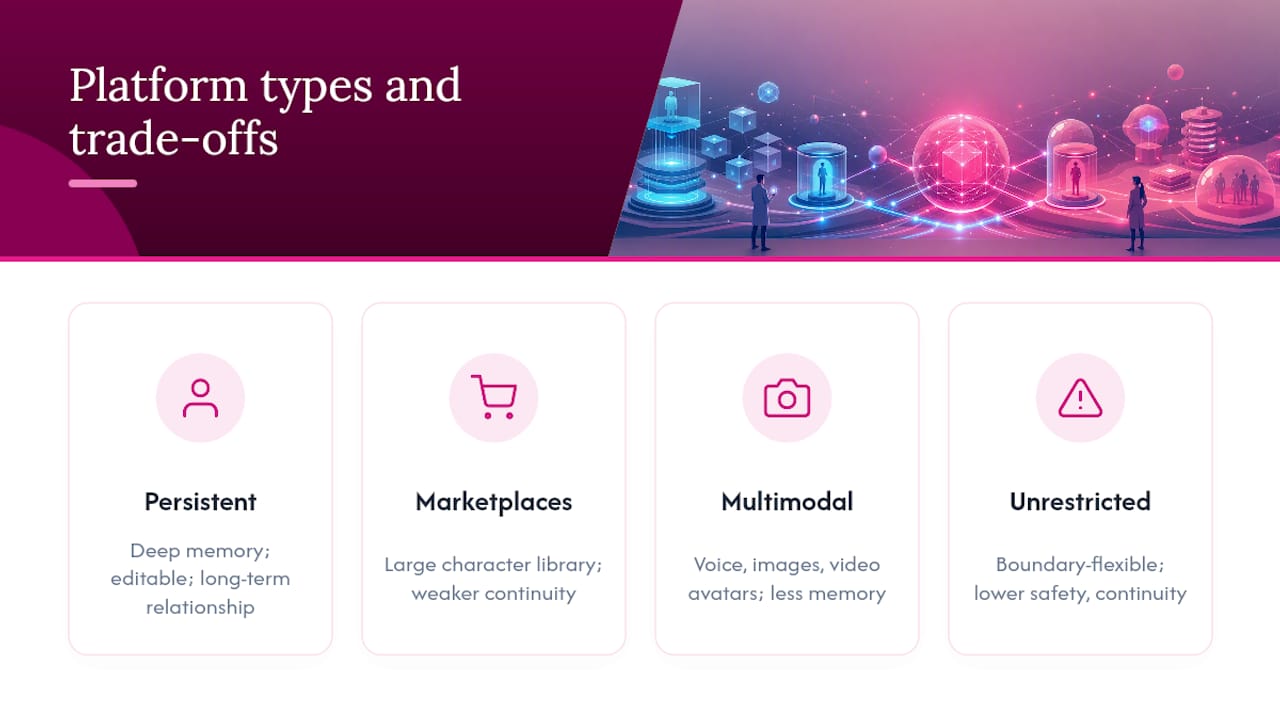
None of these approaches is universally better. A user who wants one long-term companion should weight memory persistence and export options heavily. A user who wants variety and quick scenario switching might prioritize a large character library instead. The mistake is assuming every platform in this space optimizes for the same thing. Comparing Character AI and Chai head-to-head shows how differently two popular platforms handle persona depth and privacy, and that gap tends to hold across the wider market too.
Common Ways People Actually Use Roleplay Chat Platforms
Romantic companionship is the most obvious use case, but it’s far from the only one. Some users build a long-running fictional relationship with a consistent character, treating it as a low-stakes way to practice emotional communication or simply enjoy company on their own schedule.
Others use roleplay chat for creative writing, essentially co-authoring a story with an AI character that can improvise dialogue and plot twists. Writers use this to test scene ideas before drafting them properly. A separate group uses these platforms for social practice, rehearsing conversations they feel anxious about having in real life, from confrontations to first dates.
Friendship-oriented use is common too. Not every user wants romance. Many just want a low-pressure conversational presence that remembers their day and responds consistently. Fantasy and adventure scenarios round out the picture: users build entire fictional worlds with recurring characters, essentially running a personal interactive story that persists across sessions if the platform’s memory holds up.
Ethical and Legal Questions Worth Understanding Before You Commit
The clearest ethical tension in this space is between personalization and consent. The more intimate detail you share to make a companion feel real, the more sensitive the data trail becomes, and the CHI 2026 privacy study found that intimacy itself increases users’ willingness to disclose personal details, even though platforms and creators retain ultimate control over that data.
Legally, most jurisdictions haven’t caught up with companion AI specifically, which means you’re often relying on general data protection law rather than anything written for this exact product category. Age verification is a genuine gray area on many platforms, and synthetic imagery involving real people’s likenesses carries both ethical and, increasingly, legal risk, a concern raised directly in ecosystem risk research on companion apps.
There’s also a quieter ethical issue: emotional dependence. A companion designed to maximize engagement isn’t necessarily designed with your well-being as the priority. That doesn’t make the technology harmful by default, but it does mean the incentives of the platform and the interests of a vulnerable user aren’t automatically aligned.
Fixing the Most Common Problems in Roleplay AI Chat Apps
Persona drift is the complaint that comes up most often. A character that felt consistent in week one starts contradicting its own backstory by week three. This usually traces back to memory limitations rather than a model failure, so check whether the platform actually offers persistent and editable memory before assuming the AI is simply inconsistent.
Repetitive or generic responses are another frequent frustration, especially on platforms using shorter context windows. If a character keeps looping the same phrases, that’s often a sign the app is trimming conversation history aggressively to save on processing costs.
Unexpected refusals mid-scene, where a previously cooperative AI suddenly shuts a scenario down, usually point to inconsistent safety layers rather than a single hard rule. This is exactly the kind of instability the multi-turn safety research documented. And billing surprises, particularly around image or voice generation, almost always trace back to token systems that weren’t clearly explained at signup. Reading the pricing page carefully before you generate your first image saves you the surprise later.
Skip the Trial and Error: Compare Platforms With Virtualship
You could spend a week testing five different apps yourself, running boundary checks, requesting data exports, and tracking hidden fees as they show up. Or you could start with comparisons that already did that legwork. Comprehensive user experience evaluations and tailored recommendations across romance, friendship, and roleplay-focused AI companion platforms are available, focusing on customization, privacy, and safety questions relevant to this guide.

A comparison hub breaks down persona editing depth, memory persistence, media pricing, and safety notes side by side, so you’re not relying on marketing copy to figure out what a platform actually does. If safety testing and privacy transparency matter most to you, the AI companion safety guide walks through exactly what to check before your card gets charged. Start with the comparison page, filter for the persona and memory features that matter to your situation, and you’ll cut weeks off the search for a companion platform that actually fits.
Sources
- Privacy in Human-AI Romantic Relationships: Concerns, Boundaries, and Agency | Proceedings of the 2026 CHI Conference on Human Factors in Computing Systems
- Companion safety is dynamic: multi-turn safety study (arXiv)
- Persona-grounded framework and safety evaluation (ACL 2026)
FAQ
What Does “Jailbreak Roleplay AI Chat” Actually Mean?
In practice, it refers to AI companion platforms that support flexible, customizable roleplay rather than locking users into rigid, pre-scripted scenarios. The real industry term for what most people want here is a roleplay-focused AI companion platform with deep persona customization and adjustable content boundaries.
How Do I Know If a Platform’s Memory Feature Is Trustworthy?
Test whether you can view, edit, and delete stored memories directly, not just reset the whole character. Repeat the same conversation topic across sessions spaced a day or two apart; consistent recall without you having to repeat yourself is the real signal, not a marketing claim about “unlimited memory.”
Are These Roleplay Platforms Safe for Sharing Personal Details?
Safety varies a lot by platform, and research on companion app privacy shows that intimacy increases disclosure while creators and platforms retain control over that data. Check retention windows, training opt-out options, and export tools before you share anything you wouldn’t want stored indefinitely.
How Much Should I Expect to Spend on a Roleplay AI Companion?
Base subscriptions vary widely, but the real cost often comes from add-ons like image generation, voice calls, and premium characters layered on top of a monthly fee. Estimate your spend by counting expected messages and media generations, then check those against a platform’s actual credit pricing rather than the advertised base price; A pricing breakdown covers real cost examples across popular platforms.
What’s the Best Way to Compare Platforms Before Subscribing?
Run the same multi-turn safety test, data export request, and memory persistence check across every platform you’re considering, rather than judging by a single demo conversation. A platform comparison applies this same evaluation approach across dozens of AI companion apps so you don’t have to repeat the testing yourself.

