

Credits are a per-use currency apps charge to meter resource-heavy features like images, voice clips, and advanced model runs. A cheap-looking monthly plan can cost far more once you factor in credits, especially if you send photos or use voice regularly. The rest of this piece breaks down how credits are calculated, what real packs cost, and how to keep your bill under control.
TL;DR:
- Spending habits such as generating multiple images or voice messages weekly can significantly increase total costs beyond basic subscription fees.
- Most credit systems use multipliers that vary depending on model complexity, context length, and task type, affecting the actual charges for similar requests.
- To control expenses, users should track their credit consumption weekly and choose providers with transparent per-action pricing and clear usage dashboards.
- Buying larger credit packs often reduces the per-credit cost, but trial periods are recommended to estimate actual usage before committing to bigger purchases.
- Beware of apps that do not clearly explain credit multipliers or hide per-request costs, as these practices can lead to unexpected and inflated charges.
Table of Contents
- What Are AI Companion Credits, and How Do They Differ From Tokens?
- Why Are AI Companion Apps Switching to Credit Pricing?
- How Are Credits Calculated and Charged?
- What Do Real AI Companion Subscriptions and Credit Packs Cost?
- How Do You Avoid Overpaying for AI Companion Credits?
- How Virtualship Breaks Down Credit Systems for You
- Where to Verify Credit Rules Yourself
- Sources
- FAQ
What Are AI Companion Credits, and How Do They Differ From Tokens?
A credit is a billing unit, not the same thing as a raw model token. Vendors measure the actual computing work behind a request (tokens processed, image resolution, voice length) and convert that into credits using an internal formula, which the ONES Assistant documentation describes as varying by context length, number of steps, and which model handles the task.
Subscription-included credits usually reset every month and don’t roll over. Purchased credits work differently: they accumulate in your account, typically don’t expire on a monthly cycle, and are usually nonrefundable once bought.
Here’s what tends to draw down your credit balance versus what stays free on most plans:
- Usually costs credits: AI-generated images, voice messages or calls, video clips, and “deep” or extended-reasoning responses.
- Usually included free in a subscription: basic text chat, standard response length, and memory of past conversations.
Knowing which bucket a feature falls into before you tap it is the single biggest lever you have over your bill.
Why Are AI Companion Apps Switching to Credit Pricing?
Running an image generator or a voice model costs a provider far more per request than running a basic chat model. Flat subscriptions forced companies to price for their heaviest users, which meant light users were subsidizing people who generated dozens of photos a day. Credits let providers charge closer to actual cost, and industry reporting frames this shift as a direct response to rising compute costs tied to media generation and more capable models.
There’s a fairness argument buried in there. Someone who only texts their companion a few times a day shouldn’t pay the same as someone who generates fifty portraits a week. But the tradeoff cuts the other way for the reader: the predictable “$12 a month covers everything” feeling disappears the moment you start seeing line items. Reporting on compute costs and pricing changes also notes that consumer advocates have flagged marketing language that makes “unlimited” tiers sound broader than the fine print actually allows.
How Are Credits Calculated and Charged?
Most systems apply a model multiplier. A basic chat response might cost a small, flat number of credits, while a request routed to a more advanced or “premium” model gets multiplied several times over before it’s deducted from your balance. Two nearly identical questions can cost different amounts if one triggers a longer context window or a multi-step reasoning process.
Provider documentation gives a useful sense of scale here. The ONES Assistant guide publishes sample ranges: a quick question might run 10 to 30 credits, while a deep analysis task can run 100 to 400 credits, depending on complexity.
Typical charging order looks like this:
- Your monthly subscription allowance gets used first, if you have one.
- Once that’s exhausted, the system pulls from purchased or pooled credits.
- Unused subscription credits usually vanish at the reset date; purchased credits often carry over.
Pro Tip: Check whether your app charges the “advanced” model rate by default. Some companions default to a premium model for every reply unless you manually switch to a lighter one, quietly burning credits faster than you’d expect.
What Do Real AI Companion Subscriptions and Credit Packs Cost?
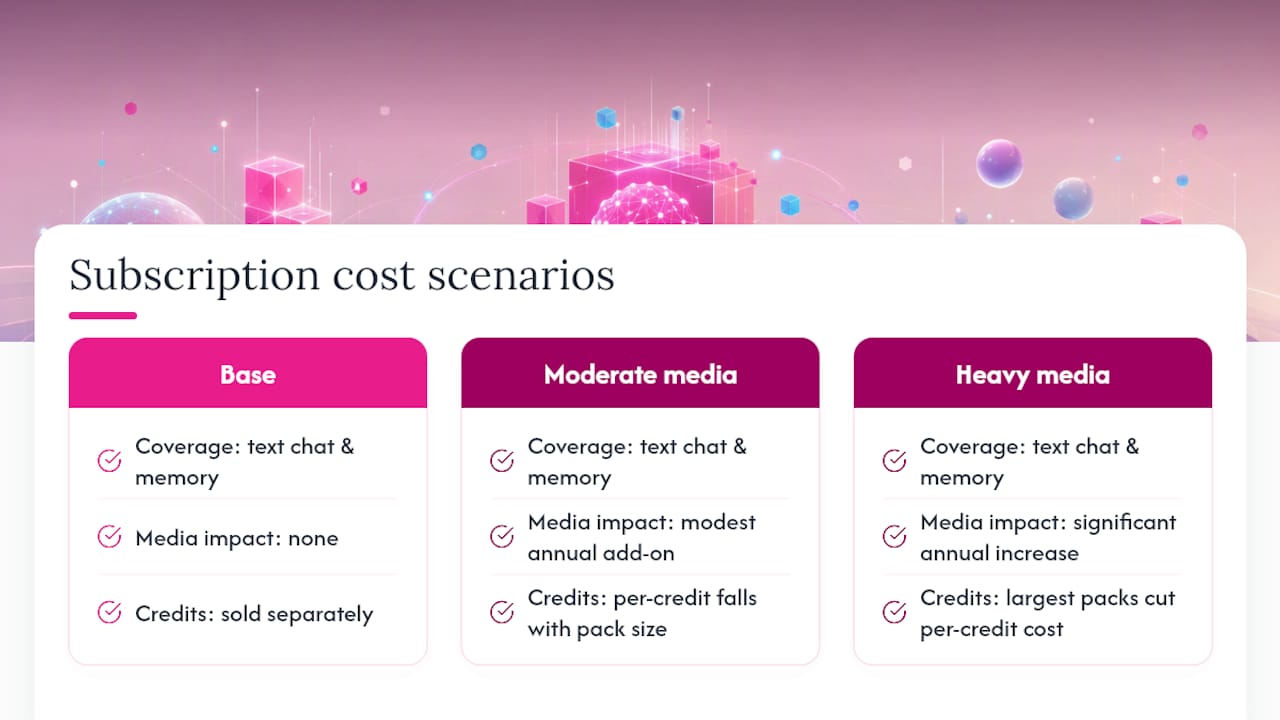
Base subscriptions for mainstream AI companion apps mostly cluster in a predictable range. According to a comparative pricing guide covering major AI companion apps, most paid tiers fall within a range that generally covers text chat and memory, excluding media generation.
Credit packs are sold on top of that, and the per-credit price usually drops as pack size grows. Pricing pages aggregated by guides covering apps like Nomi AI show this pattern clearly: buying the largest available pack can cut your cost per credit significantly compared to the smallest one.
Here’s how the math tends to play out across usage types:
Moderate media use may add a modest annual amount on top of the base subscription, while heavy media users can see their effective annual cost increase significantly compared to the base subscription alone, as noted in the same pricing comparison. The subscription price on the app store rarely reflects what you’ll actually pay if you like seeing your companion, not just reading from it.
How Do You Avoid Overpaying for AI Companion Credits?
Credits reward people who track their spending and punish people who don’t check their balance until it hits zero. A few habits close most of that gap.
- Check your usage dashboard weekly. Most apps log a transaction history showing exactly what consumed credits, when, and how many.
- Favor apps that publish per-action pricing. If a provider tells you a voice message costs a fixed number of credits, you can budget. If it doesn’t, you’re guessing.
- Run a trial month before buying a big pack. Measure your real photo and voice habits for four weeks, then buy a pack sized to match, not a jumbo pack “just in case.”
- Choose pay-as-you-go top-ups over auto-renewing packs if the per-credit rate stays transparent and doesn’t spike on smaller purchases.
- Clear or archive long conversation histories occasionally. Longer context windows can quietly raise the credit cost of everything that follows in that same thread.
Pro Tip: Screenshot your credit balance and the app’s stated per-action costs the day you sign up. Providers sometimes adjust multipliers with little notice, and having a baseline makes it obvious if your credits are suddenly disappearing faster than before.
Red flags worth walking away from: an app that requires credits just to continue a basic text conversation, a multiplier system it won’t explain in plain language, or a dashboard that hides your per-request usage entirely. Transparent providers tend to publish exactly the kind of token-to-credit conversion math that Reverie’s documentation on its own credit system lays out, letting you audit consumption instead of just trusting the total.
How Virtualship Breaks Down Credit Systems for You
Various websites build side-by-side comparisons of AI companion platforms to help users understand pricing without reverse-engineering each app’s details. This can include checking whether platforms disclose their credit math, whether unused credits carry over, and if the advertised subscription price reflects the actual cost once media and voice features are included.
If you want to run your own math before committing to a pack, Virtualship’s message cost and token math checklist walks through how to estimate your likely spend based on your actual chat habits. Pair that with the comparison hub, which lines up companion platforms by pricing model, feature set, and transparency. This ensures credit-based apps aren’t hiding behind a low headline number.
Where to Verify Credit Rules Yourself
Don’t take any single guide’s word for how a specific app prices its credits. Cross-check against the provider’s own documentation, like the ONES Assistant licensing guide or Reverie’s credit system breakdown, both of which publish their actual conversion formulas. For the broader pricing shift across the industry, the 2026 report on AI companion pricing and coverage of rising generation costs explain why this trend isn’t slowing down.
Sources
- ONES Assistant | ONES Guide
- How Much Does an AI Companion Cost? Every Major App’s Pricing Compared (2026)
- Industry reporting on compute costs and pricing moves
- Understanding Reverie’s Credit System – Transparent Pricing and Generous Rewards | Reverie
FAQ
What Exactly Is an AI Companion Credit?
A credit is a billing unit apps use to charge for resource-heavy actions like images, voice messages, or advanced model responses, separate from your base subscription. The ONES Assistant docs note that the exact conversion depends on context length, the number of processing steps, and which model handles your request.
Are AI Companion Tokens the Same as Credits?
Not exactly. Tokens are the raw units a language model processes internally, while credits are the customer-facing currency vendors convert those tokens into, often using a multiplier tied to model type or feature.
How Do I Earn or Get More AI Companion Credits Without Paying?
Most apps don’t let you earn meaningful credits for free beyond a signup bonus or occasional loyalty reward, since credits are designed to cover real compute costs. Your most reliable options are sticking to text-only chat, which is usually covered by a base subscription, or buying a modest credit pack sized to a trial month of actual usage.
Why Did My Favorite AI Companion App Suddenly Add Credit Charges?
Providers are shifting from flat subscriptions to credit systems mainly because media generation and advanced models cost significantly more to run than basic text chat. Industry reporting ties this shift directly to rising compute costs, and the change lets vendors charge heavy users closer to their actual usage instead of spreading that cost across everyone.
What’s a Reasonable Amount to Spend on Credits Each Month?
It depends heavily on how much media you generate. A comparative pricing analysis found that moderate media use adds roughly $10 to $40 a year on top of a base subscription of $8 to $16 a month, while heavy voice or image users can see their annual cost roughly double.

