

Most AI companion apps generally charge monthly fees in the low double digits, with annual plans lowering the effective monthly cost by avoiding app-store markups. Budget shoppers do well with Candy AI or Serena’s annual plan; Nomi wins on voice calls; Kindroid or Replika suit anyone who wants deep memory and customization. The comparison table below has the exact numbers, verified against each platform’s own pricing page.
TL;DR:
- Heavy users sending around 100 messages daily may incur monthly costs significantly higher than the base plan due to message top-ups or capped models.
- Flat-rate unlimited plans, like Serena’s or Nomi’s voice features, provide better value for frequent texters and callers compared to metered or capped options.
- App store prices often include a 30% markup, making direct web purchases consistently more economical across most platforms.
- Additional costs such as memory extensions, voice/video upgrades, or message packs can double or triple the initial advertised price for intensive use.
- Trying free tiers or short trials helps verify a companion’s memory and features before committing to long-term subscriptions or annual plans.
Table of Contents
- How much does an AI companion cost, plan by plan?
- How does AI companion app pricing actually work?
- Platform-by-platform pricing breakdown
- How do you pick the right plan for your budget?
- What hidden costs catch people off guard?
- Should you subscribe through the app store or the website?
- How were these prices verified?
- Compare prices before you commit to a subscription
- Sources
How much does an AI companion cost, plan by plan?
Sticker prices lie if you don’t check the billing model behind them. A $9.99/month plan with a hard message cap can cost more over a year than a $12/month plan with unlimited chat, once you factor in the top-ups you’ll inevitably buy. That’s the entire reason to compare effective monthly cost, not the number on the app store listing.
The table below pulls from official pricing and help-center pages where available. Where a platform doesn’t publish exact figures publicly, the entry reflects its documented billing structure rather than a guessed number.
A few notes before you skim past this table. Serena’s $24.99/month vs $89.99/year math is worth sitting with: that annual plan works out to about $7.50 a month, but the 7-day free trial only applies to the annual tier, so you can’t sample the monthly plan risk-free before committing to a year. Kindroid publishes lower prices on the web than through app-store billing, a pattern that repeats across several platforms below. Dearest’s message packs, at $5 for 250 messages, mean a “cheap” base tier can quietly cost more than a flat subscription for anyone who chats daily.
Quick picks by use case:
-
Budget: Candy AI’s annual tiers and Serena’s $89.99/year plan both land near the bottom of the price range for unlimited or near-unlimited chat.
-
Best value: Serena’s annual rate beats most flat subscriptions on a per-month basis, provided you’re comfortable committing for 12 months upfront.
-
Best voice/video: Nomi for live voice calls, Atmee if you want a face on the other end of the conversation.
-
Best memory/customization: Kindroid, once you factor in that its Ultra and MAX add-ons exist specifically to extend context length beyond the base plan.
If a platform’s app-store price looks higher than what’s listed on its own site, that’s not a glitch. It’s Apple and Google’s standard commission showing up in the sticker price, and it shows up on more than one app in this list.
How does AI companion app pricing actually work?
Every app you’ll encounter uses one of five billing structures, and they are not interchangeable in how they punish (or reward) heavy use.
- Flat-rate subscription. One price, unlimited or generously capped messaging, billed monthly or annually. Serena and Nomi both work this way.
- Credit or token systems. You buy a bundle of credits and each response, image, or voice call draws down the balance. Heavy users burn through credits fast and end up buying more mid-cycle.
- Per-resolution or per-conversation fees. Rarer among companion apps, but functionally similar to credits: you pay per interaction rather than per period.
- Message-cap models with top-ups. Dearest’s approach: a set message allowance per billing cycle, with $5 top-up packs of 250 messages when you run dry.
- Lifetime or one-time purchases. Replika has occasionally run lifetime-access promotions instead of ongoing subscriptions, though these are periodic rather than standard.
Here’s where the math gets uncomfortable. Say you send 3,000 messages a month, which is roughly 100 a day, not unusual for someone using a companion app as a daily check-in. On a message-cap plan charging $5 per 250 extra messages, that’s potentially $30 to $60 a month in top-ups stacked on top of a base fee that looked cheap at first glance. A flat $15/month unlimited plan wins easily at that volume.
Pro Tip: Track your actual message count for one week on whatever app you’re using now (or estimate from memory) and multiply by four. If that number blows past a platform’s cap, skip the message-based plan and go flat-rate, even if the sticker price looks higher.
Platform-by-platform pricing breakdown
Here’s what each major platform charges, pulled from official pricing and help pages where those exist publicly.
- Kindroid runs monthly, quarterly, and yearly tiers, with web prices consistently lower than the same plan bought through an app store. Its Ultra and MAX add-ons are separate monthly charges that extend memory and context beyond the base plan, best for users who’ve hit a memory ceiling and want more room.
- Serena charges $24.99/month or $89.99/year, an effective $7.50 a month on the annual plan, with unlimited messaging on both tiers. The 7-day trial only applies to the yearly commitment.
- Dearest offers a free tier with capped messages, paid tiers with larger allotments, and $5 top-up packs for 250 additional messages when you run out. Best for anyone who wants precise control over spend rather than a flat recurring charge.
- Character.AI leads with a genuinely usable free tier and an optional paid upgrade for faster responses and priority access, making it the default entry point for anyone who wants to test companion chat before paying anything.
- Replika charges for its Pro tier and has periodically offered lifetime-access deals instead of ongoing billing, appealing to long-term users who dislike recurring subscriptions.
- Nomi gates realistic voice calls behind a paid tier, positioning itself around audio quality rather than text volume.
- Candy AI keeps its annual tiers priced low, aimed squarely at budget-conscious users who want adult-oriented roleplay without a premium price tag.
- Atmee charges for access to live video-avatar conversations, a feature most competitors don’t offer at all, which is where its cost is concentrated.
- Kissable, Janitor AI, Chai AI, SpicyChat AI, CrushOn.ai, Talkie AI, Pi AI, DreamGF, Anima AI, Muah AI, Dream Companion, ChatFAI, Paradot, and Romantic AI each run their own mix of free tiers, flat subscriptions, or credit systems. Pricing on these shifts often enough that checking the current in-app screen before you commit matters more than trusting a number printed anywhere else, including here.
The pattern across nearly every platform on this list: the base price gets you in the door, and the real cost lives in the add-ons.
How do you pick the right plan for your budget?
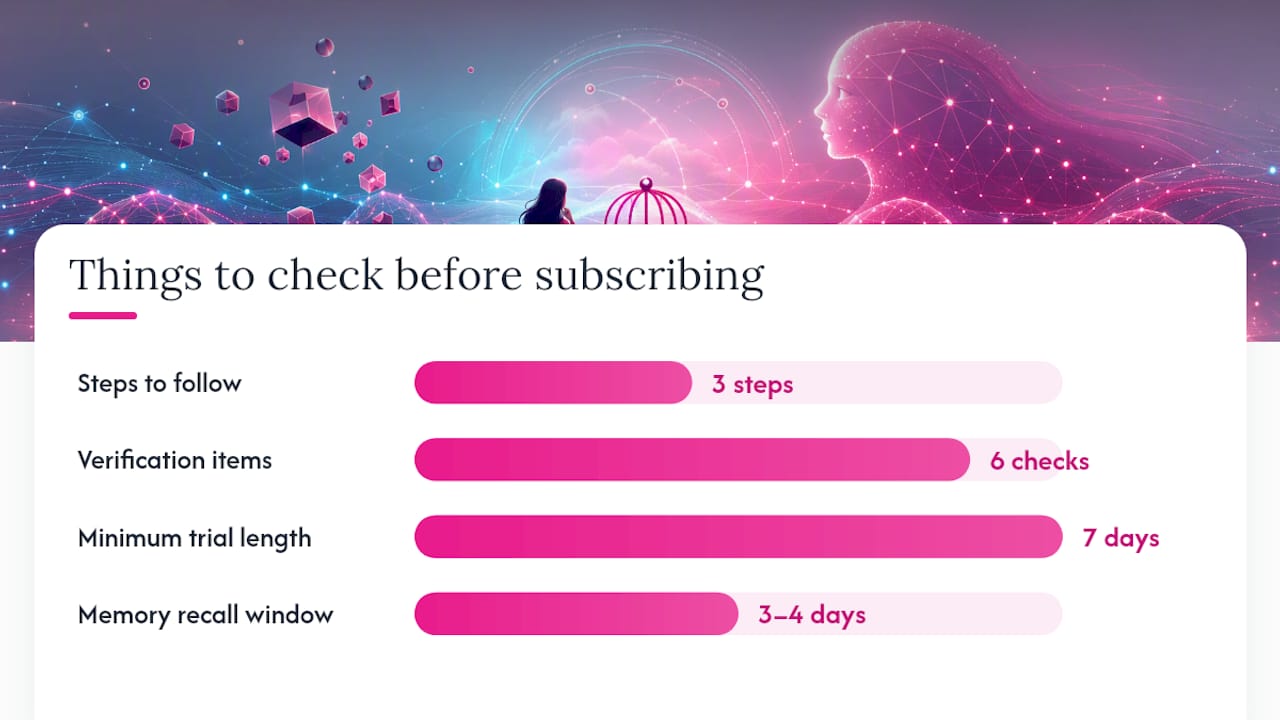
Three steps, in order, and skipping the first one is how people end up overpaying.
- Set your realistic usage before you shop. Are you sending a few messages a day or having hour-long voice conversations? Someone chatting casually a few times a day has completely different needs than someone using voice calls daily, and the second use case gets expensive fast on the wrong plan.
- Pick the billing model that matches that usage, not the cheapest sticker price. Heavy texters should default to flat-rate unlimited plans. Light or occasional users can often get away with a message-cap or free tier and never touch a top-up.
- Test on a trial or single-month plan before committing annually. A 7-day trial is enough to tell you whether a companion’s memory holds up and whether the “unlimited” claim survives contact with actual use.
Before you hand over a card number, verify six things: trial length, cancellation and refund policy, whether billing runs through the app store or the web, any message or conversation caps, what add-ons cost extra, and how long the app retains your conversation history. Mozilla Foundation’s review of romance-focused chatbots found privacy practices on many of these apps are weaker than users assume, which makes that last item worth more than a passing glance.
Pro Tip: During any trial, deliberately reference something you told the companion three or four days earlier. If it can’t recall it, you’ve found the real limit of that plan’s memory, regardless of what the marketing copy claims.
Worth sitting with before you subscribe: research on chatbot use and loneliness has found that leaning on a companion app while already isolated can sometimes deepen the feeling rather than ease it for some users. A subscription buys you features. It doesn’t guarantee a particular emotional outcome.
What hidden costs catch people off guard?
The advertised price is rarely the final price. Watch for these five traps specifically:
- Ultra/MAX-style add-ons that extend memory or context length but bill separately from the base subscription, as seen on Kindroid.
- Message top-ups on cap-based plans, like Dearest’s $5-per-250-messages packs, which add up fast for daily users.
- App-store markups, where the same plan costs more through Apple or Google than it does bought directly on the web.
- Automatic annual renewals that lock in a full year’s charge before you’ve decided whether you’re still using the app.
- Feature-gated tiers where voice, video, or image generation sits behind a second paywall above the base subscription.
Run the numbers on three usage levels: a light user sending a few dozen messages a week might stay entirely within a free tier or the cheapest paid plan. A moderate daily texter usually lands squarely in the $10 to $20/month range most platforms target. A heavy user layering voice calls, image generation, and expanded memory add-ons on top of a base subscription can end up paying two or three times the advertised monthly price by the time every add-on gets billed. Feeling genuinely heard by a companion, which Harvard’s coverage of chatbot research points to as the core value driver, often depends on exactly the memory and voice features that carry the highest add-on costs.
Before buying, check whether the price you’re looking at includes tax, whether the trial auto-converts to a paid plan, and whether the platform lists its add-on costs anywhere before checkout.
Should you subscribe through the app store or the website?
Web pricing beats app-store pricing often enough that it’s worth checking both before you tap “subscribe.” Apple and Google both take a commission on in-app purchases, and platforms like Kindroid pass that cost directly to app-store buyers while keeping web prices lower.
A few practical notes:
- Switching a subscription from one platform to another (say, canceling an iOS subscription to resubscribe on the web) usually isn’t prorated, so you can lose the remainder of a paid period.
- App Store and Google Play refund policies run through the platform, not the app developer, and timing windows are typically shorter than what a web vendor might offer directly.
- Currency conversion and local sales tax can shift your effective monthly cost, especially on annual plans billed in a single lump sum.
If a platform offers both purchase paths, price-check the web version first. The savings, when they exist, aren’t small.
How were these prices verified?
Every price cited here comes from an official pricing or help-center page, checked directly rather than pulled from a third-party listing.
- Sources include Kindroid’s, Serena’s, and Dearest’s own documentation pages, along with in-app pricing screens for platforms without public pricing pages.
- Local sales tax, VAT, and promotional discount codes are excluded from every figure, since those vary by region and change often.
- Pricing was last checked in early 2026 and gets revisited monthly or whenever a reader flags a discrepancy.
Compare prices before you commit to a subscription
Sorting through numerous pricing pages to find the plan that actually fits your budget and use case is exactly the kind of work a dedicated comparison site can do for you. Comparisons pull real, verified pricing across AI companion platforms, so you’re comparing effective monthly cost and actual feature access instead of guessing from an app-store screenshot.

You can filter by price range, by modality (text, voice, video), and by privacy practices, since not every platform handles data retention the same way. Rather than opening a dozen tabs and cross-referencing billing pages yourself, you get the current numbers and the add-on traps laid out side by side. Head to Virtualship’s comparison page to filter by budget and feature set, or check the pricing safety checklist before you enter payment details on any platform.
Sources
- Romantic AI chatbots and privacy | Mozilla Foundation
- Subscriptions · Kindroid Help Center
- Serena AI companion pricing page
- Plans & billing · Dearest
- Chatbots and loneliness | PsyPost

