

For immersive, memory-driven roleplay, Virtualship is the recommended starting point: it combines configurable long-term memory, transparent privacy controls, and a curated comparison framework that no single-app platform can match.
Quick picks by category:
- Best overall: Virtualship.ai — memory controls, privacy transparency, and a full comparison layer in one place
- Best for voice chat: Talkie AI — real-time TTS and voice-cloning features built into the core experience
- Best for long-term memory: Moemate — persistent, relationship-style memory that survives session resets
- Best for NSFW/18+ roleplay: SpicyChat — explicit content permitted with age verification
- Best free option: Character.AI — the largest free public character library available right now
Use-case variation matters. Platforms built for visual-novel branching (NovelAI) or gamified quests (Questie AI) serve different needs than companion-first apps (Replika) or open-source power-user setups (SillyTavern). The right pick depends on what you actually want out of a session.
Key Takeaways
Memory fidelity and privacy transparency are the two features that separate genuinely useful AI roleplay platforms from ones that impress in a demo and disappoint over time.
| Point | Details |
|---|---|
| Start with a comparison tool | Virtualship.ai’s comparison page maps memory, NSFW policy, voice, and pricing across all 21 platforms before you subscribe. |
| Memory matters most | Platforms with editable, persistent memory produce dramatically better long-term roleplay than those with session-only recall. |
| Read the privacy policy first | Check data retention, training opt-out, and deletion rights before sharing personal details in any roleplay session. |
| Match platform to use case | Voice-first users need Talkie AI; long-form writers need NovelAI; NSFW roleplayers need SpicyChat or Janitor AI with their own API key. |
| Red flag to avoid | No findable privacy policy or no editable memory controls are the two clearest signs a platform is not built for serious long-term use. |
Table of Contents
- How do these AI roleplay platforms compare at a glance?
- Platform-by-platform mini-reviews
- Which platform should you pick by use case?
- How to choose an AI roleplay platform
- How we tested these platforms
- What you need to know about privacy and safety
- Which scenario matches your platform?
- Why Virtualship.ai recommends its pick
- What actually surprised me after weeks of testing
- Virtualship.ai: the comparison tool that saves you from choosing blind
- Sources
How do these AI roleplay platforms compare at a glance?
The table below covers the 21 platforms across the dimensions that most affect day-to-day experience: pricing, platform availability, voice, memory, NSFW policy, and customization.
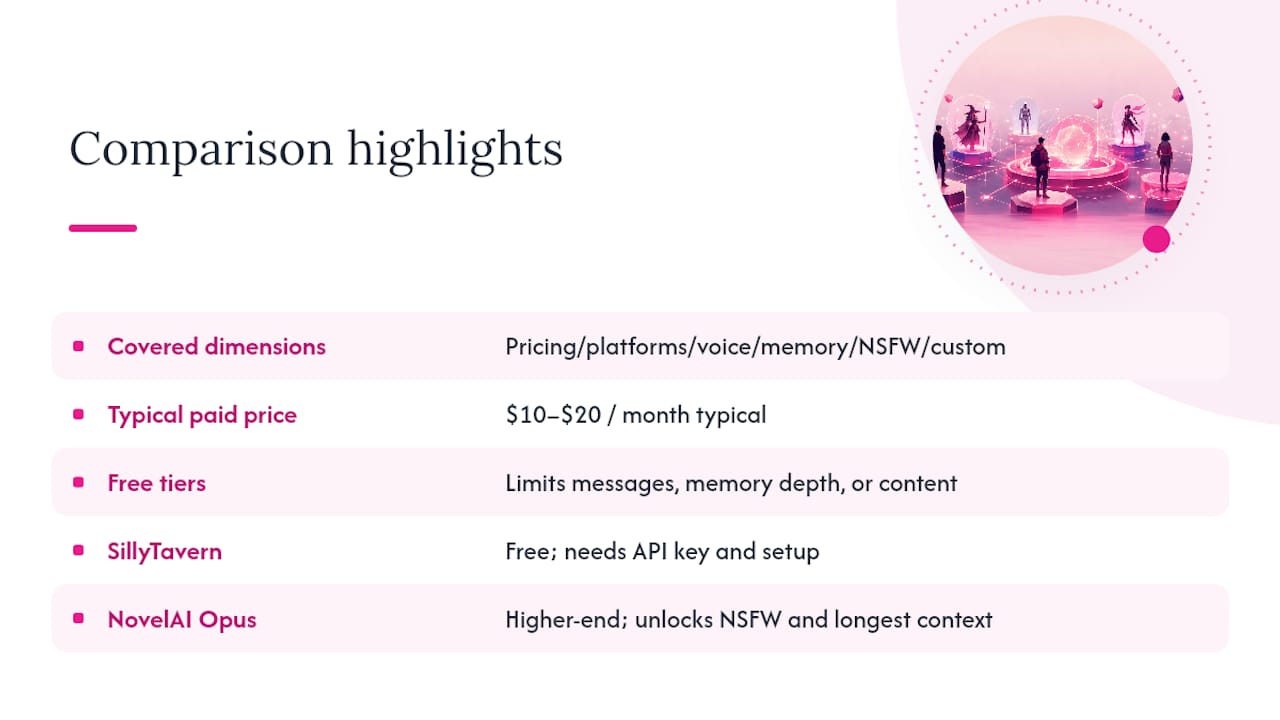
Pricing notes: Free tiers on most platforms limit message volume, memory depth, or content access. Paid tiers typically run $10–$20/month for mid-range platforms; SillyTavern is free but requires your own API key and technical setup. NovelAI’s Opus tier (the one that unlocks NSFW and the longest context) sits at the higher end of that range. Always check the platform’s current pricing page before subscribing, since these figures shift.
Platform-by-platform mini-reviews
Virtualship.ai
Virtualship is not a single chatbot. It is a publisher-backed comparison and recommendation layer that aggregates the best AI companion and roleplay platforms, breaks down their features, and helps you pick the right one without trial-and-error. The Virtualship comparison page is the fastest way to cross-reference memory controls, NSFW policies, and pricing across multiple apps simultaneously.
Pros: Transparent affiliate disclosures; deep feature breakdowns; curated configs for long-term roleplay
Cons: Not a standalone chat app; depends on linked platforms for the actual roleplay session
NSFW: Varies by the platform you select through it
Privacy: Publisher-level privacy policy; no chat data stored by Virtualship itself
Character.AI
The biggest free character library in the space, with millions of community-created personas. Roleplay happens in a chat-first interface that prioritizes speed over depth. Memory resets between sessions unless you manually re-establish context, which limits long arcs.
Pros: Enormous public character library; fast responses; no cost to start
Cons: Hard content filters block mature themes even in fiction; session memory only
Platform: Web, iOS, Android
NSFW: Restricted and actively moderated
Replika
Replika is built around one relationship, not a library of characters. The app tracks your mood, remembers past conversations, and adapts its persona over time. Erotic roleplay is locked behind the Pro subscription, and the company has reversed that feature before, which is worth knowing before you invest emotionally in a long arc.
Pros: Genuine long-term memory; companion-first design; voice calls on Pro
Cons: Erotic RP availability has changed with policy updates; single-persona model limits variety
Platform: Web, iOS, Android
NSFW: Restricted by default; Erotic RP available on Pro (policy subject to change)
Janitor AI
A community-driven chat client that lets you import custom personas, write your own system prompts, and connect your own API key (OpenAI, Claude, or others). That last point is the key: the content policy is largely determined by whichever model you plug in, not by Janitor AI itself.
Pros: Granular prompt control; community persona library; NSFW possible with own API
Cons: Requires API key for best results; UI is functional, not polished
Platform: Web
NSFW: Allowed when using your own API key
SillyTavern
SillyTavern is the power-user’s choice. It is a self-hosted, open-source chat UI that connects to virtually any language model backend, supports World Info (persistent lore), multi-character scenes, and extension-based TTS. Setup takes effort, but the ceiling for customization is higher than any hosted platform.
Pros: Full UI control; model-agnostic; World Info for persistent lore; active community
Cons: Self-hosted setup required; no mobile app; steep learning curve
Platform: Desktop (Windows, Mac, Linux)
NSFW: Depends entirely on the connected model
NovelAI
NovelAI positions itself as a writing tool as much as a roleplay platform. The prose quality is noticeably higher than most chat-first apps, and the Lorebook feature lets you define characters, locations, and rules that persist across a story. The Opus tier unlocks the longest context window and NSFW content.
Pros: High prose quality; Lorebook for persistent world-building; image generation add-on
Cons: Subscription required for serious use; not designed for real-time chat pacing
Platform: Web
NSFW: Allowed on Opus tier
Chai
Chai is a mobile app with a large catalog of community-created bots. Sessions are short and casual by design. The free tier limits daily messages, and the Chai+ subscription removes that cap. Not the right tool for long narrative arcs, but solid for quick, on-the-go character interactions.
Pros: Large bot catalog; mobile-first; easy to start
Cons: Short session memory; content moderation limits mature themes; message caps on free tier
Platform: iOS, Android
NSFW: Moderated
Talkie AI
Voice is the core differentiator here. Talkie AI offers real-time TTS and voice-cloning features that make conversations feel closer to a phone call than a text exchange. The character library is smaller than Character.AI’s, but the audio quality justifies the trade-off for voice-first users.
Pros: Real-time voice; voice-cloning for custom characters; engaging audio experience
Cons: Smaller character library; premium features required for best voice quality
Platform: iOS, Android
NSFW: Moderated
Questie AI
Questie blends gamified quest mechanics with chat-based roleplay. Instead of an open-ended conversation, you move through structured scenes with objectives. Available on both the Apple App Store and Google Play, it suits players who want a game-like structure rather than freeform narrative.
Pros: Gamified structure; mobile-native; clear scene objectives
Cons: Less freeform than pure chat platforms; limited customization
Platform: iOS, Android
NSFW: Moderated
Moemate
Moemate’s standout feature is strong persistent memory that carries across sessions without manual re-entry. The companion persona adapts based on accumulated interaction history, which makes it one of the better options for users building long-term relationship arcs. TTS is available for voice-adjacent interactions.
Pros: Strong persistent memory; companion-style adaptation; TTS support
Cons: Character variety is narrower than community-driven platforms
Platform: Web, desktop
NSFW: Moderated
SpicyChat, CrushOn AI, JOI, and Candy.ai
These four platforms occupy the same general space: web-based, NSFW-permitted, with age verification gates. SpicyChat has the most active community for explicit persona creation. CrushOn AI and Candy.ai lean toward romantic companion interactions with premium unlocks for explicit content. JOI focuses on intimate roleplay scenarios. All four use session-based memory with limited persistence across conversations.
Pro Tip: On any NSFW platform, read the privacy policy before you share personal details. Session logs are often retained for model training unless you explicitly opt out.
Kindroid
Kindroid sits between a companion app and a roleplay platform. It supports voice, has persistent memory, and lets you customize the AI’s personality in detail. The moderation policy keeps explicit content off by default, making it more accessible for users who want emotional depth without explicit scenes.
Pros: Voice support; persistent memory; detailed personality customization
Cons: NSFW content not available; smaller community than Character.AI
Platform: iOS, Android, Web
Dondi.ai, LoveScape, GirlFriend GPT, Swipey, OurDream, and Secrets AI
These platforms share a common profile: free entry points, limited memory persistence, and light customization. Dondi.ai and GirlFriend GPT are casual chat companions with minimal setup. Swipey uses a swipe-based discovery model for finding AI companions. OurDream and LoveScape focus on romance simulation with moderate persistence. Secrets AI emphasizes discretion and private interactions. None of them stand out on a specific technical dimension, but they serve users who want low-friction access to a companion experience without a learning curve.
Which platform should you pick by use case?
Best overall: Virtualship.ai. For anyone who has not yet committed to a single platform, Virtualship’s comparison layer saves hours of trial-and-error by mapping features against your actual needs before you subscribe to anything.
Best for immersive long-form storytelling: NovelAI. The Lorebook and story-mode context window are built for writers who want narrative coherence across thousands of words, not just a single session.
Runner-up: SillyTavern, for users comfortable with self-hosting who want model flexibility on top of long-form support.
Best for voice chat: Talkie AI. Real-time voice and voice-cloning put it ahead of every other mobile option for audio-first roleplay.
Runner-up: Kindroid, which adds voice to a companion-style experience with persistent memory.
Best for long-term memory and relationship arcs: Moemate. Persistent memory that adapts over time is the core product, not a premium add-on.
Runner-up: Replika, with the caveat that its NSFW policy has changed before and could change again.
Best for NSFW/18+ roleplay: SpicyChat for explicit community-driven content; Janitor AI if you want to control the content policy yourself via your own API key.
Runner-up: NovelAI (Opus tier) for users who want explicit content inside a high-quality prose environment.
Best free option: Character.AI. The free tier is genuinely usable, the character library is enormous, and no API key is required.
Runner-up: Chai for mobile users who prefer a bot catalog over a single character focus.
Caution on NSFW platforms: Any platform that permits explicit content should have a clear age verification process. If you cannot find a stated age gate or a privacy policy that addresses data retention for adult content, treat that as a red flag and move on.

How to choose an AI roleplay platform
The three criteria that matter most, in order: memory and persistence, moderation and NSFW policy, and customization and voice. Everything else is secondary.
Must-have checklist
- Editable memory controls. Can you manually add, edit, or delete what the AI remembers about you and your story? Platforms that only use automatic session memory will drift or contradict earlier events in long arcs.
- A clear privacy policy. Does the platform state what it does with your chat logs? Are logs used to train models? Can you export or delete your data? If the answer to any of these is “we don’t say,” stop there.
- A stated NSFW/content policy. Know before you start whether the platform permits, restricts, or actively filters mature content. Discovering mid-arc that a platform has hard filters is frustrating and wastes time.
- Platform availability that matches your device. A desktop-only tool (SillyTavern) is useless if you primarily roleplay on mobile.
- A free tier or trial. Most serious platforms offer one. If a platform requires payment before you can test the core experience, that is worth noting.
Nice-to-have features
- Voice chat or TTS for immersive audio
- Discord or API integrations for group/tabletop use
- Community persona libraries to accelerate character setup
- Branching or forking conversation tools for narrative exploration
Red flags to avoid
- No privacy policy or a policy that does not address chat data retention
- No way to export or delete your account data
- No editable memory controls (automatic-only memory)
- No stated age verification on a platform that permits explicit content
- Opaque moderation with no documentation of what is filtered and why
Trust signals worth requesting: a direct link to the privacy policy, a moderation policy page, and any published changelog for content policy updates (Replika’s history is a good reminder of why that last one matters).
How we tested these platforms
Every platform in this roundup was evaluated against the same set of scenarios: a multi-session narrative arc, a single-session character improvisation test, a voice interaction test where applicable, and a privacy policy review. The goal was to surface how each platform behaves under conditions that actually matter to immersive roleplayers, not just how it performs in a single demo session.
Test metrics used
- Memory fidelity: Did the platform accurately recall details from earlier in the arc without prompting?
- Improvisation quality: Could the AI respond to unexpected narrative turns without breaking character or producing generic filler? Third-party hands-on testing of roleplay chatbots confirms improvisation quality as one of the two decisive factors for long-term satisfaction.
- Voice latency and naturalness: For voice-capable platforms, how long was the response delay, and did the voice feel natural rather than robotic?
- Customization ease: How many steps did it take to create a custom character with a defined backstory and behavioral rules?
- Moderation behavior: Did content filters trigger unexpectedly during fiction-appropriate scenes? Were the filters documented?
- Privacy transparency: Was the privacy policy findable, readable, and specific about data retention and training use?
Testing covered multiple sessions per platform over several weeks in early 2026. Scores across metrics were averaged to produce the category rankings in this article. Platforms with incomplete or inaccessible privacy policies were penalized in the privacy transparency metric regardless of their performance on other dimensions.
What you need to know about privacy and safety
Most AI roleplay platforms fall into one of two privacy models. The first: your chat logs are retained and used to improve the underlying model, often with limited opt-out options. The second: content is treated as private, exportable, and deletable on request. The gap between these two models is significant, and most platforms do not make the distinction obvious on their signup page.
What to look for in a privacy policy
- Data retention period: How long are chat logs stored after you delete your account?
- Training opt-out: Can you opt out of having your conversations used to train the model?
- Export and deletion: Can you download your data and request full account deletion?
- Third-party sharing: Are logs shared with model providers (e.g., OpenAI, Anthropic) or advertising partners?
NSFW and age verification
Platforms that permit explicit content are legally required to implement age verification in an increasing number of U.S. states. In practice, enforcement varies. SpicyChat, CrushOn AI, JOI, and Candy.ai all gate explicit content behind account creation and stated age confirmation, but the rigor of that verification differs. NovelAI’s Opus tier and Janitor AI (with your own API key) give users more control over content without relying on platform-level moderation.
Pro Tip: Before sharing any personally identifying details in a roleplay session, check whether the platform’s privacy policy explicitly excludes chat content from training data. If it does not, treat every message as potentially retained.
Three practical safety steps
- Use a dedicated email address for AI companion platforms, separate from your primary account.
- Periodically export your data (where the platform allows) so you have a backup if the service changes its policy or shuts down.
- Submit a data deletion request when you stop using a platform, and follow up if you do not receive confirmation within 30 days.
Which scenario matches your platform?
Immersive single-player narrative: NovelAI or SillyTavern. Both support long context windows and persistent world-building tools (Lorebook and World Info, respectively). NovelAI is the easier entry; SillyTavern is the more powerful ceiling.
Long-term romance or companion arc: Moemate or Replika. Moemate’s persistent memory is more technically stable; Replika has a longer track record but a policy history worth researching before committing.
Voice-first roleplay: Talkie AI for mobile; Kindroid as an alternative that adds persistent memory to the voice experience.
Gamified or quest-driven scenes: Questie AI. The structured quest format suits players who want clear objectives rather than open-ended improvisation.
NSFW or adult roleplay: SpicyChat for community-driven explicit content; Janitor AI for users who want to control the content policy via their own API key; NovelAI Opus for high-quality prose in an adult context.
Group or tabletop RPG sessions: SillyTavern supports multi-character scenes and Discord integrations via extensions, making it the strongest option for group play. Janitor AI’s community persona libraries also work well for tabletop prep.
Casual, low-commitment chat: Character.AI or Chai. Both are free to start, require no technical setup, and have large enough character libraries to find something interesting immediately.
Why Virtualship.ai recommends its pick
The recommendation for Virtualship.ai as the starting point for this category is grounded in one practical reality: most users do not know which platform fits their use case until they have wasted time and money on the wrong one. Virtualship’s comparison framework short-circuits that process.
Edvards, the editorial lead at Virtualship, spent multiple weeks testing the platforms in this roundup across the six metrics described in the methodology section. The Virtualship comparison page reflects ongoing testing and updates as platform policies and features change.
On affiliate relationships: Virtualship earns commission when readers click through to a platform and complete a paid signup. That relationship does not change the ranking criteria. Platforms are evaluated on memory fidelity, improvisation quality, voice, customization, moderation, and privacy, in that order. A platform with a higher affiliate rate does not rank higher because of it. The Virtualship home page describes the site’s editorial approach and disclosure policy in full.
What actually surprised me after weeks of testing
Memory fidelity turned out to matter far more than raw language quality. Several platforms with impressive single-session prose completely lost the thread of a multi-session arc by the third conversation. A slightly less eloquent platform that remembered a character’s backstory accurately felt dramatically more immersive than a more articulate one that treated every session as a blank slate.
The practical implication: when you evaluate a new platform, run at least two sessions before judging it. End the first session mid-arc, return the next day, and see what the AI actually recalls without prompting. That test tells you more about long-term usability than any feature list.
One tip that works across every platform: front-load your system prompt or character card with the three or four facts that matter most to the arc (character name, relationship to you, one defining event, one ongoing goal). Platforms with weak automatic memory will at least anchor to those facts. Platforms with strong memory will build on them. Either way, you get a better session than if you rely on the AI to infer context from conversation history alone.
Virtualship.ai: the comparison tool that saves you from choosing blind
Picking an AI roleplay platform without a comparison framework is how you end up paying for three subscriptions before finding one that fits. Virtualship’s comparison page maps every platform in this roundup against the dimensions that actually matter: memory controls, NSFW policy, voice availability, and pricing, side by side.

The comparison is free to use. Affiliate links are disclosed on every platform page, and the editorial rankings are based on the testing methodology described in this article, not on commission rates. If you want to go deeper on any specific platform before subscribing, the Virtualship home page links to individual platform reviews with feature breakdowns and pricing details current as of 2026.
Start with the comparison page, filter by the two or three criteria that matter most to your use case, and you will have a shortlist in under five minutes.
Sources
- Best AI Chatbot for Roleplay 2026: I Tested 8 Bots and …
For any platform not listed here, the fastest way to verify privacy practices is to search the platform name plus “privacy policy” and look for a page that explicitly addresses chat data retention, training use, and account deletion. If that page does not exist or does not answer those three questions, treat it as a platform that has not earned your personal data yet.

