

Short answer: Character.AI does not permit explicit pornographic sexual content. The platform enforces that rule through filters, classifiers, and moderation review, according to its Help Center. The ban covers pornography, sexual exploitation of minors, grooming, and sexual extortion, and adult accounts still run into active content screening even when they follow the rules.
TL;DR:
- Romance and implied intimacy generally pass when scenes avoid anatomical detail and cut away before sex; graphic descriptions can be blocked even after harmless prompts.
- Input screening checks prompts, output classifiers can block replies to harmless prompts, and repeated violations or reports can lead to human review.
- Age assurance starts with automated activity signals, uses a selfie check when needed, and falls back to government ID if a selfie cannot confirm age.
- Confirmed under 18 accounts lose open ended chat and face daily time limits; keep screenshots, timestamps, and conversation IDs when disputing a block.
Table of Contents
- What Character.AI bans versus what you can still roleplay
- How Character.AI enforces its NSFW rules
- Age assurance and the under-18 experience
- What happens when you get flagged or banned
- Writing safely: avoiding flags without losing the story
- Finding a platform that fits how you actually want to roleplay
- FAQ
- Sources
What Character.AI bans versus what you can still roleplay
Character.AI’s policy draws a clear line: pornographic content is against its terms of service “and will not be supported at any point in the future,” according to the Help Center article on NSFW content. That single sentence anchors most of the platform’s content moderation.
The prohibited list goes beyond explicit sex scenes. It includes sexual content involving minors in any form, grooming language, sexual extortion, and obscene material that violates the terms of service. None of this is negotiable, regardless of account age or subscription tier.
What tends to survive moderation is different: romance and intimacy framed without graphic detail. Think slow-burn storylines, emotional tension, implied closeness, and fade-to-black scenes rather than anatomical description.
- Explicit descriptions of sex acts or anatomy are blocked, even in fictional framing.
- Sexual content involving minors is banned categorically with zero exceptions.
- Grooming language or sexual extortion attempts trigger immediate enforcement.
- Non-explicit romance, flirtation, and implied intimacy generally stay within bounds.
The gap between “allowed” and “banned” often comes down to specificity. A character who leans in for a kiss and the scene cuts away reads very differently to a classifier than a scene written in graphic detail.
How Character.AI enforces its NSFW rules
Enforcement happens in layers, not a single checkpoint. Input screening looks at what you type before it reaches the model. Output classifiers scan what the character generates before it displays on your screen. Platform-level filters sit on top of both, catching patterns that slip past the first two layers.
- Input filters flag prompts that look like attempts to solicit explicit content.
- Output classifiers can block a response even when your prompt looked harmless.
- Repeated violations route to Trust & Safety for manual review.
- Jailbreak attempts, meaning prompts designed to override the filters, count as policy violations on their own.
One frustrating reality: automated systems sometimes block content without explaining why, according to the Help Center’s troubleshooting guide. Filters get updated regularly, so a phrasing that worked last month might not work today. Trust & Safety staff step in mainly for reported content and repeat offenders rather than every single flagged message.
Pro Tip: If a message gets blocked, rephrasing with less explicit language usually works better than trying to find a workaround.
Age assurance and the under-18 experience
Character.AI requires age assurance and routes accounts it assesses as under 18 into a restricted experience, according to its Age Assurance Help Center page. The company announced it would remove open-ended chat for under-18 users entirely, replacing it with more limited interactions and daily time caps, in a blog post detailing the change.
- Automated signals assess account activity first to estimate a user’s age bracket.
- A selfie-based check serves as the primary verification step when more certainty is needed.
- Government ID becomes a fallback only when selfie verification cannot confirm age.
- Confirmed under-18 accounts lose access to open-ended chat and face daily time limits.
This shift lines up with growing regulatory pressure. Online safety codes in jurisdictions like Australia increasingly expect services capable of generating age-restricted content to run layered age checks rather than relying on a single filter. Our guide on how AI companion apps verify age breaks down how these flows typically work across different platforms.
What happens when you get flagged or banned
Most enforcement follows a predictable path. An automated system blocks a message or output first. If a user reports the content, or if the pattern repeats, the case escalates to Trust & Safety for human review. Minor, one-off flags rarely lead anywhere beyond a blocked message. Repeated or egregious violations are a different story.
- Uploading or requesting pornographic material commonly leads to account suspension.
- Grooming attempts or sexual extortion result in immediate, serious action.
- Repeated jailbreak attempts to bypass filters can escalate from warnings to bans.
- Reporting content works best with screenshots, timestamps, and the conversation ID attached.
The terms of service also cover dispute resolution, including arbitration clauses that apply if you want to formally contest an account action. Keeping clear records when you report something, or when you believe you were wrongly flagged, makes the review process faster on both ends.
Writing safely: avoiding flags without losing the story
The simplest way to avoid moderation trouble is to write the way a PG-13 novel would handle an intimate scene: imply, don’t describe. Emotional buildup, tension, and a cut-away before anything explicit happens will almost always clear filters that a graphic description won’t.
- Skip anatomical detail and explicit action verbs in romantic scenes.
- Avoid known jailbreak phrasing or instructions aimed at disabling filters.
- Let implied consent and emotional context carry the scene instead of explicit narration.
- Keep a screenshot and the conversation ID any time you think a block was a false positive.
If you do get flagged incorrectly, don’t just resend the same message. Check the relevant Help Center article for current guidance, then contact support with the conversation ID and a clear explanation of what you were trying to do. Our checklist on avoiding jailbreak-related bans walks through the prompts that most often trigger suspensions, and our guide to confirming a chatbot’s SFW behavior covers how to test a character’s responses before committing to a long roleplay.
Pro Tip: Test a new character with a mild, non-explicit prompt first. How it responds tells you a lot about how strict its filtering will be for anything more intimate later.
If you’d rather run your own AI privately, without platform-side content filters at all, local AI tools with built-in privacy controls are worth a look as an offline alternative.
Finding a platform that fits how you actually want to roleplay
Character.AI’s content rules work well for readers who want light romance and storytelling, but they’re clearly not built for anyone looking for explicit adult roleplay. That’s a deliberate choice on Character.AI’s part, not a bug, and it means a meaningful share of adult users end up frustrated by blocked messages no matter how carefully they phrase things.
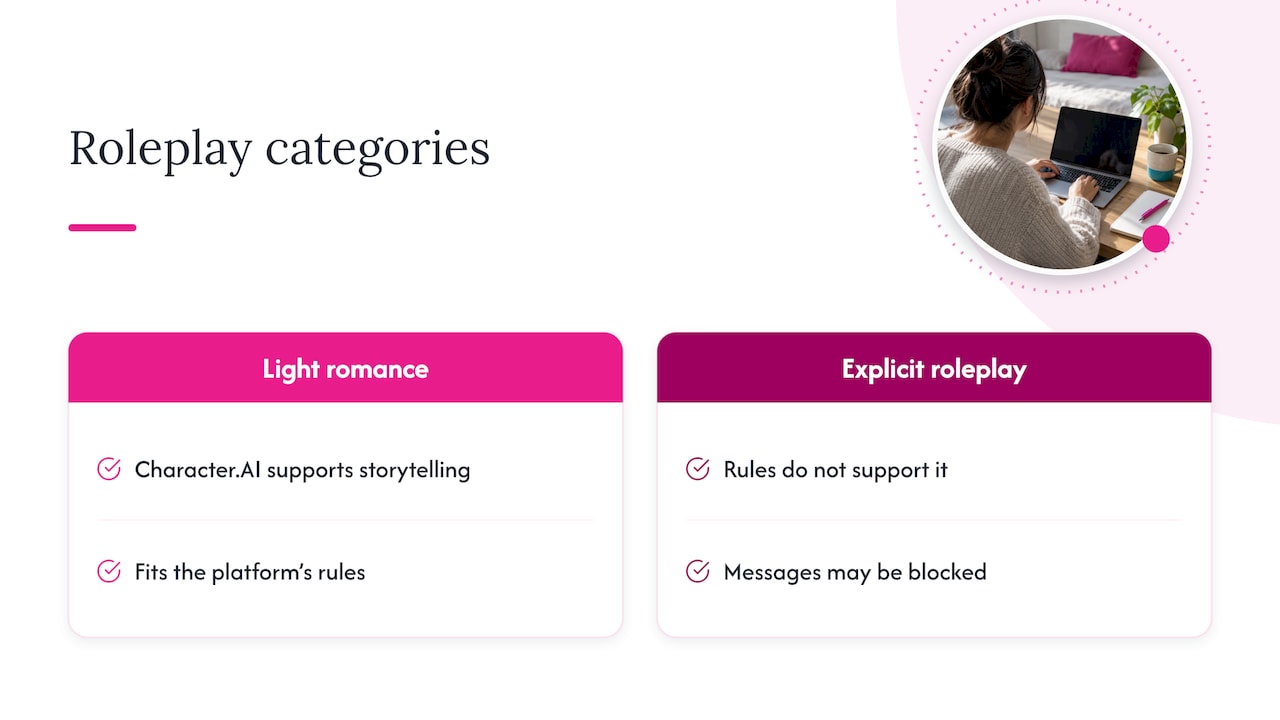
Our comparison of AI companion platforms is designed specifically for readers in that position. Rather than fighting filters on a platform that was never designed for explicit content, we break down which platforms state clear adult-content policies upfront, how their moderation actually works in practice, and where personalization and privacy options differ. Reviews cover pricing, customization depth, and roleplay flexibility across the field, so you can pick a platform whose rules match what you’re actually looking for instead of guessing and getting flagged.
Start with recommended AI girlfriend roleplay platform picks to see which services explicitly support the kind of roleplay you want, or review a AI companion safety checklist before committing to a subscription anywhere.
FAQ
Does Character.AI have an 18+ policy?
Character.AI does not offer a separate unrestricted 18+ tier for explicit content. Instead, it uses age assurance to route under-18 accounts into a restricted experience, while adult accounts still follow the same ban on pornographic material as everyone else.
Can you get banned from Character.AI?
Yes, accounts can be suspended or banned for violations like uploading pornographic content, grooming, sexual extortion, or repeated attempts to bypass filters through jailbreak prompts. Enforcement typically escalates from an automated block to a Trust & Safety review for repeated or serious cases.
What does “restricted access” mean in Character.AI?
Restricted access refers to the limited experience Character.AI applies to accounts it assesses as belonging to users under 18, according to its age assurance guidance. It removes open-ended chat and applies daily chat-time limits, among other protective measures.
What is the limit on go-ons in Character.AI?
Character.AI has not published a specific public number for “go-on” limits in its official policy pages. The platform does apply daily chat-time limits for accounts in the restricted under-18 experience, as described in its blog announcement on teen safety changes.

