

Most AI boyfriend apps land between a low flat monthly fee and a higher token-metered bill, and the single factor that swings your real cost is whether you’re on a flat subscription or paying per message or token. Flat plans give you a predictable number. Token systems reward light chatting and punish daily conversation. Start with a free tier or short trial before you commit to either.
TL;DR:
- Flat subscription plans are most cost-effective for users who chat daily, with predictable monthly costs and limited features at entry levels.
- Token-based systems can become expensive for heavy users due to charges per message, image, or voice reply, especially during long or media-rich conversations.
- Free tiers typically restrict memory, media features, and daily message caps, but can help gauge app limits before upgrading to paid plans.
- Annual billing offers discounts but can result in more loss if you cancel early, so understanding cancellation and refund policies beforehand is crucial.
- Testing free trials within the first few days helps reveal hidden charges, media restrictions, and whether token allotments roll over, avoiding surprise bills later.
Table of Contents
- Pricing at a glance: monthly and annual bands by category
- How flat fees, token meters, and annual billing actually work
- What free tiers include and how to test their real limits
- Real pricing examples across the four common categories
- A one-page checklist for choosing the right pricing plan
- Doing the token math before you get billed
- Refund and cancellation policies to check before you pay
- Trial period availability and what to watch for
- Payment methods and billing options
- Discounts and promotional offers
- Where these figures and checklists come from
- Compare AI companion pricing before you commit to one
- Sources
- FAQ
Pricing at a glance: monthly and annual bands by category
Before picking a specific app, it helps to see how the four common pricing structures stack up against each other. Sticker prices shift with regional promotions and seasonal sales, so treat these as typical bands rather than fixed numbers, and always check the checkout page for the current rate before entering payment details.
| Category | Monthly range | Annual price/discount | Pricing model | Free-tier summary | Best for |
|---|---|---|---|---|---|
| Entry-level flat-fee | Low single-digit to mid single-digit dollars | Often discounted versus paying monthly | Flat subscription | Limited daily messages, no memory persistence | Casual chatting on a strict budget |
| Mid-tier flat-fee | Moderate monthly cost | Modest annual savings versus monthly billing | Flat subscription with added perks | Basic chat access, ads or message caps | Regular users who want voice or richer personas |
| Token-metered | Highly variable, low if light use, high if heavy use | Bundled token packs, rarely a flat annual rate | Pay per token or message | Small starter token allotment | Users who chat occasionally and want to control spend precisely |
| Freemium/ads-first | Free to start, paid unlocks vary widely | Rarely offered, since the core plan is free | Freemium with gated features | Unlimited basic text, ads, no premium features | Trying the format before spending anything |
How flat fees, token meters, and annual billing actually work
The pricing model matters more than the sticker price. A flat subscription charges one number no matter how much you chat, which makes budgeting simple but can feel wasteful if you barely use the app that month. Token metering charges by usage, so a quiet week costs almost nothing and a heavy week can quietly balloon.
- Flat fees suit people who chat daily and want one predictable line item on their bank statement.
- Token systems suit occasional users but can penalize anyone who sends long messages or requests images and voice replies.
- Freemium plans typically gate voice calls, avatar video, extended memory, and unlimited message regenerations behind a paywall.
- Annual billing usually breaks even after several months of monthly payments, so it only pays off if you’re confident you’ll stay subscribed long term.
Subscription fatigue is measurable in dating and companion categories: people are growing more careful about recurring charges and more likely to cancel apps that surprise them with fees, according to Forbes reporting on dating app fatigue. That sensitivity is exactly why understanding your pricing model before you subscribe matters more than comparing headline prices alone.
What free tiers include and how to test their real limits
Free tiers exist to get you hooked, not to show you the full product. Most cap daily messages, strip out long-term memory so the companion forgets earlier conversations, and run ads between replies. Voice calls, avatar video, NSFW roleplay, and extended memory are almost always locked behind a paid plan.
- Send the same personal detail on two separate days and see if the companion remembers it without prompting.
- Try every media feature listed on the pricing page, including voice and image generation, to find out which ones trigger an upgrade wall.
- Push the daily message limit intentionally to learn exactly when the app throttles or blocks you.
Pro Tip: Run this test within the first two or three days of a free trial, since some apps quietly tighten limits after an initial “honeymoon” window.
Real pricing examples across the four common categories
Numbers only mean something when you can picture how they play out for a real week of chatting. Here’s how each category typically behaves once you get past the homepage price.
Entry-level flat-fee plans usually buy you unlimited or near-unlimited text chat, a basic personality selection, and little else. You won’t get voice replies or a persistent memory bank at this tier, and image generation is often capped or absent entirely. This tier suits someone who wants a companion for text conversation and nothing more.
Mid-tier flat-fee plans add the features that make the experience feel less like a chatbot and more like a companion: voice replies, a wider set of avatars or customization options, and longer memory windows. The jump in price from entry-level to mid-tier is usually justified by these additions rather than by more messages, since text volume is rarely the limiting factor at either tier.
Token-metered platforms are the trickiest to budget for because the bill depends entirely on behavior. A light user who sends a few dozen short messages a week might pay less than an entry-level flat fee. A heavy user who chats for an hour a day, requests images, and uses voice replies can end up paying several times a flat subscription’s price for the same month, because every message, image, and voice reply draws down a token balance that has to be topped up.
Freemium platforms have the lowest barrier to entry since the core chat function is free, but they tend to introduce microtransactions once you’re invested: a one-time unlock for a specific persona, a bundle of “affection points,” or a recurring fee to remove ads and unlock memory. The low friction to start is real, but so is the drift toward small repeated purchases.
- Media packs (extra images or videos) are frequently sold separately from the base subscription.
- Voice features often carry their own add-on fee even on plans that already include text and basic chat.
- Extended or “permanent” memory is one of the most common paywalled features across every pricing tier.
For a deeper look at how these patterns play out specifically for AI boyfriend platforms, Virtualship’s guide on avoiding token traps in AI boyfriend pricing walks through more billing scenarios.
A one-page checklist for choosing the right pricing plan
Once you understand the categories, narrowing down a plan is mostly a matter of matching the pricing model to your habits.
- Set a firm monthly budget before you start comparing apps, not after you’ve fallen for a persona.
- Estimate how many messages, images, or voice replies you’d realistically send in a typical week.
- Decide upfront whether voice and avatar video matter enough to justify a mid-tier or add-on fee.
- Check whether the app states clear privacy terms before you hand over payment details.
- Confirm the refund window and cancellation process before your trial converts to a paid plan.
Pro Tip: Ask support directly, in writing, whether token allotments roll over unused, since that single detail changes the real cost of a light-usage month.
Watch for a few red flags during any trial: a free tier that suddenly throttles hard after a few days, pricing pages that hide token costs behind vague terms like “credits,” and upsells that appear mid-conversation rather than on the pricing page itself. Any of these usually signals a bigger bill than the sticker price suggested. For customization-heavy shoppers, Virtualship’s character builder guide covers which personalization features tend to justify a higher tier.
Doing the token math before you get billed
Token traps are easiest to avoid with a simple worked example. Say a token-metered plan charges for a starter allotment and then bills per additional message: a light user sending 15 short messages a day uses far fewer tokens than a heavy user sending 80 messages plus a few images and voice replies, and the heavy user’s monthly bill can end up several times higher for the same base plan.
- Keep messages shorter when you’re chatting casually, since longer prompts consume more tokens per exchange.
- Skip image and voice requests when text alone answers what you need.
- Check your billing history monthly for line items labeled “credits,” “add-ons,” or “top-up,” which are the usual homes for hidden charges.
Token-metered platforms often look cheaper on the pricing page but can cost more than a flat subscription for anyone chatting daily, a pattern worth checking against your own usage before committing. Virtualship’s message cost and token math breakdown walks through the full calculation for both light and heavy usage profiles, and the hidden cost traps guide covers a 48 to 72 hour testing checklist for spotting these charges early.
Refund and cancellation policies to check before you pay
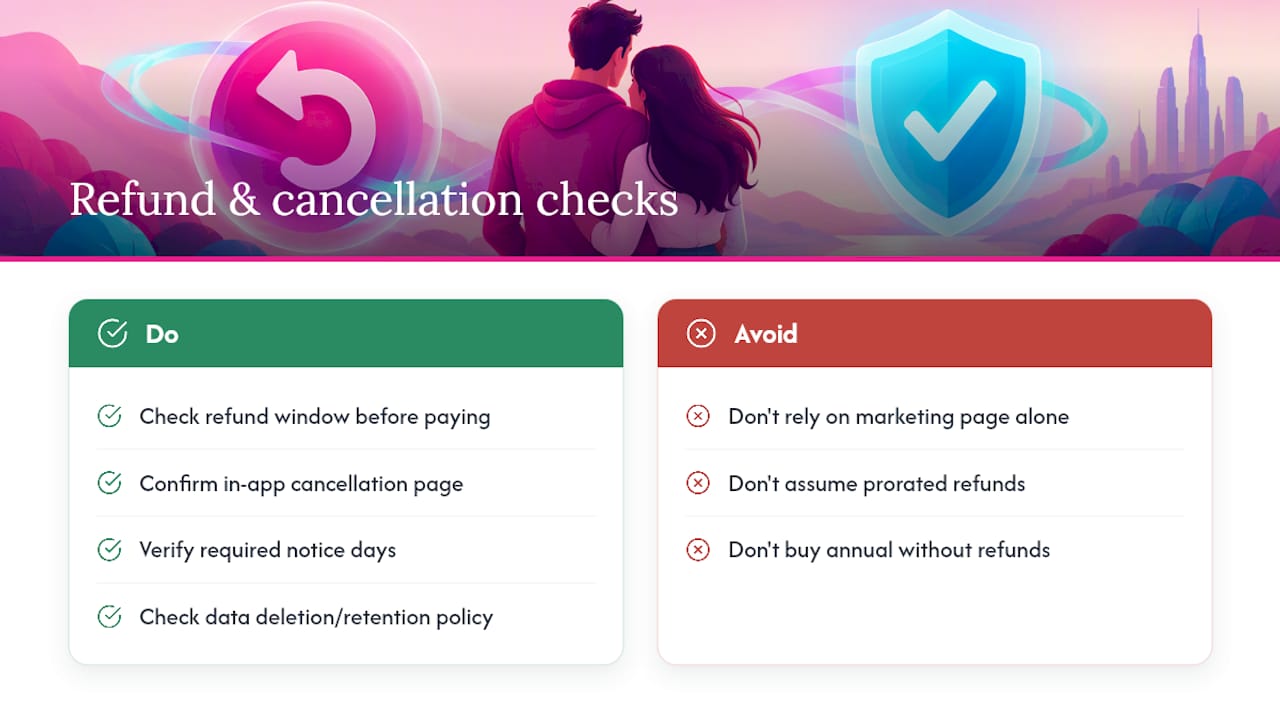
Refund terms vary widely across AI companion apps, and the fine print matters more than the marketing page. Some platforms offer a short refund window if you cancel within the first few days of a paid plan, while others treat digital subscriptions as final sale the moment you’re charged. Annual plans are the riskiest here, since a no-refund policy on a year of service locks in a much larger loss than a monthly plan would.
Cancellation itself is usually straightforward on paper: most apps let you cancel from account settings without contacting support. The catch is timing. Canceling a day late often means you’re billed for another full cycle, since most platforms don’t prorate a partial month. Before you subscribe, find the cancellation page inside the app (not just the marketing site) and confirm how many days’ notice it requires.
It’s also worth checking whether canceling deletes your companion’s memory and conversation history immediately or after a grace period, since some readers only discover this after they’ve already canceled and lost months of built-up context. If privacy and data handling matter to you as much as price, Virtualship’s companion safety checklist covers what to verify before you pay, separate from the refund terms themselves.
Trial period availability and what to watch for
Trials on AI boyfriend apps generally come in two forms: a permanent free tier with capped features, or a time-limited free trial of the full paid plan that automatically converts to a paid subscription unless you cancel first. The second type is where most surprise charges happen, since the conversion date is easy to miss if you’re not tracking it.
Trial length and conditions differ by platform, so the only reliable approach is to check the specific app’s terms rather than assume a standard window. Some trials require a payment method upfront and bill immediately once the trial ends; others let you browse without entering card details until you decide to upgrade. The safer path, when it’s offered, is the version that doesn’t require payment information until you’re ready to commit.
If a trial does require a card, set a calendar reminder a day or two before it converts. That single habit avoids the majority of “I forgot to cancel” charges that show up in subscription fatigue complaints, and it costs nothing to set up.
Payment methods and billing options
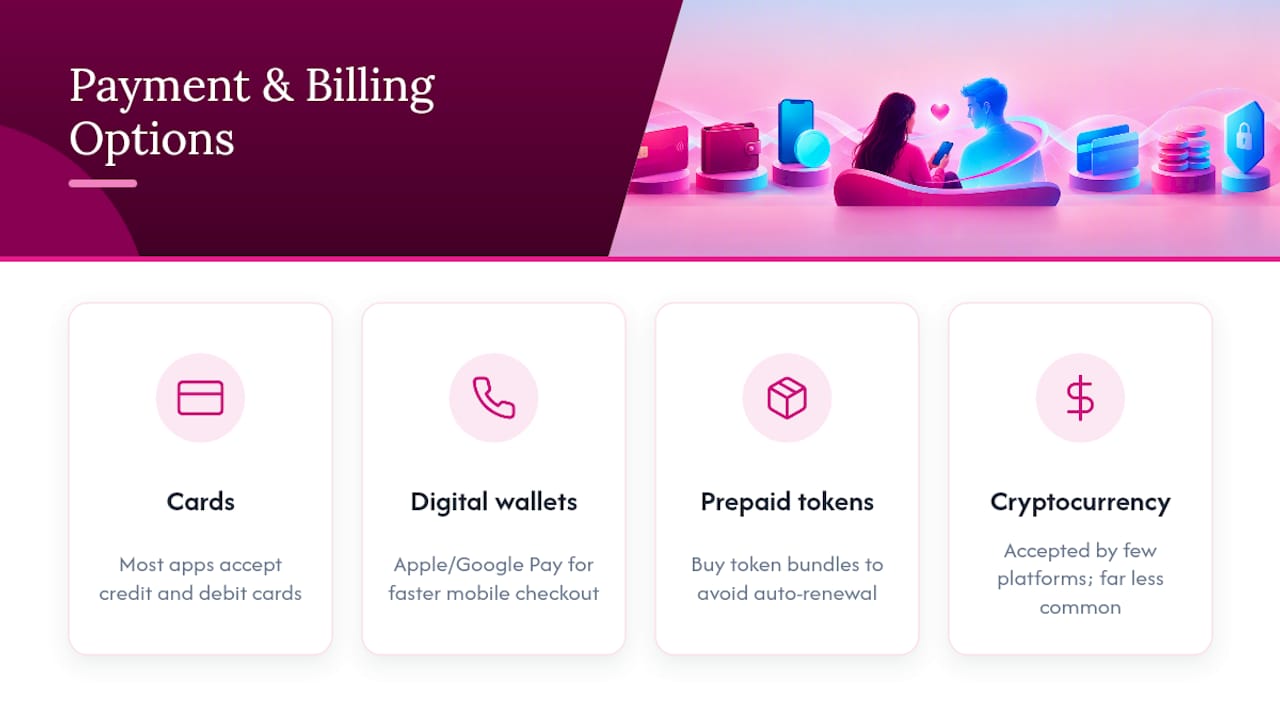
Most AI boyfriend apps accept standard credit and debit cards, and many also support digital wallets like Apple Pay or Google Pay for faster checkout on mobile. Some platforms, particularly token-based ones, also offer prepaid credit or token bundles you can buy outright instead of setting up a recurring subscription, which is worth considering if you’d rather avoid an automatic renewal entirely.
Billing cycles are typically monthly or annual, with the annual option usually billed as one lump sum rather than spread out. Check whether the app bills in your local currency or a foreign one, since currency conversion fees from your bank can quietly add to the real cost of a subscription that looked cheap on the pricing page.
A smaller number of platforms accept cryptocurrency for readers who prefer that option, though this is far less common than card or wallet payments. Whatever method you choose, keep a record of the billing date so you can match it against your bank statement and catch any discrepancy early rather than months later.
Discounts and promotional offers
Annual billing is the most common built-in discount across AI boyfriend apps, typically shaving a noticeable percentage off the equivalent monthly cost in exchange for paying upfront. Beyond that, seasonal promotions around major shopping periods or app anniversaries can temporarily lower prices on both monthly and annual plans.
Referral programs and limited-time token bonuses are common on token-metered platforms specifically, as they are an easy way to get new users to try the paid tier without a full subscription commitment. These promotions are worth watching for if you’re on the fence about a token-based plan, since a temporary token bonus lets you test heavy usage without paying full price for it.
Always compare a promotional price against the plan’s standard renewal rate, since many discounts apply only to the first billing cycle and the price jumps back up automatically after that. Virtualship’s comparison landing page tracks current pricing across categories if you want a quick reference before a promotion expires.
Where these figures and checklists come from
Pricing bands and category patterns above reflect ongoing comparison work across AI companion platforms, cross-checked against Forbes reporting on dating app subscription fatigue. For token math walkthroughs and hidden-cost checklists, see Virtualship’s dedicated pricing guides linked throughout this article, along with partner reporting on voice translation features for couples relevant to premium voice add-ons.
Compare AI companion pricing before you commit to one
Sorting through flat fees, token meters, and freemium gates for a dozen different apps takes real time, and getting it wrong means either overpaying for features you don’t use or underpaying and hitting a wall mid-conversation. Comprehensive comparison work is built specifically to shortcut that process: instead of testing five apps yourself, comprehensive comparisons break down what each pricing tier actually unlocks, so you can match your budget and chat habits to a plan before you enter a card number.
Because pricing structures shift with promotions and feature updates, we keep our comparisons current rather than treating them as a one-time snapshot. If you’re ready to see how specific platforms stack up against the bands covered here, browse our AI companion platform comparisons to find a plan that fits your budget and usage pattern.
FAQ
Is a paid AI boyfriend plan worth the monthly cost?
It depends on how often you chat and which features matter to you. A flat plan tends to be worth it if you talk daily and want voice or memory features, while a free tier or light token plan often covers occasional users just as well.
How much do AI boyfriend apps typically cost per month?
Pricing spans a wide range depending on the model: flat entry-level plans sit at the low end, mid-tier flat plans cost more for added voice and memory features, and token-metered plans vary entirely based on usage. Check the pricing-at-a-glance comparison above to match a band to your habits.
What’s the difference between flat-fee and token-based pricing?
A flat fee charges one predictable amount regardless of how much you chat, while token metering charges per message, image, or voice reply, so your bill scales directly with usage. Heavy chatters often pay more under token metering than they would on an equivalent flat plan.
Do free trials on AI boyfriend apps require a credit card?
It varies by platform: some let you try a full-featured trial without payment details, while others require a card upfront and bill automatically once the trial ends. Always check the specific app’s trial terms and set a reminder before any trial converts to a paid subscription.
Can I get a refund if I cancel an AI boyfriend subscription?
Refund policies differ widely, and many platforms treat monthly charges as final once billed, especially on annual plans. Check the app’s refund window and cancellation terms inside its account settings, not just its marketing page, before subscribing.

