

For most people who want a custom personality AI girlfriend, the fastest reliable route is to pick a character builder platform that offers persistent memory, deep personality controls, and explicit safety settings, then refine the personality with short identity prompts. The three things that actually determine whether a companion feels satisfying are customization depth, memory that persists across sessions, and safety controls you can verify before paying for anything.
TL;DR:
- Write an identity prompt of four to six lines covering voice, interests, and emotional tone, then test chats and adjust one trait at a time.
- Before paying, check retention and deletion terms, test account deletion and content boundaries, and contact support; age checks are weak across many platforms.
- Free tiers often limit memory to one session and restrict voice or images, so test tone there before using a monthly plan to verify persistence.
- Model or policy updates can disrupt a persona; save meaningful chat history and avoid annual commitments until memory and safety hold for several weeks.
Table of Contents
- Which platform category fits your goals
- How to build a custom personality step by step
- Customization settings that most affect how real it feels
- Privacy, safety, and consent controls worth verifying
- Reading free tiers versus paid plans
- Our quick evaluation checklist and vetting process
- How long people typically stay on one platform
- Customer support and how often platforms update
- Getting a personality that feels natural, not scripted
- Try our comparisons and quick-start build guides
- FAQ
- Sources
Which platform category fits your goals
Before choosing an app, it helps to know what each category is built for. Character builder platforms let you set traits, backstory, and voice in detail, which suits anyone who wants a companion that stays consistent over weeks. Open roleplay platforms trade some of that structure for creative range, useful if you want scenario variety over a tightly scripted identity. Voice and image first apps prioritize sensory presence, which matters if talking out loud or seeing a consistent face drives the connection for you. Curated or reviewed services do the vetting work for you, trading some choice for a shorter, safer shortlist.
- Character builders: best for long term consistency and layered personality traits.
- Open roleplay platforms: best for scenario variety and creative freedom.
- Voice and image first apps: best for sensory realism in calls and visuals.
- Curated or reviewed services: best for readers who want a vetted shortlist instead of trial and error.
| Category | Best for | Customization depth | Memory | Safety posture | Pricing shape |
|---|---|---|---|---|---|
| Character builders | Long term persona consistency | High (traits, backstory, voice) | Usually persistent | Varies, check settings | Free tier plus paid upgrade |
| Open roleplay platforms | Scenario and story variety | Medium to high | Session based or limited | Varies widely | Freemium with message caps |
| Voice/image first apps | Sensory realism | Medium | Often limited on free tier | Depends on media moderation | Paid add-ons for voice/image |
| Curated/reviewed services | Fast, safer shortlisting | Depends on platform chosen | Depends on platform chosen | Pre-screened | Varies by platform |
Most readers do best starting with a character builder, since it gives you direct control over the traits that make a companion feel personal rather than generic.
How to build a custom personality step by step
Building a believable companion is less about finding the perfect app and more about how you set it up in the first ten minutes, as explained in this detailed comparatif des chatbots IA pour le bien-être émotionnel.
- Choose a social role and basic archetype: decide whether you want a supportive partner, a playful friend, or a roleplay character, since this frames every later choice.
- Write a concise identity prompt with 4 to 6 characteristic lines covering speech style, one or two recurring interests, and a consistent emotional tone.
- Configure memory entries deliberately: store name, relationship context, and a few recurring preferences, but avoid loading in sensitive personal data you would not want retained indefinitely.
- Run several short test conversations, then adjust tone, pacing, and who initiates conversations, since that single setting changes how “present” the companion feels.
Pro Tip: Treat the first few days as iterative micro training: correct one trait at a time instead of rewriting the whole persona, since small consistent corrections stick better than large rewrites.
Our step-by-step build guide walks through identity prompt templates if you want a starting script rather than writing one from scratch.
Customization settings that most affect how real it feels
Appearance settings shape first impressions, but behavioral controls shape whether the relationship feels sustained over time. Tone and initiation behavior (whether your companion texts first or only replies) do more to create a sense of presence than any visual detail. The specificity of remembered personal details, the scope of what memory holds onto, and one or two consistent quirks make a companion feel distinct rather than interchangeable with any other chatbot.
Configure these six settings first:
- Tone and vocabulary, so replies match the register you actually want.
- Initiation behavior, deciding whether the companion starts conversations.
- Memory scope, choosing what gets remembered long term versus session only.
- Specificity of personal details, like referencing a shared joke or ongoing topic.
- One or two recurring quirks, such as a verbal tic or a consistent interest.
- Response pacing, since overly long or overly short replies break immersion fast.
A shortlist focused on memory behavior is worth checking if persistence across sessions matters most to you.
Privacy, safety, and consent controls worth verifying
Before paying for anything, scan the privacy policy for data retention periods and whether you can request deletion. Age verification on most companion platforms relies on self-reported birthdates, which is easy to bypass, so assume enforcement is weak rather than strict, a pattern documented in reporting on weak age assurance across companion apps. A formal risk assessment of social AI companions documents harms tied to weak age assurance and recommends verifying moderation and safety controls before you pay.
Run three quick tests before committing:
- Request account or conversation deletion and time how long it takes to confirm.
- Test NSFW boundaries early to see whether the platform enforces its stated policy.
- Contact support with a basic question to gauge response time and moderation quality.
Regulatory attention on this category is increasing: the FTC has opened inquiries into AI companion providers over age restrictions, sexually themed interactions, and data collection, which signals that transparency on these points is now a meaningful differentiator between platforms.
Our privacy breakdown and safety checklist go deeper on what to scan in a privacy policy before you hand over payment details.
Reading free tiers versus paid plans
Free tiers typically cap daily messages, limit memory to the current session, and restrict voice or image features, which is enough to test tone and responsiveness but not enough to judge long term fit. Paid tiers usually unlock persistent memory, voice calls, generated images, and unlimited or much higher message limits, which are the features that most improve how personalized the experience feels over time.
Before upgrading, confirm:
- Whether the free tier lets you test memory persistence at all, even briefly.
- Which paid feature matters most to you: memory, voice, images, or message volume.
- Whether a short trial or monthly plan exists so you are not locked into a longer commitment before confirming fit.
Our quick evaluation checklist and vetting process
We built a short checklist to vet any platform in 10 to 20 minutes before you commit money or personal details.
- Customization: can you set personality traits, backstory, and tone, not just appearance?
- Persistent memory: does the companion recall details across separate sessions?
- Safety controls: are NSFW boundaries, moderation, and reporting clearly stated?
- Demo or sandbox: can you test core features before paying?
- Privacy transparency: is data retention and deletion clearly explained?
- Support and terms: does support respond, and are terms easy to find and read?
Spend five minutes on setup, five minutes testing memory with a follow-up question in a new session, and five to ten minutes on the safety tests above. A platform that fails more than one of these checks is worth skipping. Our character builder guide and comparison pages apply this same checklist across platforms if you want the shortlist already filtered.
How long people typically stay on one platform
Most people treat AI companion platforms as an ongoing subscription rather than a one-time purchase, similar to a streaming service, with usage ranging from a few weeks of casual testing to long term daily use. Commitment is usually monthly rather than annual, which matters because personality and memory settings can shift when a platform updates its underlying model.
Service churn is common in this category. Model updates or policy changes can alter how a companion responds almost overnight, sometimes breaking continuity that took weeks to build. Because of this, it makes sense to export or save meaningful conversation history periodically rather than assuming it will always be retrievable. Platforms that communicate model changes in advance, rather than silently updating, tend to preserve the relationship feel better through transitions.
If you are testing multiple platforms, a month-to-month plan rather than an annual commitment gives you room to switch without losing much. Reserve longer commitments for a platform that has already passed your safety and memory checks over several weeks of actual use, not just the first session. Treat the first month as a trial period even on a platform you expect to like, since personality drift after an update is common enough to plan for rather than be surprised by.
Customer support and how often platforms update
Support quality varies sharply across this category, from responsive ticketing systems to minimal or automated replies only. Before committing, send a real support question (billing, deletion request, or a bug report) and time the response, since this is a reliable proxy for how the platform will handle problems later. Platforms that publish a changelog or update notes tend to be more transparent about when personality or memory behavior might shift, which matters more here than in most software categories because updates can change how your companion “feels” overnight.
Regular updates are generally a positive signal, since they suggest active development and bug fixes, but frequent silent updates to the underlying model without notice are a red flag. Look for a status page, release notes, or a community channel where changes are announced ahead of time. A support team that is slow to respond to a basic billing question is unlikely to respond quickly to a safety or moderation concern either, so treat that first interaction as a test rather than a formality.
Getting a personality that feels natural, not scripted
The most reliable way to make a companion feel natural is to keep the identity prompt short and consistent rather than writing an elaborate backstory. Effective persona crafting focuses on a small set of consistent cues, tone, initiation behavior, and two reliable quirks, rather than lengthy scripted history, since a shorter consistent profile keeps responses coherent and avoids contradictions that break immersion.
A recent framework from the Journal of Computer-Mediated Communication describes how people form intimate connections with AI by reconstructing context, applying familiar interpersonal scripts, and converting AI responses into relationship signals, which is essentially what a well-built identity prompt is doing on the design side. Users often get the most satisfying results by actively projecting the traits they want onto the companion while staying aware it is artificial, a dynamic the same research ties to more satisfying outcomes when the design supports that agency.
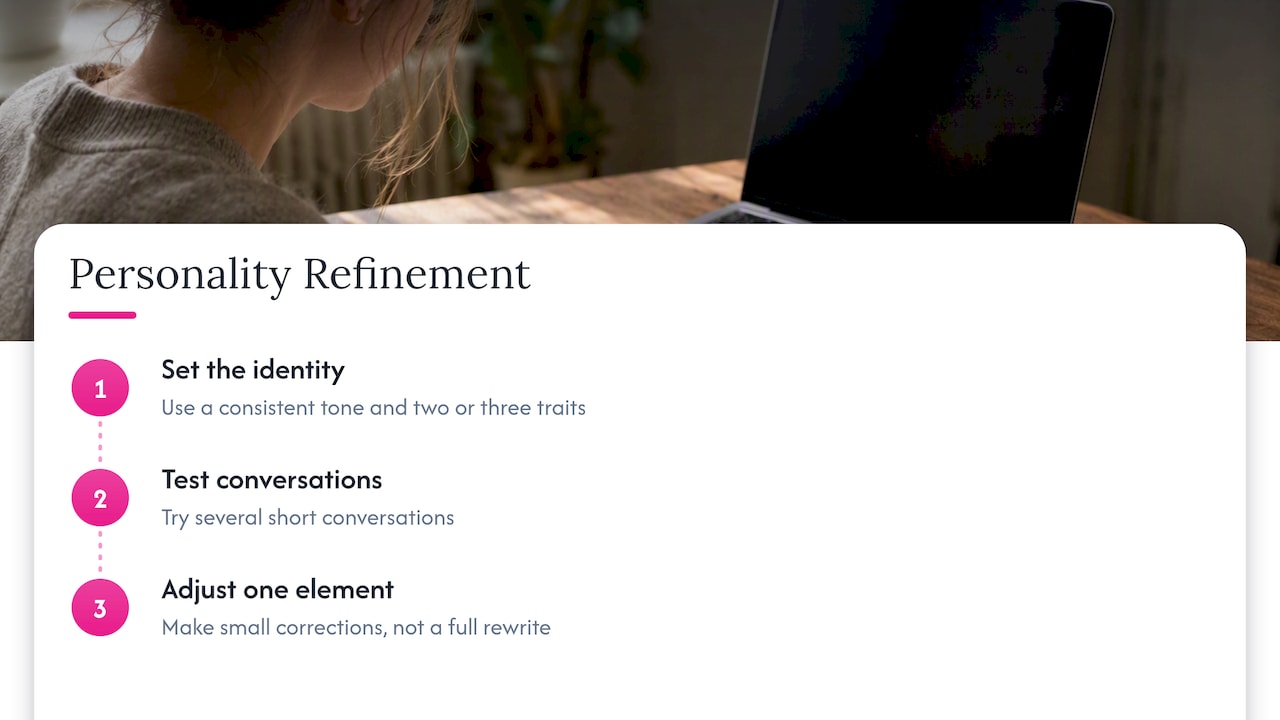
In practice, this means writing a prompt that states tone and two or three fixed traits, testing it over several short conversations, and adjusting one element at a time rather than rewriting the whole persona after a single bad reply. Iterative micro training beats a single long setup session: small corrections compound into a consistent personality faster than trying to get everything right up front.
Try our comparisons and quick-start build guides
A comparison library is built to cut down the trial and error of testing platforms one by one. Rather than guessing which character builder, roleplay platform, or voice-first app fits your priorities, our comparisons break down customization depth, memory behavior, and safety controls side by side so you can shortlist in minutes instead of hours.

- Curated comparisons across character builders, roleplay platforms, and voice or image-first apps.
- Feature breakdowns covering memory, personalization, and safety controls in one place.
- Quick-start templates for identity prompts so you are not starting from a blank screen.
Start with our AI companion platform comparisons to find a shortlist that already matches the priorities covered here, or go straight to our build guide if you are ready to set up a companion today.
FAQ
Does an AI girlfriend actually remember past conversations?
Memory depends entirely on the platform and tier: some retain details permanently across sessions, while free tiers often reset after each session. Always test memory persistence directly by referencing a detail in a new session before assuming it will carry over.
Can AI companions actually reduce loneliness?
Longitudinal research from Harvard Business School finds that AI companions can reduce momentary loneliness after use, with benefits persisting for at least a week. Separate behavioral research also found loneliness reduction comparable to talking with another person, more than passive activities like watching videos.
How do I make the personality stick instead of drifting?
Keep the identity prompt short, around four to six consistent traits, and correct one element at a time rather than rewriting the whole persona after a disappointing reply. Iterative, small corrections over several short conversations produce a more stable personality than one long setup session.
Are AI girlfriend apps safe for minors?
Most platforms rely on self-reported age verification, which is easy to bypass, so enforcement should be assumed weak rather than strict. A formal risk assessment documents these gaps directly and recommends verifying moderation and age controls before any payment.
What should I check before paying for a subscription?
Confirm that memory persists the way you expect, test the deletion process, and send a support question to gauge response time before upgrading. A short monthly trial is lower risk than an annual plan until a platform has passed these checks over a few weeks of real use.
Sources
- Harvard Business School faculty item on AI companions and loneliness
- Context, script, cue: understanding human–AI intimate relationships (JCMC, 2026)
- CSM AI risk assessment: social AI companions

